Instruments & Voices
Tambourine
A tambourine is a shallow frame drum with pairs of small metal jingles set into its rim. You strike it with the hand or shake it, so it works both as a drum and as a rattle.
A tambourine is a shallow wooden hoop, usually 5 to 7 cm deep, with a head of calfskin or plastic stretched across one side. Slots in the hoop hold pairs of thin metal disks, the jingles, loose on wire pins. Strike the head or shake the frame and the jingles clash, giving a bright, rattling sound that carries over a whole band. There is no tuning: the jingles cover any pitch the head has. Some tambourines have no head at all, just the ring of jingles.
Ways to play it
- Struck. Hold the frame in one hand and strike the head with the fingers, knuckles or palm of the other. A stroke near the rim is quieter than one farther in.
- Angle. Held flat, the jingles lie on top of each other and the sound is short and dry; held upright, they ring longer and the head is heard more.
- Fast notes. For quick, soft passages, players rest the tambourine on a knee and play near the rim with the fingertips of both hands.
- Shake roll. Hold the tambourine upright and shake it for a long, excited roll that can swell or fade.
- Thumb roll. Rub a moistened thumb along the head near the rim. The skin catches and skips, and the jingles buzz in a tight, quiet roll that lasts only a few seconds, longer when soft.
How tambourine music is written
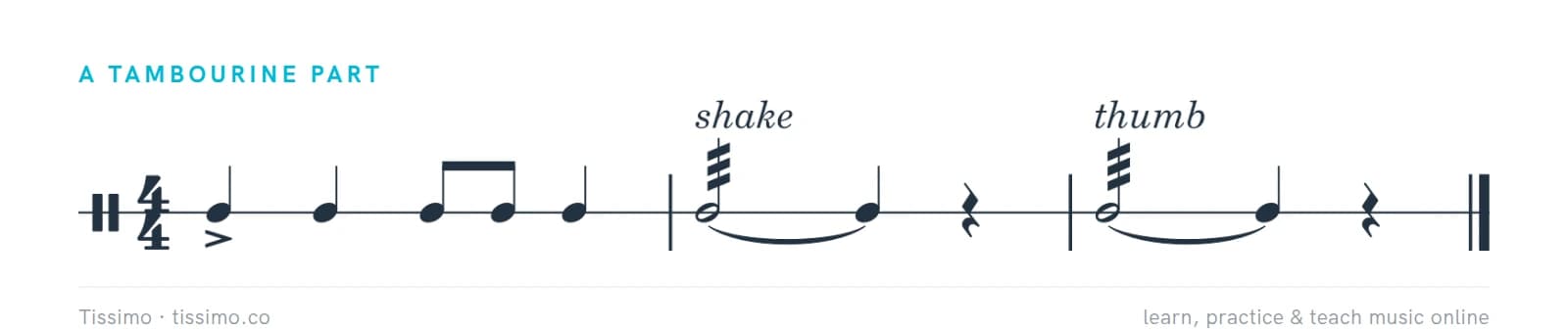
Modern parts put the tambourine on a single line, because it has no definite pitch. Single strokes are usually short notes. A roll is a note with tremolo slashes through the stem plus a word for the method: shake or thumb. Some older scores write the part on C5 in treble clef or C3 in bass clef instead.
Where you hear it
The tambourine is an old folk instrument in many cultures, especially around the Mediterranean, where it accompanies songs and dances. It reached the European orchestra in the 18th century with the Janissary-inspired percussion, along with the cymbals, bass drum and triangle. Composers since have used it for dance scenes and Spanish or festive color. In bands it may be held, mounted near the drum kit, or laid on top of a drum or the hi-hat, and it is one of the first instruments children meet in classroom music.
A common confusion
The tambourine is not the tambourin. That is a long, narrow drum from Provence in southern France, played with one hand. Old scores spell both words in several ways, so performers sometimes have to work out which instrument the composer meant.
Common questions
Is a tambourine a drum?
It is both a drum and a rattle. Its head makes it a frame drum, and the jingles make it a shaken instrument too, which is why it can be struck or shaken.
What is a thumb roll on the tambourine?
A roll made by rubbing a slightly moistened thumb along the head near the rim. The thumb sticks and skips across the skin and sets the jingles buzzing. It is quiet and short, so it suits soft passages.
Comments