Instruments & Voices
Triangle
A triangle is a metal bar, usually steel or brass, bent into a triangle with one corner left open. Hung from a loop and struck with a metal beater, it gives a bright, ringing sound with no clear pitch.
The triangle is a member of the percussion family: a metal bar, usually steel or brass, bent into a triangle with one corner left open so the ends do not touch. It hangs from a loop of string or fishing line on a clip, held in the hand or fixed to a stand, so it can ring freely. Struck with a metal beater, it sounds bright and bell-like, with many high overtones and no single note you could name, which makes it an unpitched instrument.
How to play it
- Single strokes. Hold the clip and strike the bar with the beater. A larger triangle or a heavier beater gives a fuller, longer ring; a light beater gives very soft notes.
- Damping. The fingers of the hand that holds the clip can touch the bar to stop the ring, or rest on it lightly for a muted, short "tink".
- The roll. Move the beater quickly back and forth between the two sides inside one corner.
- Fast rhythms. For complicated parts, players hang the triangle from a stand and use two beaters.
How triangle music is written
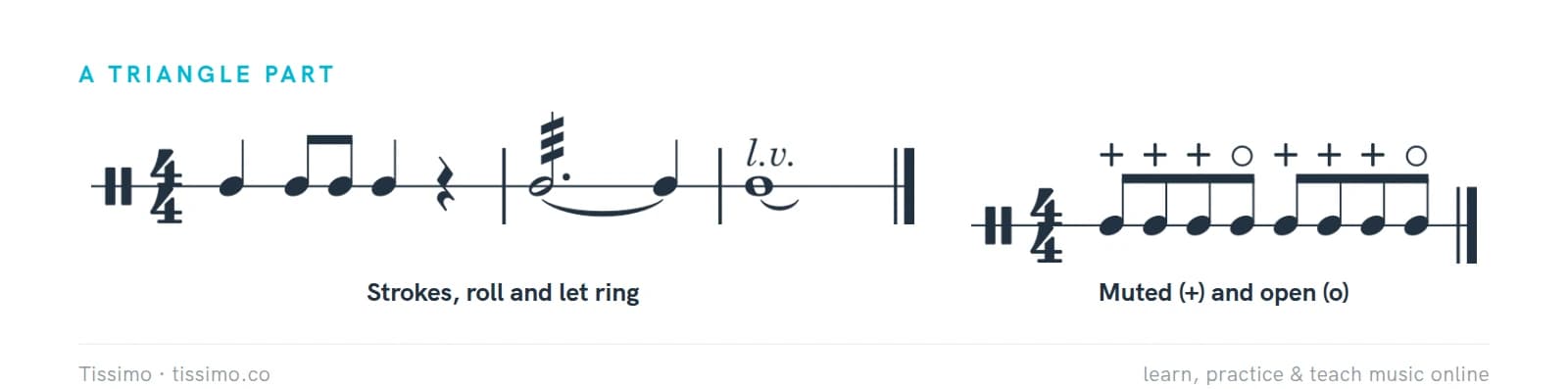
Orchestral and band parts put the triangle on a single line. A roll is written with three slashes through the stem, as on the snare drum. A tie that leads to nothing, often with l.v. (laissez vibrer, "let vibrate"), says to let the note ring on. Where muted and open strokes alternate, a + marks a muted stroke and an o an open one, the same signs that mean closed and open on a hi-hat.
Where you hear it
The triangle has been part of the orchestra since the 18th century, when composers added it, with the cymbals and the bass drum, to imitate the Turkish military bands of the Janissaries. Later composers used its long, silvery ring for color and sparkle. In folk and popular music, including Cajun music and Brazilian styles, players often hold it in the hand and switch between muted and open strokes to make a rhythm.
A common confusion
The triangle is often joked about as an instrument anyone can play, but orchestral parts demand exact timing, very soft entries and control of how long each note rings. A "triangle wave" is something else: a waveform in synthesis, named for its shape.
Common questions
Does a triangle play a note?
Not a clear one. Its many high overtones do not line up as they do on a string or a pipe, and they hide any single pitch, so it counts as unpitched percussion and is written on a single line rather than on a pitched staff.
How do you play a triangle roll?
Hold the beater inside one corner and move it rapidly back and forth so it strikes the two sides in turn. The part shows the roll with three slashes through the note's stem.
Comments