Technique & Performance
String Bending
String bending is a guitar technique in which the fretting finger pushes or pulls a string sideways across the fretboard. Stretching the string raises the note's pitch, usually by a half step or a whole step.
To bend a string, you fret a note and push or pull the string sideways across the fretboard. The string stretches and its pitch rises smoothly, like a voice sliding up to a note. Bends are one of the signature sounds of blues and rock lead guitar, most often played on the electric guitar.
How far to bend
A bend aims at a pitch:
- Half-step bend (½): up to the pitch of the next fret.
- Whole-step bend (full): up to the pitch two frets higher.
From G4 at string 2, fret 8, a half-step bend reaches A♭4 (the pitch of fret 9) and a whole-step bend reaches A4 (the pitch of fret 10). To check, play the target fret first, then bend the lower note until it matches. Bend Toward a Note and Which Pitch Is the Destination? practice exactly that. A bend that falls short sounds out of tune, not expressive.
Kinds of bend
- Bend: pick the note, then bend up to the target.
- Bend and release: bend up, then let the string back down to the fretted note without picking again.
- Pre-bend: bend the string up before you pick it, then pick and release it. You can't hear the target before you play, so it takes a well-trained hand.
How bends are written
In tab, a bend is a curved arrow with ½ or "full" (some books print 1) at its peak. On the staff, many publishers write the fretted note as a small grace note slurred to the pitch the bend reaches; others print both pitches, with one of them in parentheses. Check the key of your edition.

How to bend
- Use more than one finger. Bend with the ring finger, and put the middle and index fingers on the same string behind it to help push.
- Push the higher strings toward the low strings, toward the ceiling. On strings 5 and 6, pull toward the floor instead, or the string can slide off the fretboard.
- Listen to the target. Stop when you reach the pitch, and hold it steadily.
Bend, slide or vibrato?
A bend changes the pitch on one fret. A slide moves the finger to another fret, a kind of glissando. Guitar vibrato is a series of small, quick bends and releases. A very small bend, about a quarter tone, adds a bluesy edge; see microtone and blues scale.
Common questions
What does full mean in guitar tab?
Bend the string up a whole step, until it sounds the pitch two frets higher. ½ means a half step, the pitch of the next fret.
Which way should you bend a guitar string?
On the higher strings, push toward the low strings (toward the ceiling). On the two lowest strings, pull toward the floor, so the string does not slide off the edge of the fretboard.
Practice it: free worksheets
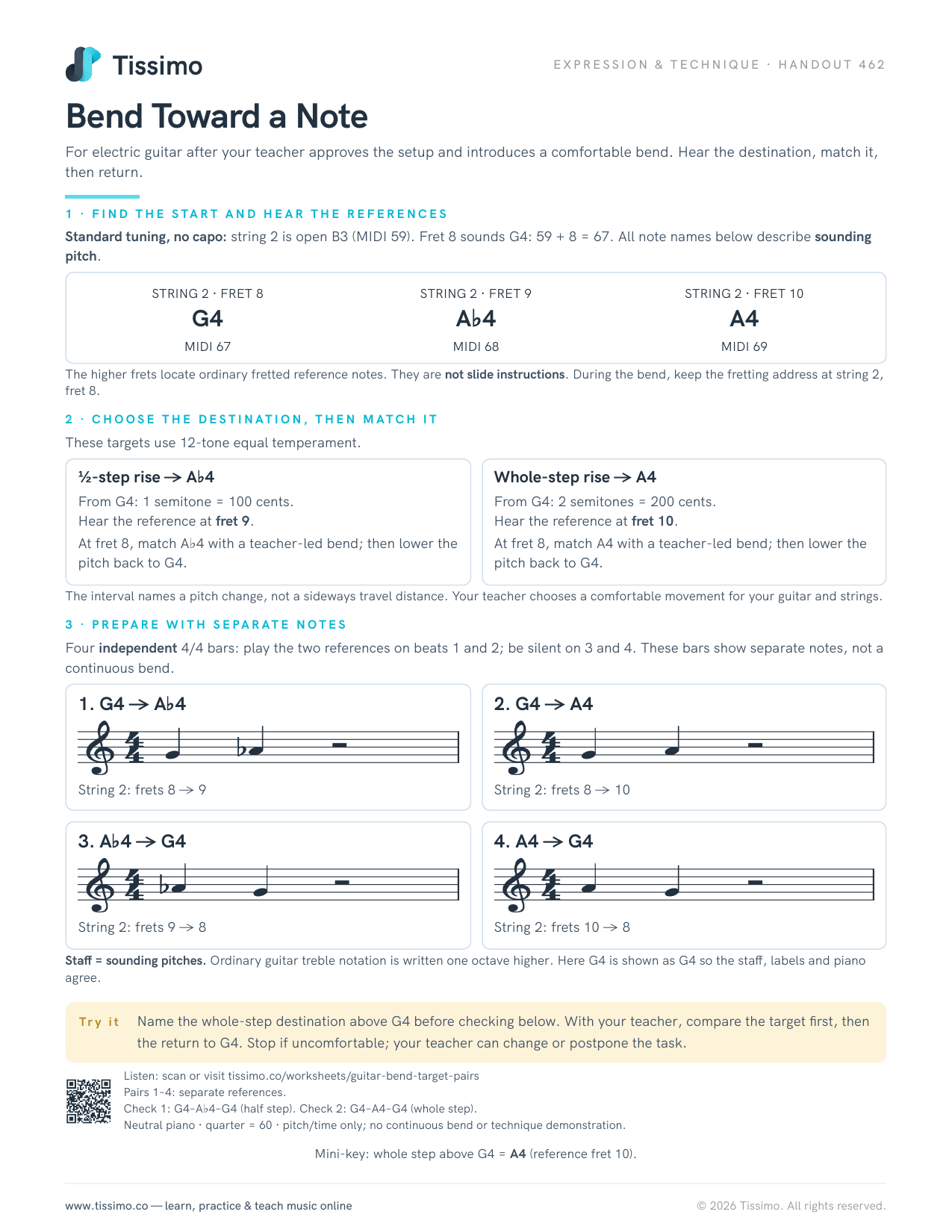 Bend Toward a NoteFor electric guitar after your teacher approves the setup and introduces a comfortable bend. Hear the destination, match it, then return.
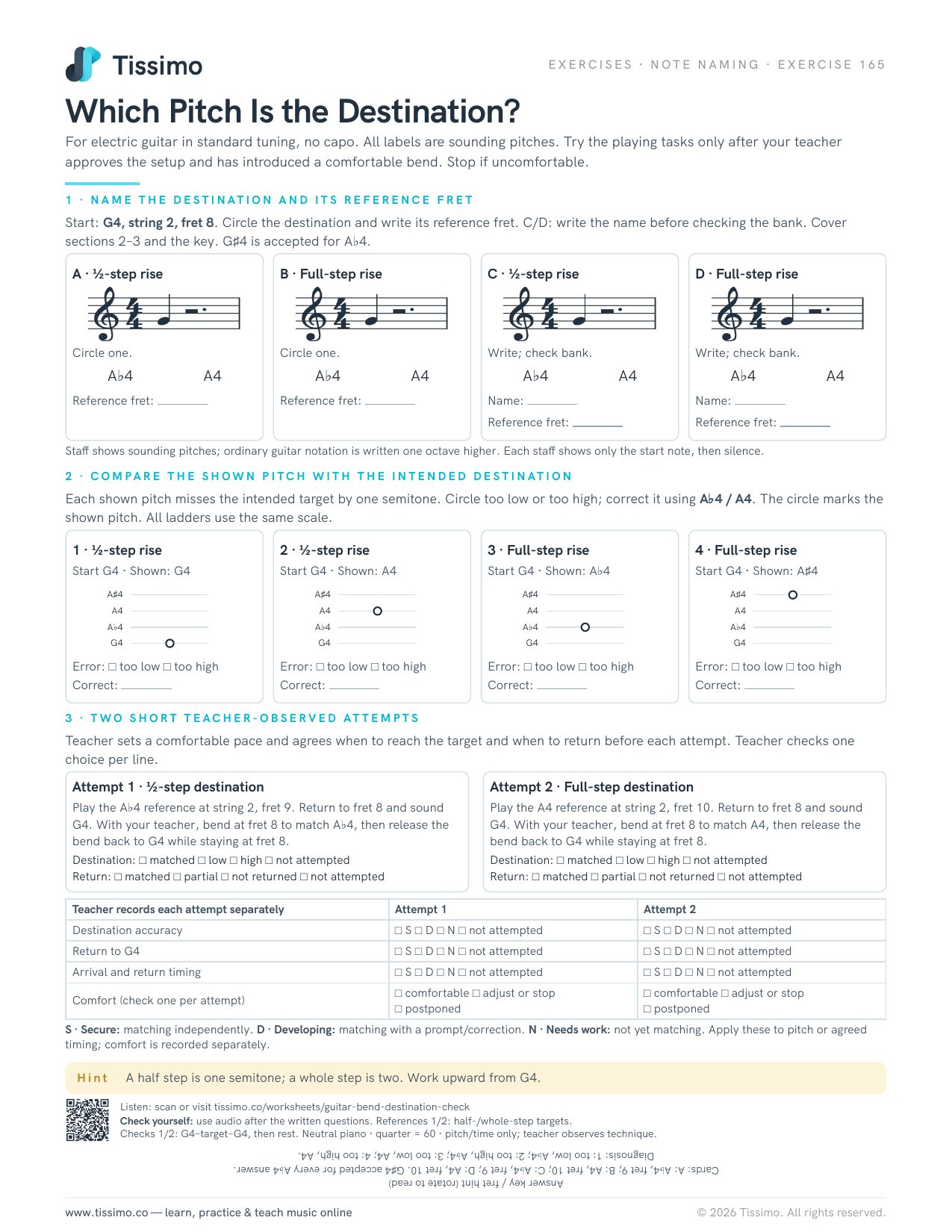 Which Pitch Is the Destination?For electric guitar in standard tuning, no capo. All labels are sounding pitches. Try the playing tasks only after your teacher approves the setup and has introduced a comfortable bend. Stop if uncomfortable.
Comments