Sound & Acoustics
Standing Wave
A standing wave is a vibration pattern that stays in place: some points, the nodes, hardly move, while the antinodes between them swing the most. Strings and air columns make their notes and harmonics this way.
Pluck a guitar string and waves run along it, reflect at the nut and the bridge, and run back. The two directions add together, and at certain frequencies the pattern seems to stand still: the string vibrates in fixed segments. That is a standing wave, also called a stationary wave. The points that stay still are nodes; the points halfway between them, which move the most, are antinodes. Neighboring nodes are half a wavelength apart.
On a string
A string fixed at both ends must have a node at each end. In the simplest pattern the whole string swings in one arc, with one antinode in the middle; its wavelength is twice the string's length, and it sounds the fundamental. The next pattern has a node in the middle and vibrates in halves at twice the frequency; then come thirds, quarters and so on. These modes, at 1, 2, 3, 4 times the fundamental, make up the string's harmonic series, and a plucked or bowed string vibrates in many of them at once. Real strings are slightly stiff, so their higher modes run progressively sharp of exact multiples.
A natural harmonic uses these patterns. A light touch at the midpoint makes a node there, so mainly the modes with a node at that point sound, led by the second harmonic, an octave up. Touch at a third of the length and the third harmonic sounds, an octave and a fifth above the open string. Try it on the violin in Touch Halfway: The Octave Harmonic and Open String, Touch Point, Sound.
In an air column
Wind instruments set up standing waves in the air inside the tube. Think of air pressure here: an open end is a pressure node and a closed end a pressure antinode.
- Open at both ends, like the flute: the longest standing wave is twice the tube's length, and every harmonic fits.
- Closed at one end, like the roughly cylindrical clarinet, closed by its mouthpiece and reed: the longest wave is four times the length, and in the ideal tube only the odd harmonics fit. So a clarinet plays nearly an octave lower than a flute of about the same length, and its upper register starts at the third harmonic, a twelfth up, not at an octave.
A brass player's lips vibrate at or very near one of the tube's resonances, one of its standing waves. Trombone: One Register, Seven Positions stays on one of them, the second partial, while the slide makes the tube longer.
In a room, and a common confusion
Low notes reflecting between walls and ceiling also form standing waves. Where reflections meet the direct sound in phase the bass is louder, and where they arrive out of phase it is much weaker. That is why bass can sound uneven from one spot in a room to another.
A standing wave does not travel, but it is made of two traveling waves. What reaches your ear is a traveling wave sent out by the string, soundboard or air column.
Common questions
What is the difference between a node and an antinode?
A node is a point of a standing wave that stays still; an antinode, halfway between two nodes, moves the most. On a string the fixed ends are nodes. In an air column a point where the air hardly moves is a pressure antinode, so it pays to say which quantity you mean.
Why does the clarinet overblow a twelfth instead of an octave?
Its tube is roughly a cylinder closed at the mouthpiece end, and an ideal tube of that kind supports only the odd harmonics. The next standing wave above the fundamental is the third harmonic, an octave and a fifth (a twelfth) higher. A flute, open at both ends, overblows to the second harmonic, an octave up.
Practice it: free worksheets
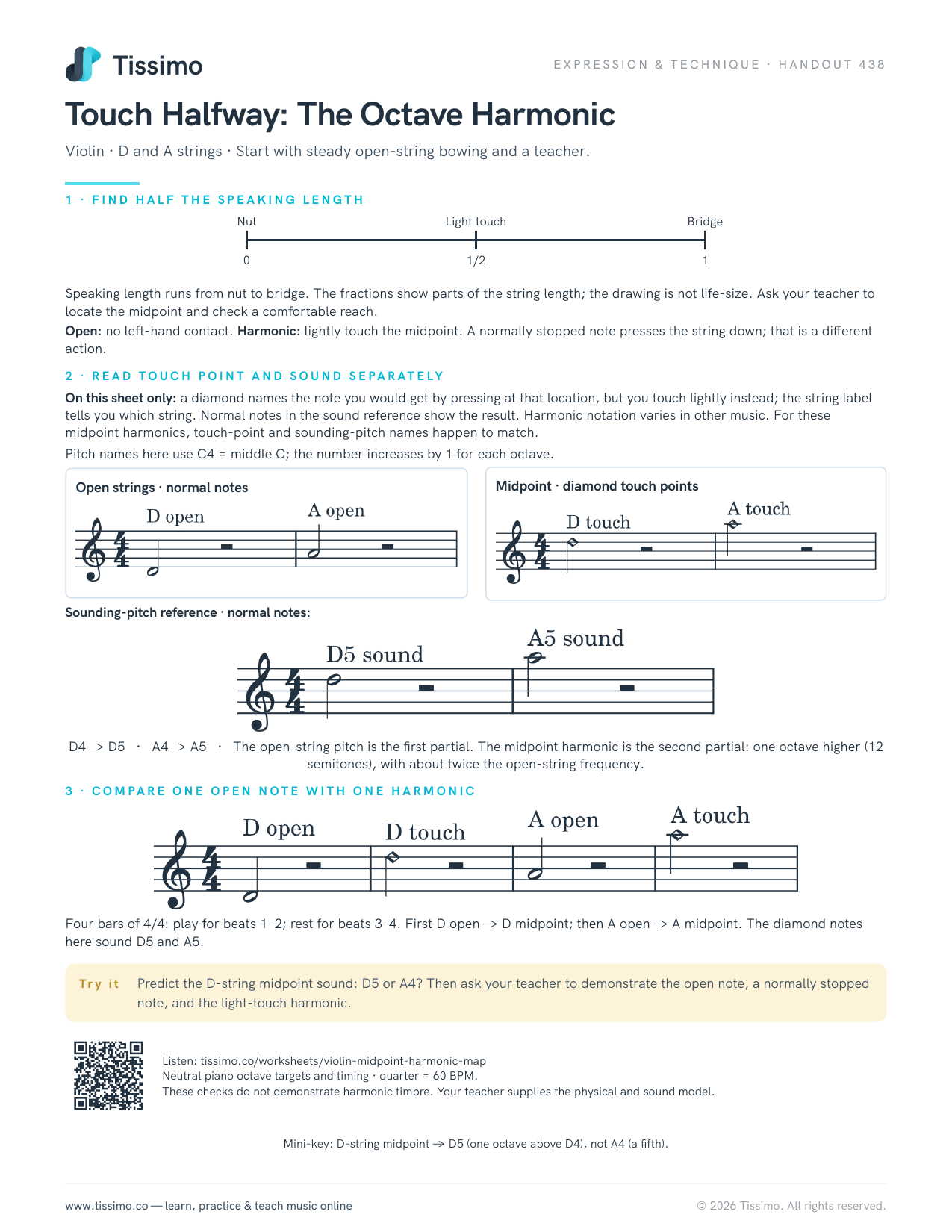 Touch Halfway: The Octave HarmonicViolin · D and A strings · Start with steady open-string bowing and a teacher.
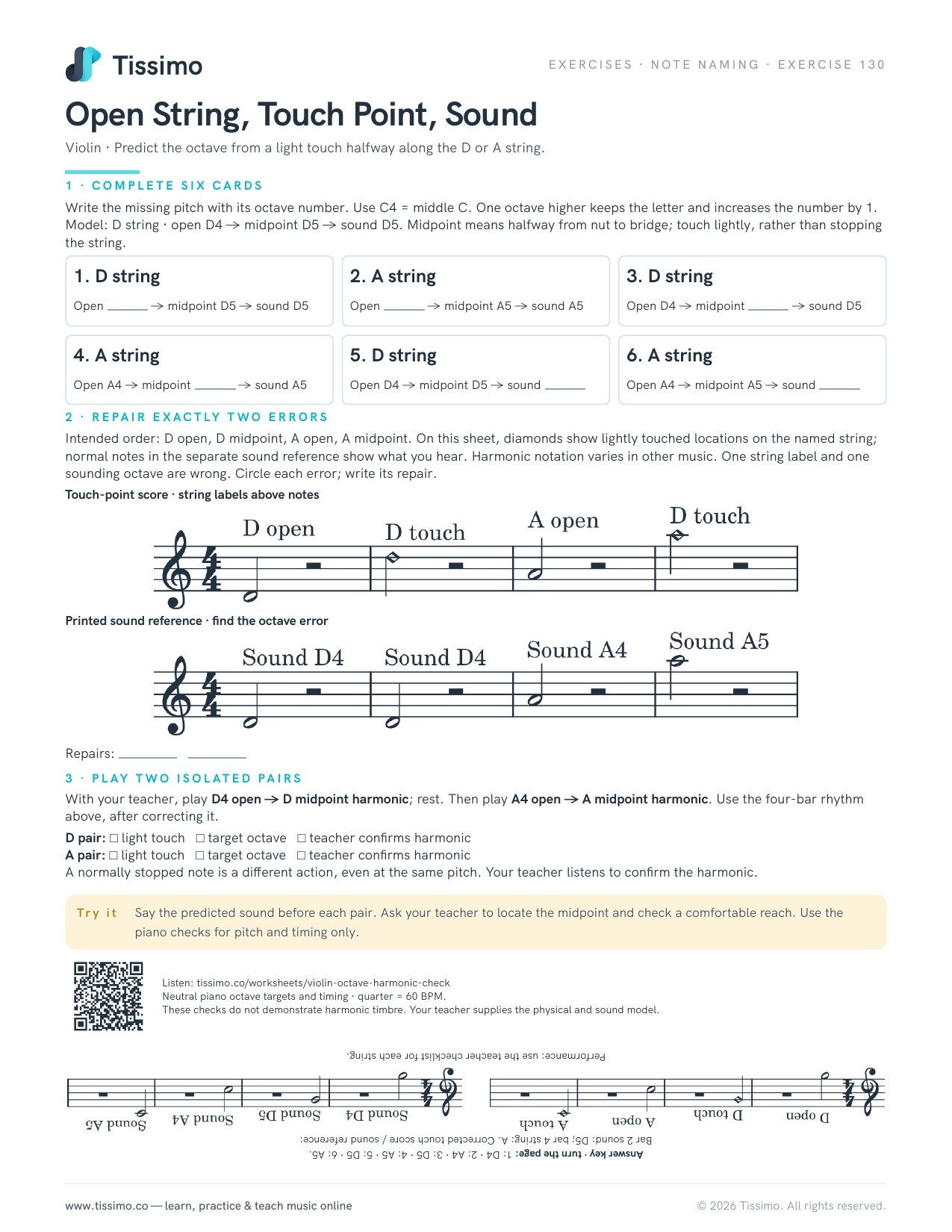 Open String, Touch Point, SoundViolin · Predict the octave from a light touch halfway along the D or A string.
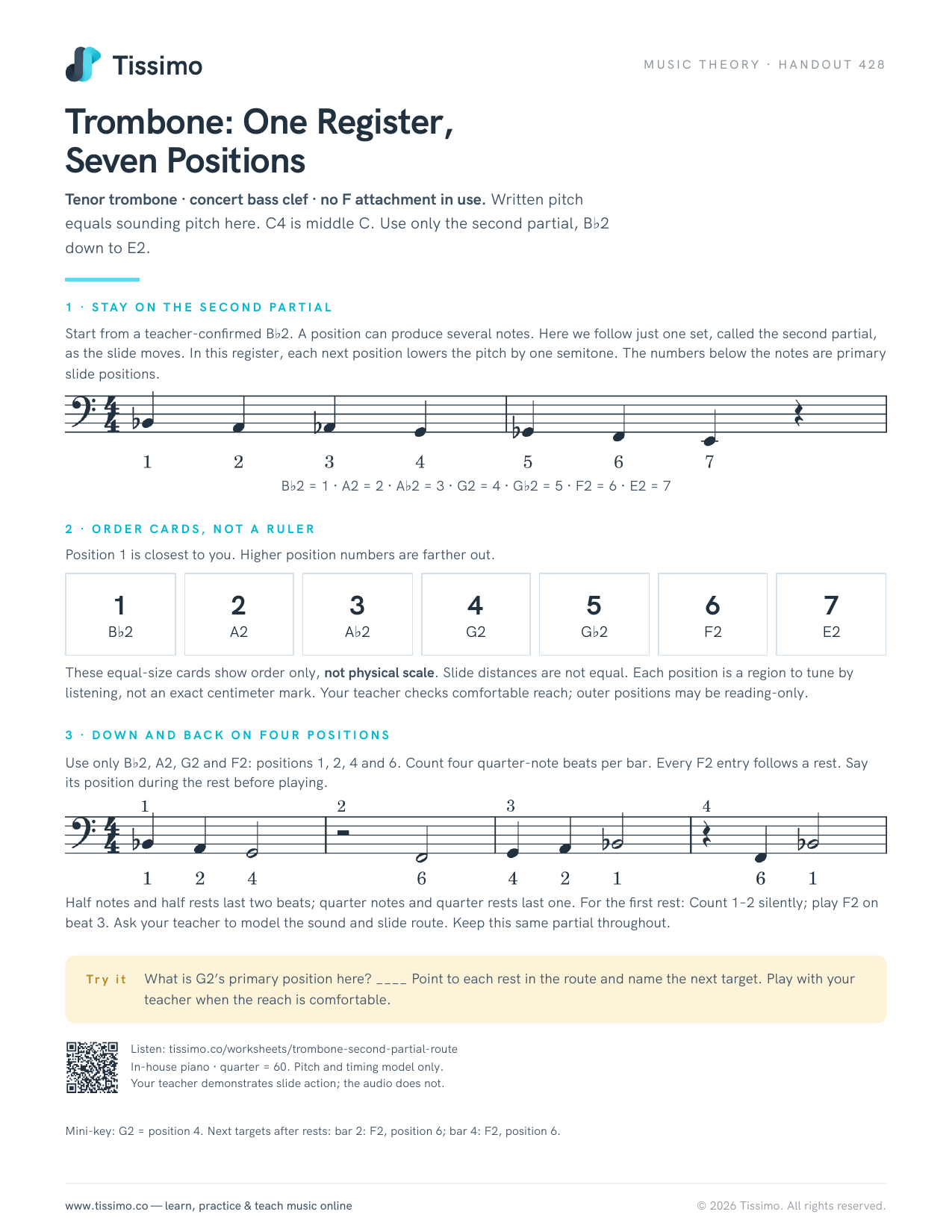 Trombone: One Register, Seven PositionsTenor trombone · concert bass clef · no F attachment in use. Written pitch equals sounding pitch here. C4 is middle C. Use only the second partial, B♭2 down to E2.
Comments