Technique & Performance
Natural Harmonic
A natural harmonic is produced by lightly touching an otherwise open string at a vibration node, then bowing or plucking it. The touch favors a higher partial rather than shortening the string with a firm stop.
A natural harmonic uses the vibrating length of an open string. The player touches lightly at a node, a point that stays still in the chosen vibration pattern, rather than pressing the string firmly to the fingerboard or fret. This suppresses incompatible modes and lets a higher partial become prominent, often giving a clear, flute-like tone.
Touch point and sounding pitch
The harmonic series counts the fundamental as partial 1. In the ideal string model:
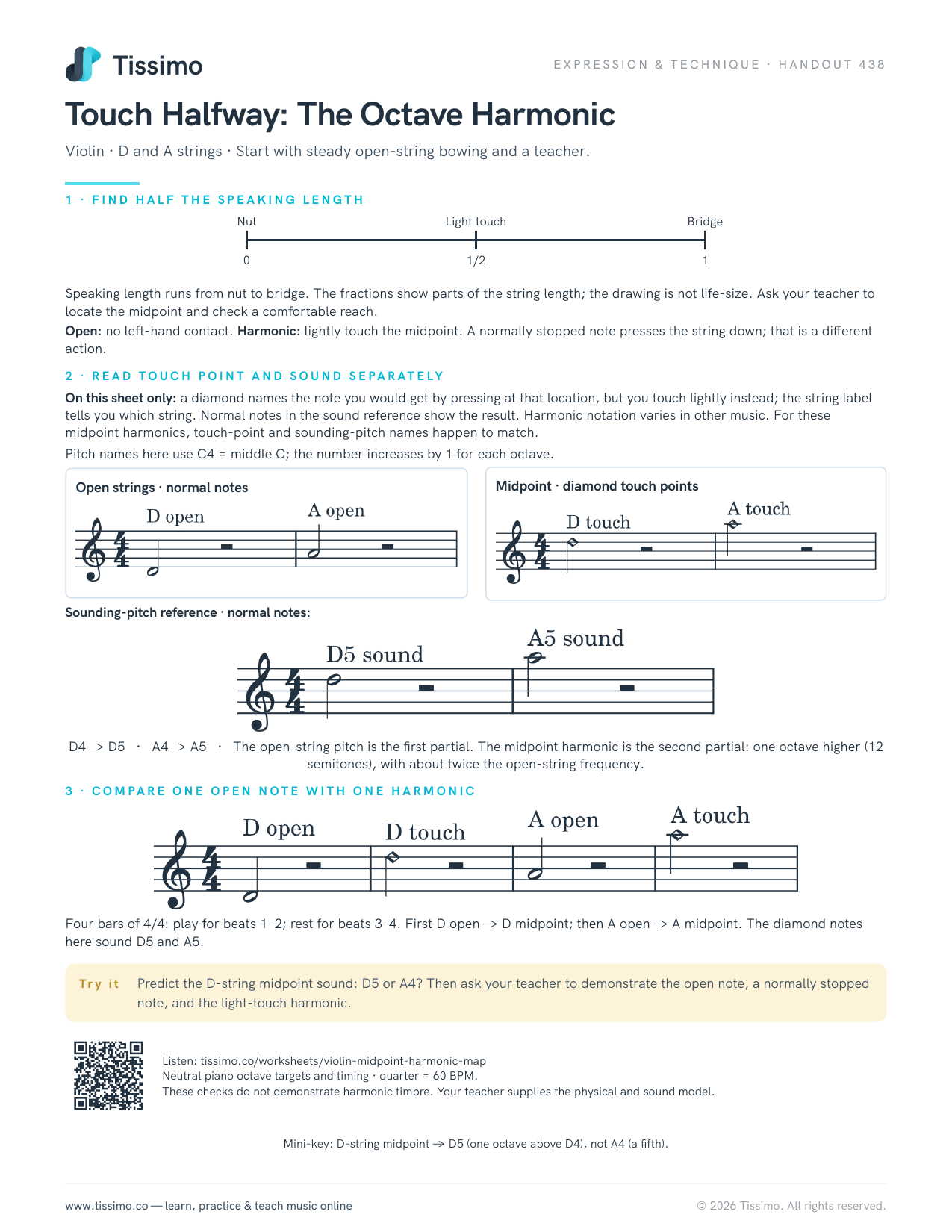
- A touch halfway along the string favors partial 2, an octave above the open note.
- A touch one-third of the length from either end favors partial 3, an octave plus a perfect fifth above it.
- A touch one-quarter of the length from either end favors partial 4, two octaves above it.
On a violin's open A4 at 440 Hz, these give A5 at 880 Hz, approximately E6 at 1320 Hz, and A6 at 1760 Hz. The third partial is not a musical third; its number describes a frequency multiple. Its E is slightly different from equal-tempered E6.
Read the notation carefully
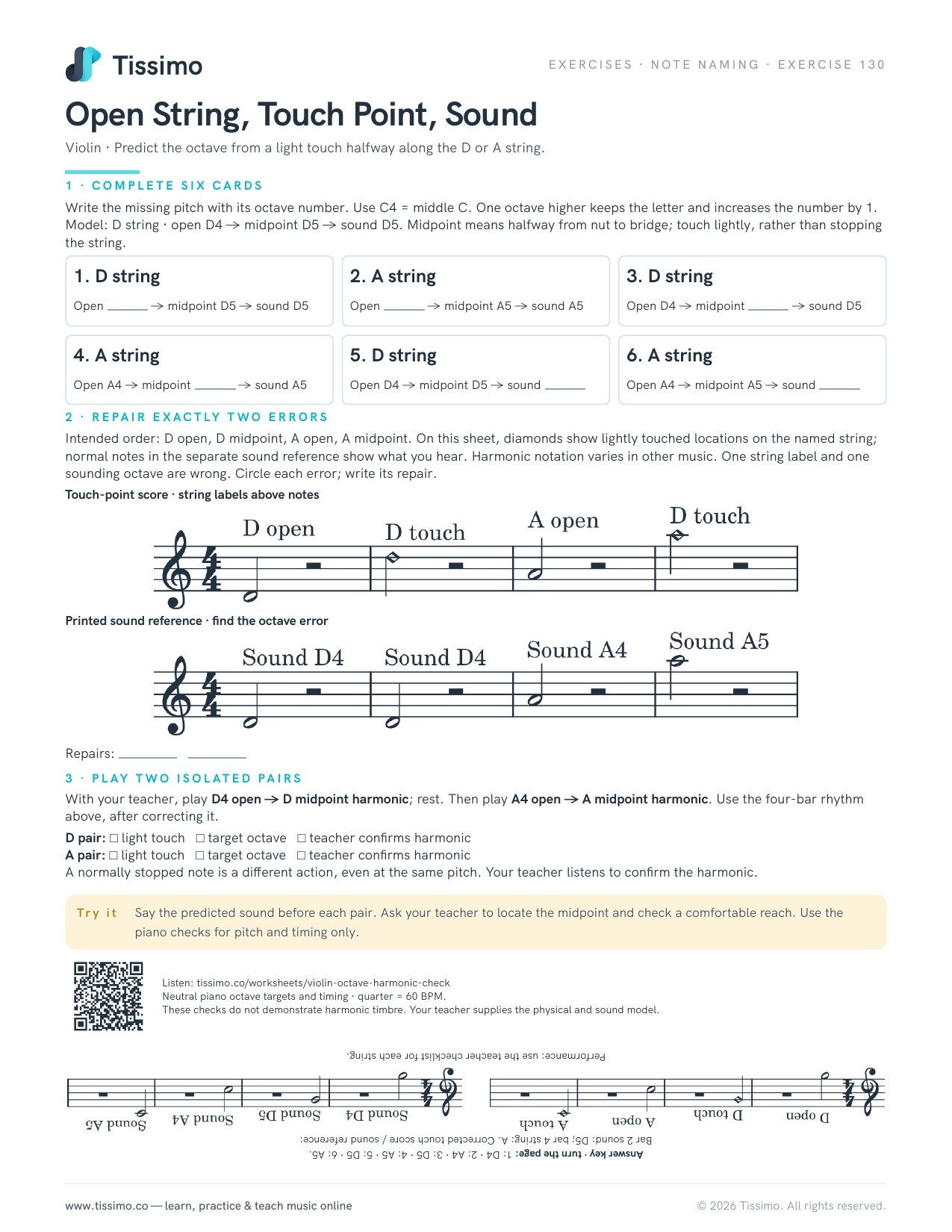
Natural harmonics may use a small circle, a diamond notehead or an explicit instruction. Some editions show the sounding pitch; others show where to touch, sometimes with a string indication. Do not assume every diamond is the note you will hear. Check the score's convention and distinguish the open string, touch position and result.
A stopped-string harmonic uses a different starting length. Neither technique guarantees a pure sine tone: higher compatible modes can remain. Begin with the midpoint example in Touch Halfway and compare the three roles in Open String, Touch Point, Sound.
Common questions
Does a natural harmonic require pressing the string down?
No. The touch is light and the open string remains the reference length. A firm stop changes that length; a stopped string with an additional light touch produces an artificial harmonic.
Is the third harmonic a third above the open note?
No. Its frequency is three times the fundamental, so it sounds an octave plus a fifth above the open note. Partial numbers and interval names are different systems.