Instruments & Voices
Reed
A reed is a thin strip of cane, metal or plastic that vibrates to start the sound in many wind instruments. Clarinets and saxophones use a single reed, oboes and bassoons a double reed, and harmonicas and accordions free reeds.
Every wind instrument needs something that vibrates to turn a stream of air into sound. On the flute it is the air itself, split against an edge; on brass instruments it is the player's lips. On reed instruments it is a reed: a thin, springy strip that vibrates when air flows past it. The reeds of orchestral and band instruments are made of cane from the giant reed plant, Arundo donax; harmonica and accordion reeds are metal, and some reeds are made of plastic.
Three kinds of reed
- Single reed: one flat blade of cane held against the mouthpiece. Blowing makes it beat against the mouthpiece. The clarinet and saxophone families are the only single-reed families.
- Double reed: two blades of cane tied together, which vibrate against each other, as on the oboe, the English horn, the bassoon and the contrabassoon. Oboists and bassoonists spend much of their time making and adjusting reeds, because the reed shapes the tone and the tuning. The chanter of the bagpipes also has a double reed, enclosed inside the instrument.
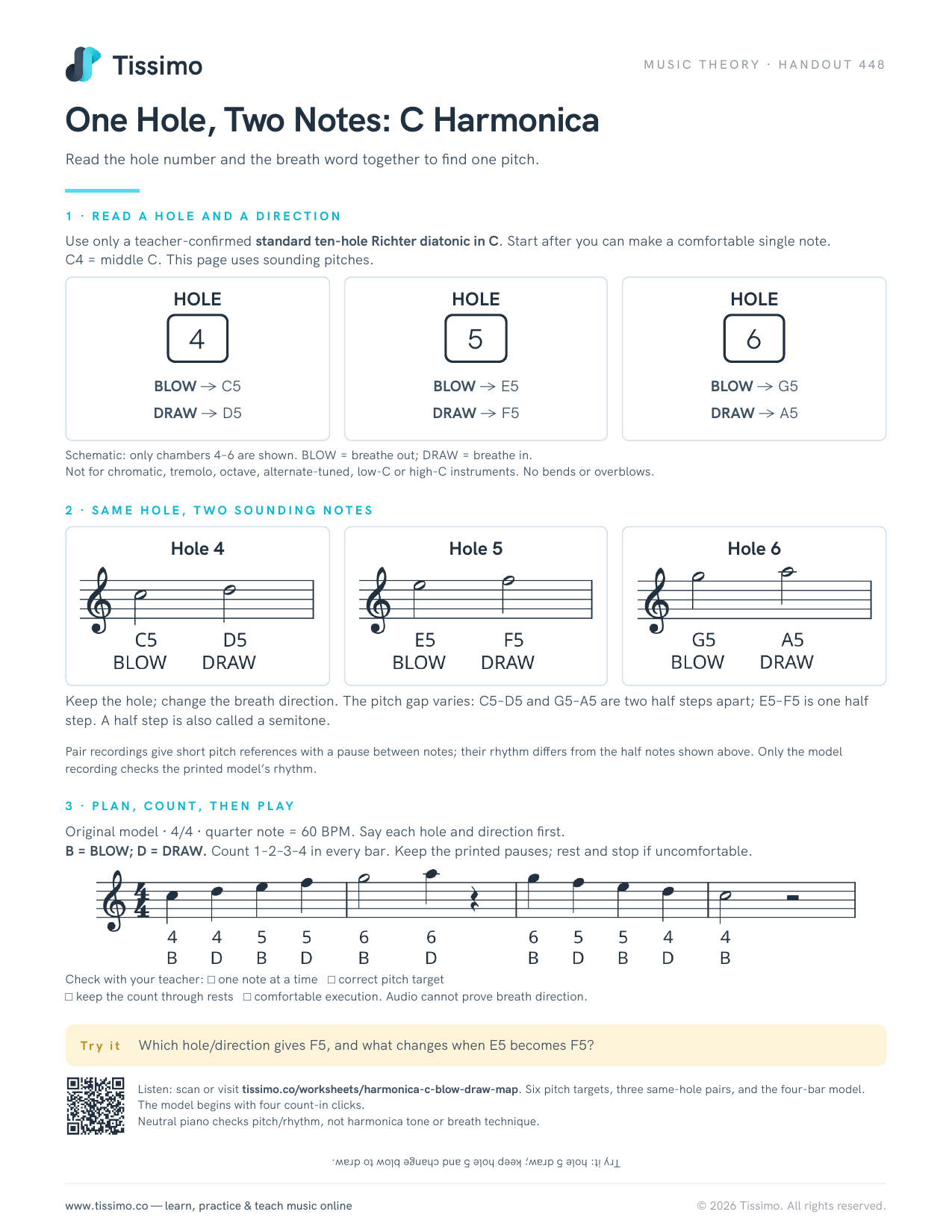
- Free reed: a metal tongue that swings back and forth through a slot without striking anything, as in the harmonica, the accordion, the concertina and the harmonium. A free reed sounds one pitch, so these instruments need a reed for every note; a harmonica has a blow reed and a draw reed in each hole, as One Hole, Two Notes: C Harmonica shows.
The reed pipes of a organ use a beating reed: a metal tongue that strikes against a tube, which gives them their strong, penetrating sound.
Reed strength
Clarinet and saxophone reeds are sold by size, one for each instrument, and by strength, a number that tells you how stiff the cane is. Most makers number from about 1 (soft) to 5 (hard), in half steps. A softer reed vibrates with less air and less lip strength, so many teachers start beginners on a 2 or 2.5 and move up a half strength at a time. A reed that is too hard sounds airy or muffled; one that is too soft sounds thin or buzzy, tends to go flat and can close up when you play loudly. Strengths differ between brands, and a higher number is not a sign of a better player.
Looking after reeds
Cane is a natural material, so no two reeds play quite the same, and every reed wears out. Keep several in rotation, wipe them after playing and store them in a reed case rather than on the mouthpiece. Double reeds are moistened in water before you play (see oboe).
A common confusion
In a theater orchestra, the woodwind parts are often labeled "Reed 1", "Reed 2" and so on, and the player of one book may switch between clarinet, saxophone and flute, although the flute has no reed.
Common questions
What is the difference between a single reed and a double reed?
A single reed is one blade of cane that vibrates against a mouthpiece, as on the clarinet and saxophone. A double reed is two blades tied together that vibrate against each other, as on the oboe and bassoon.
What reed strength should a beginner use?
Many teachers start clarinet and saxophone beginners on a strength 2 or 2.5 and move up by half strengths as the embouchure and air support develop. Strengths vary between brands, so ask your teacher which reed suits your mouthpiece.
Comments