Instruments & Voices
Contrabassoon
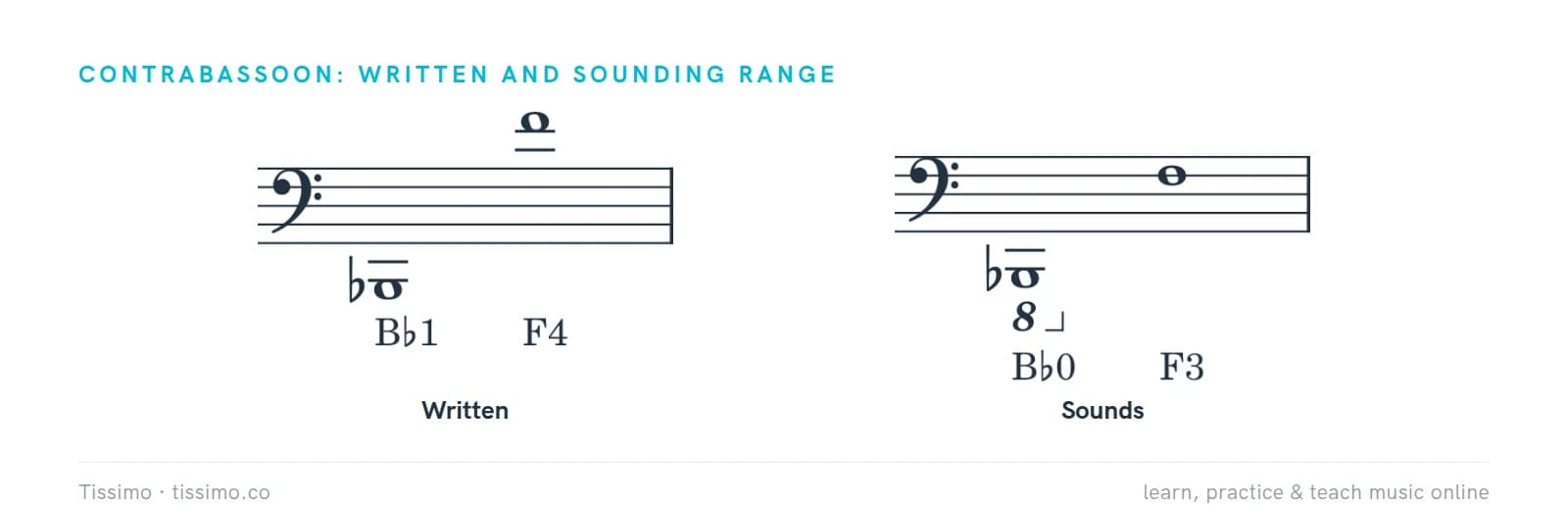
The contrabassoon is the deepest double-reed woodwind, a larger relative of the bassoon. It reads bass clef an octave higher than it sounds, and its lowest note, B♭0, is one of the lowest in the orchestra.
The contrabassoon, or double bassoon, plays an octave below the bassoon. Its conical tube is about 5.5 meters (18 feet) long, folded into four parallel sections, so the instrument stands about 135 cm tall and rests on the floor on a spike. Like the bassoon, it has a double reed on a curved metal crook, but a larger one, and on most modern instruments every tone hole is covered by a key.
Written an octave higher than it sounds
Contrabassoon music is written in bass clef, rarely in tenor clef, an octave higher than it sounds. That keeps most of its part on or near the staff instead of far below it. The lowest written note is B♭1, which sounds B♭0, one half step above the piano's lowest note. Some instruments have an extension down to A0. The highest practical written note is about F4, sounding F3, though solo pieces sometimes go higher.
Its role
The contrabassoon usually doubles the bassoons an octave lower or plays in unison with the double basses, adding weight and a slight rattle to the bottom of the orchestra, much like an organ's 16-foot stop. It joined the orchestra in the 18th century, and since Beethoven's Fifth and Ninth Symphonies it has been a regular member of the large orchestra. Often the third bassoonist switches to it. Its long tube makes it slower to respond than the bassoon, but it can still play quick figures and, now and then, a solo.
A common confusion
"Double bassoon" is simply another name for the contrabassoon; it does not mean two bassoons. The name does share an idea with the double bass: both sound an octave lower than written. When you compare a contrabassoon part with a piano score, read it an octave lower.
Common questions
What is the lowest note of the contrabassoon?
B♭0 (written B♭1), the B-flat just above the piano's lowest A. Some instruments have an extension down to A0.
Is the contrabassoon a transposing instrument?
Yes, by an octave. Its part is written in bass clef an octave higher than it sounds, while the bassoon sounds as written.
Comments