Instruments & Voices
Harmonica
The harmonica is a small free-reed wind instrument played with the mouth. Each hole has two metal reeds, one that sounds when you blow and one when you draw (breathe in), so the hole and the breath together choose the note.
The harmonica, or mouth organ, is a free-reed instrument small enough to carry in a pocket. Inside it, thin metal reeds are fixed over slots in metal plates. Your breath makes a reed swing back and forth through its slot, and each reed sounds one pitch. Every hole has two reeds: one sounds when you blow (breathe out), the other when you draw (breathe in). One hole therefore gives two notes, and the direction of your breath chooses between them.
The ten-hole diatonic harmonica
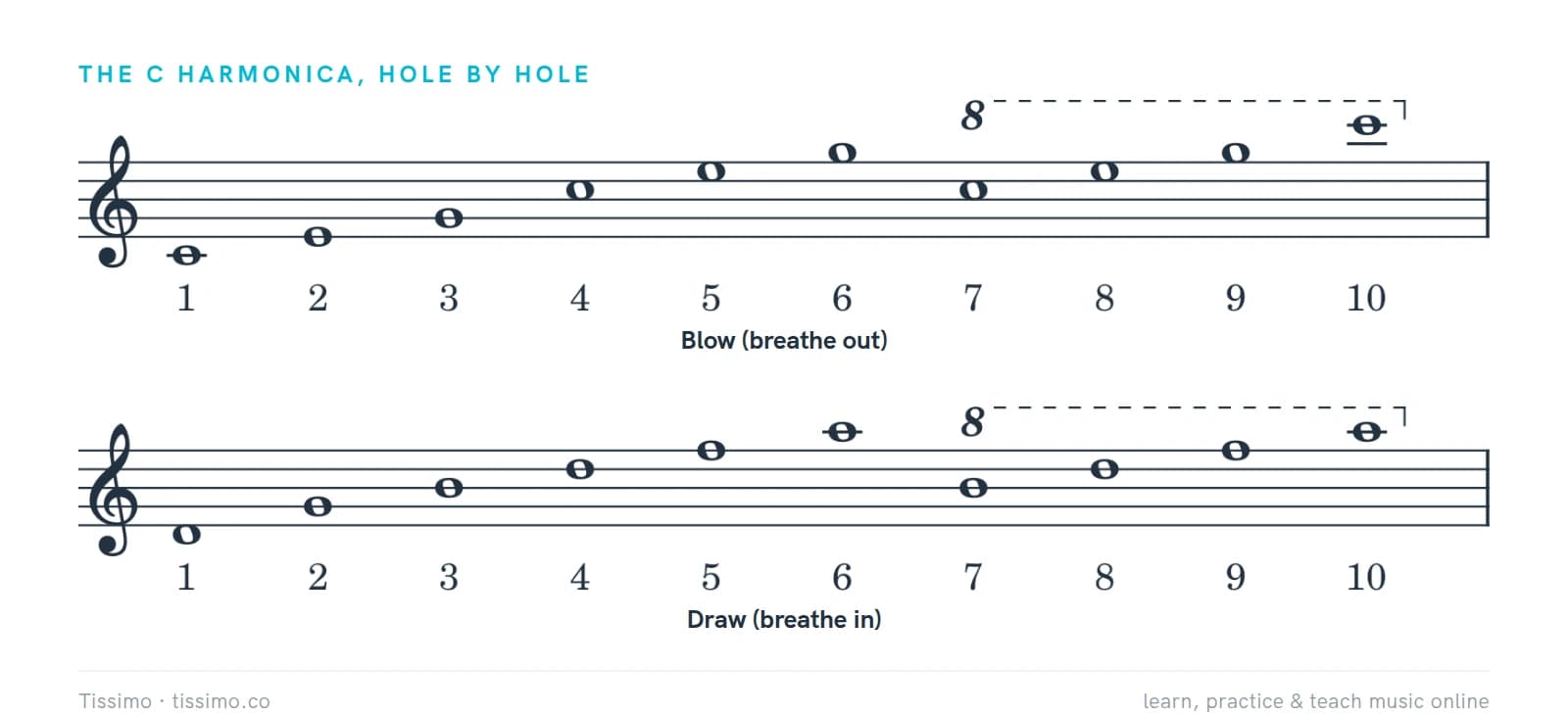
The most common harmonica has ten holes and a layout called Richter tuning. On a harmonica in C:
- Blow, holes 1 to 10: C, E, G, C, E, G, C, E, G, C. These are the notes of a C major chord, from middle C (C4) up to C7.
- Draw, holes 1 to 10: D, G, B, D, F, A, B, D, F, A.
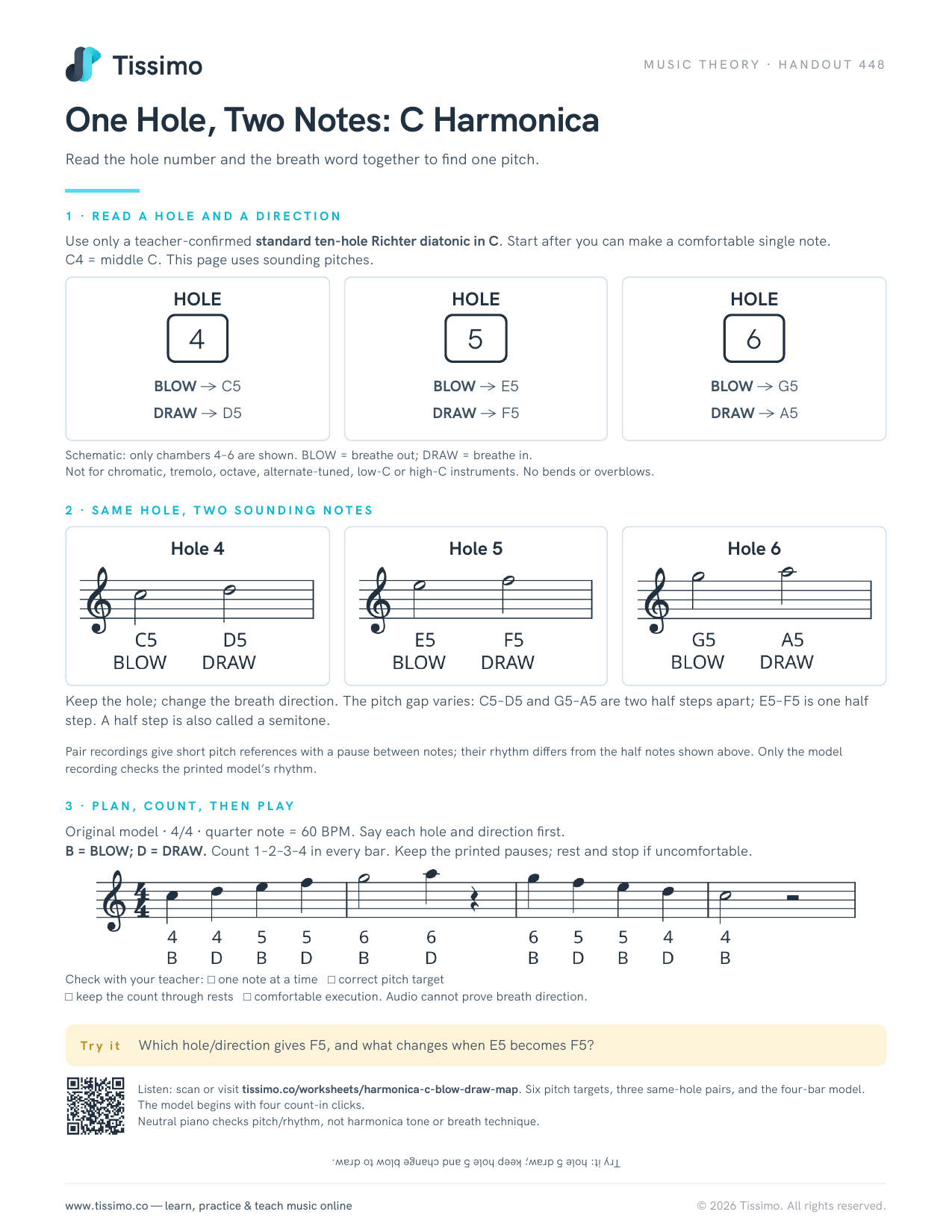
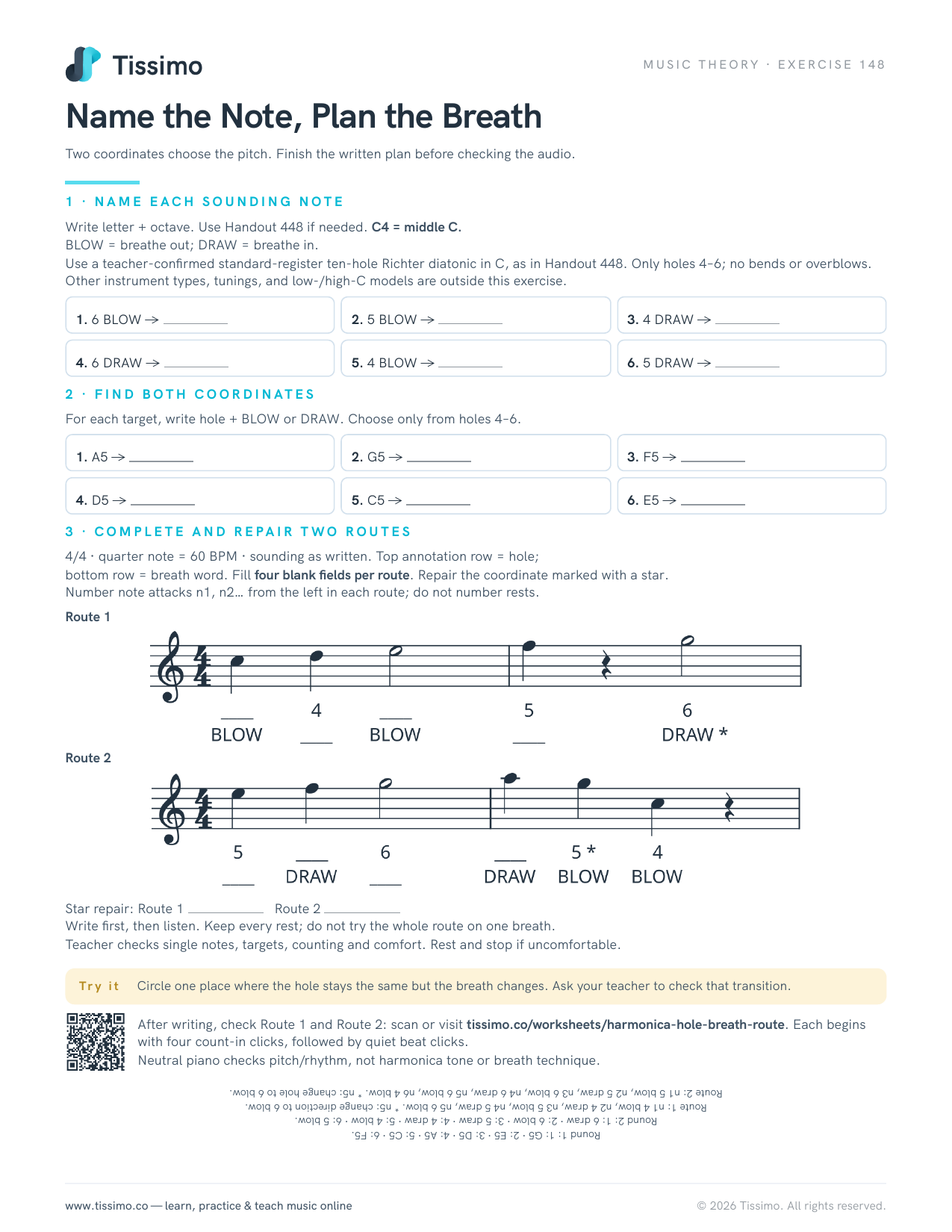
Blowing on several neighboring holes at once sounds a C major chord, and drawing on holes 2 to 5 sounds the notes of a G7 chord (G, B, D, F). Hole 2 draw and hole 3 blow give the same note, G4. In the middle, holes 4 to 7 give a complete C major scale: 4 blow, 4 draw, 5 blow, 5 draw, 6 blow, 6 draw, 7 draw, 7 blow. Map the holes in One Hole, Two Notes: C Harmonica, then plan the breaths in Name the Note, Plan the Breath.
Keys and other types
Diatonic harmonicas are made in many keys. Each has the same pattern of holes and breaths starting on a different note, so players choose the harmonica to suit the song. Two other types are common:
- The chromatic harmonica has two sets of reeds a half step apart and a button-operated slide that switches between them, so it can play every note of the chromatic scale. It is at home in jazz, classical music and pop.
- The tremolo harmonica has two reeds for each note, tuned slightly apart, which gives a warm, pulsing sound for simple melodies and chords.
Bending and the blues
On a diatonic harmonica, skilled players bend notes: by reshaping the mouth and throat (the embouchure), they make a reed sound at a different pitch. Bending adds notes that the layout lacks and gives the wailing slides heard in blues, folk, country and rock.
Relatives
The harmonica belongs to the same free-reed family as the accordion, the concertina and the harmonium. A free reed swings through its slot without striking anything, which is why the harmonica sounds so different from a clarinet or a saxophone, whose reeds beat against a mouthpiece.
How harmonica music is written
Most beginner books write the hole number together with the breath direction, shown with a sign or a word for blow and draw. The signs vary between books, so check the key at the start of yours.
Common questions
What are the notes on a C harmonica?
On a ten-hole diatonic in C, the blow notes from hole 1 to hole 10 are C, E, G, C, E, G, C, E, G, C (C4 to C7), and the draw notes are D, G, B, D, F, A, B, D, F, A. Hole 2 draw and hole 3 blow are both G.
Why can't I find F and A in the low holes?
Holes 1 to 3 of a diatonic harmonica give only C, D, E, G and B, so F and A are missing in that octave. A full major scale starts at hole 4. Experienced players reach some of the missing notes by bending.
Comments