Instruments & Voices
Bagpipes
Bagpipes are wind instruments in which a bag, filled by the player's breath or by bellows, feeds reed pipes: a chanter with finger holes plays the melody while drone pipes each sound one unchanging note beneath it.
Bagpipes are reed instruments with a store of air in a bag. The piper fills the bag through a blowpipe with a one-way valve, or with small bellows under the arm, and squeezes it with the arm to keep the air flowing while taking a breath, so the sound never stops. The reeds sit inside the pipes, out of reach of the lips. The chanter, a pipe with finger holes, plays the melody, and one or more drones each sound a single note beneath it. Bagpipes appear in medieval art and are older still, and most countries of Europe have one of their own.
The Great Highland bagpipe
Scotland's Great Highland bagpipe is the best known. A modern set has a bag, a blowpipe, a chanter with a double reed, two tenor drones and one bass drone. The tenor drones sound an octave below the chanter's keynote, low A, and the bass drone an octave below them, so a drone is always sounding under the tune.
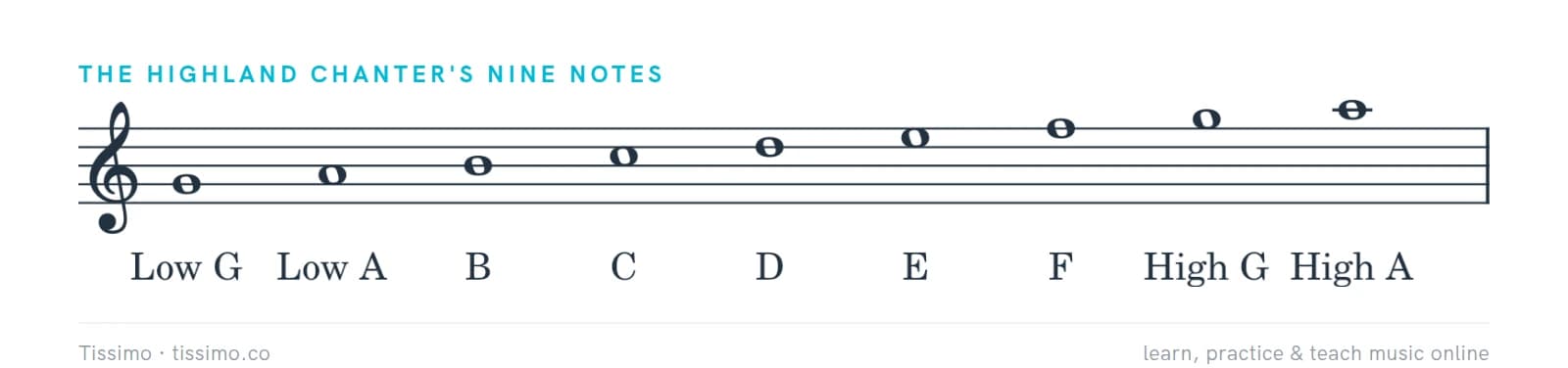
The chanter has only nine notes: low G, low A, B, C, D, E, F, high G and high A, an octave from low A plus one note below it. Pipers call the keynote A, but on a modern chanter it sounds higher than B♭, usually around 470 to 480 Hz. The notes are tuned to blend with the drones rather than to equal temperament. C and F sound close to C♯ and F♯, and G stays close to G natural, so the scale is a Mixolydian scale on A.
How pipe music is written
Highland pipe music is written in treble clef with no key signature, as if the keynote were A, and C and F are read as sharps. The figure shows the nine notes as written; a piano cannot play them as they sound, because both the pitch and the tuning differ.
Grace notes instead of tonguing
Because the air never stops and the reeds are out of reach, a piper cannot stop, tongue or accent a note, and the bagpipe has no louder or softer. To separate notes and give a tune its rhythm, pipers play quick grace notes and combinations of them, called embellishments, such as doublings, throws and grips. These ornaments are the heart of piping technique.
Highland pipe music falls into two kinds: ceòl mór ("big music"), or pìobaireachd, long themes with variations; and ceòl beag ("small music"): marches, dance tunes such as strathspeys, reels and jigs, and slow airs.
Other bagpipes
- The Irish uilleann pipes are blown by bellows; their chanter reaches a second octave, and keyed pipes called regulators can add chords.
- The Northumbrian smallpipes have a keyed chanter with a closed end, so the piper can silence it between notes and play crisply detached notes.
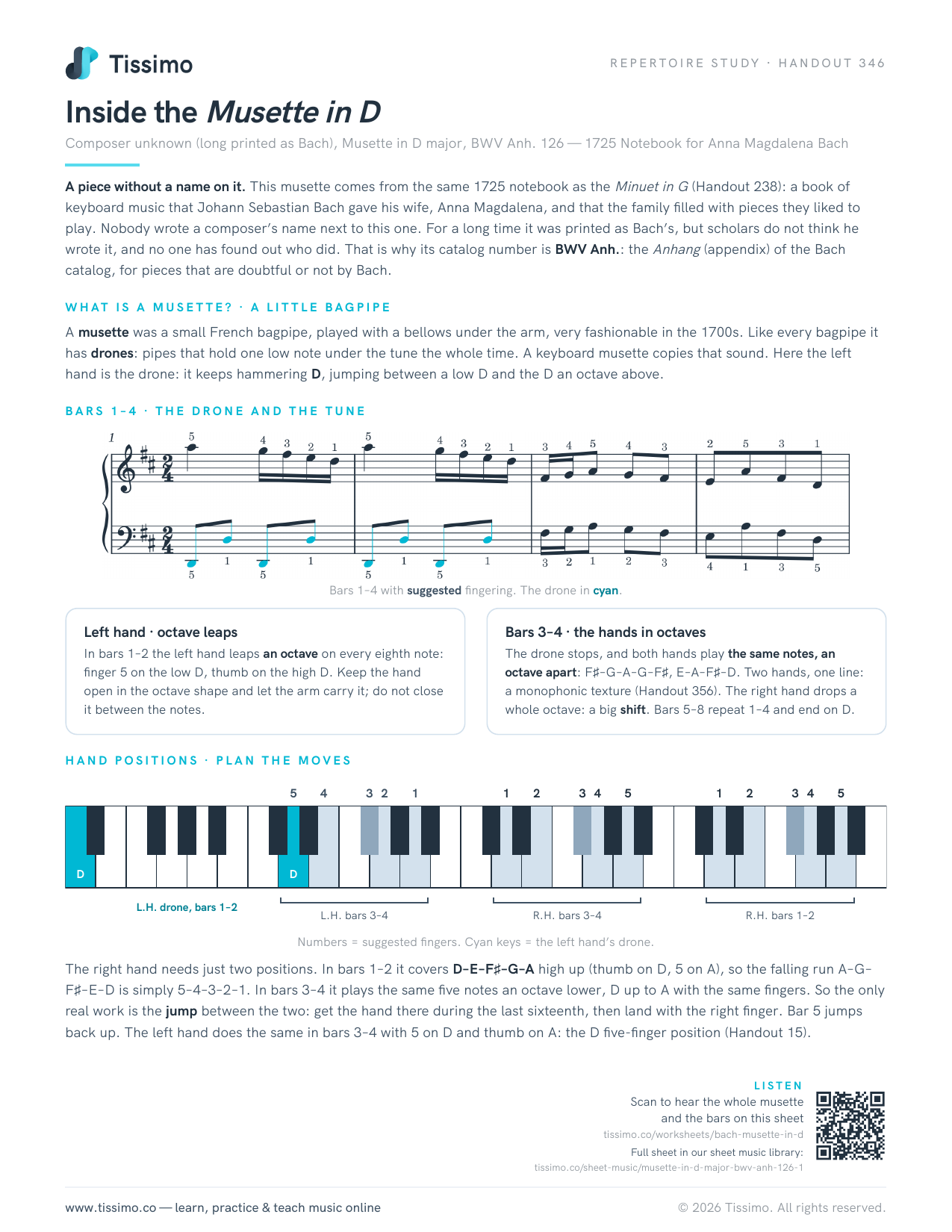
- The French musette was a small bellows-blown bagpipe fashionable in the 1700s. Keyboard pieces named after it imitate its drone, as the left hand of Inside the Musette in D does.
Common questions
How many notes can bagpipes play?
The Great Highland bagpipe chanter has nine: low G, low A, B, C, D, E, F, high G and high A, an octave plus one note. The drones add a constant A beneath them. Some other bagpipes, such as the uilleann pipes, can reach a second octave.
What key are bagpipes in?
Pipers call the keynote A and write the music as if in A, with C and F read as sharps and no key signature. On a modern Highland chanter that A actually sounds above B♭, around 470 to 480 Hz, and the scale is Mixolydian, with a G natural.
Comments