Technique & Performance
Memorization
Memorization is learning a piece well enough to play or sing it without the score. Secure memory combines several kinds: hearing the music, feeling the movements, seeing the page and understanding the structure.
Many students memorize by accident: after enough repetitions the fingers seem to know the way. That is motor memory, and it is real, but on its own it is also the most fragile kind. Under the pressure of a performance, or after a single slip, a piece held only in the fingers can vanish, because there is nothing to fall back on. Secure memorization builds several kinds of memory on purpose.
Four kinds of musical memory
- Aural memory: you can hear the music in your head, and sing the melody and the bass.
- Motor memory: the feel of the movements, fingerings and hand positions.
- Visual memory: a picture of the page, or of your hands on the instrument.
- Analytical memory: you understand what is happening: the key, the chord progression, where a sequence repeats, where the form returns to the opening theme.
The more of these you use, the more routes back you have when one of them falters.
A method that works
- Analyze first. Mark the sections, keys, chords and repetitions in the score. Notice where two similar passages differ: those are classic memory traps.
- Learn in short chunks. Memorize a phrase, then the next, then join them.
- Build restart points. Choose places throughout the piece where you can begin from memory, such as the start of each section, and practice starting at each one. Piano Memory: Four Places to Restart shows how to make this kind of cue map.
- Test away from the instrument. Write out a passage, say the chords aloud, or play it through in your head with the music closed.
- Test later. Check what you remember the next day, not just five minutes after learning it. Start Anywhere: A Piano Memory Check builds in exactly that delay.
- Play slowly from memory. Fast playing can run on motor memory alone; slow playing shows whether you really know the notes.
Performing from memory
Memory slips happen to experienced performers too. The best protection is preparation: restart points you have practiced, a few run-throughs for listeners before the real event, and the habit of keeping going after a slip (recital).
Whether to play from memory at all depends on the tradition. Solo pianists and string soloists often do; chamber musicians, accompanists and orchestral players usually play from the music. When memory isn't expected, playing with the score in front of you is completely professional.
Common questions
What is the fastest way to memorize a piece of music?
There is no shortcut, but combining kinds of memory saves time: understand the structure, learn short chunks, practice starting from several places, and test yourself away from the instrument and again the next day.
Why do I forget my piece when I perform?
Often because it was memorized mainly in the fingers, and that motor memory can fail under pressure. Build aural and analytical memory as well, and practice restarting from several places in the piece.
Practice it: free worksheets
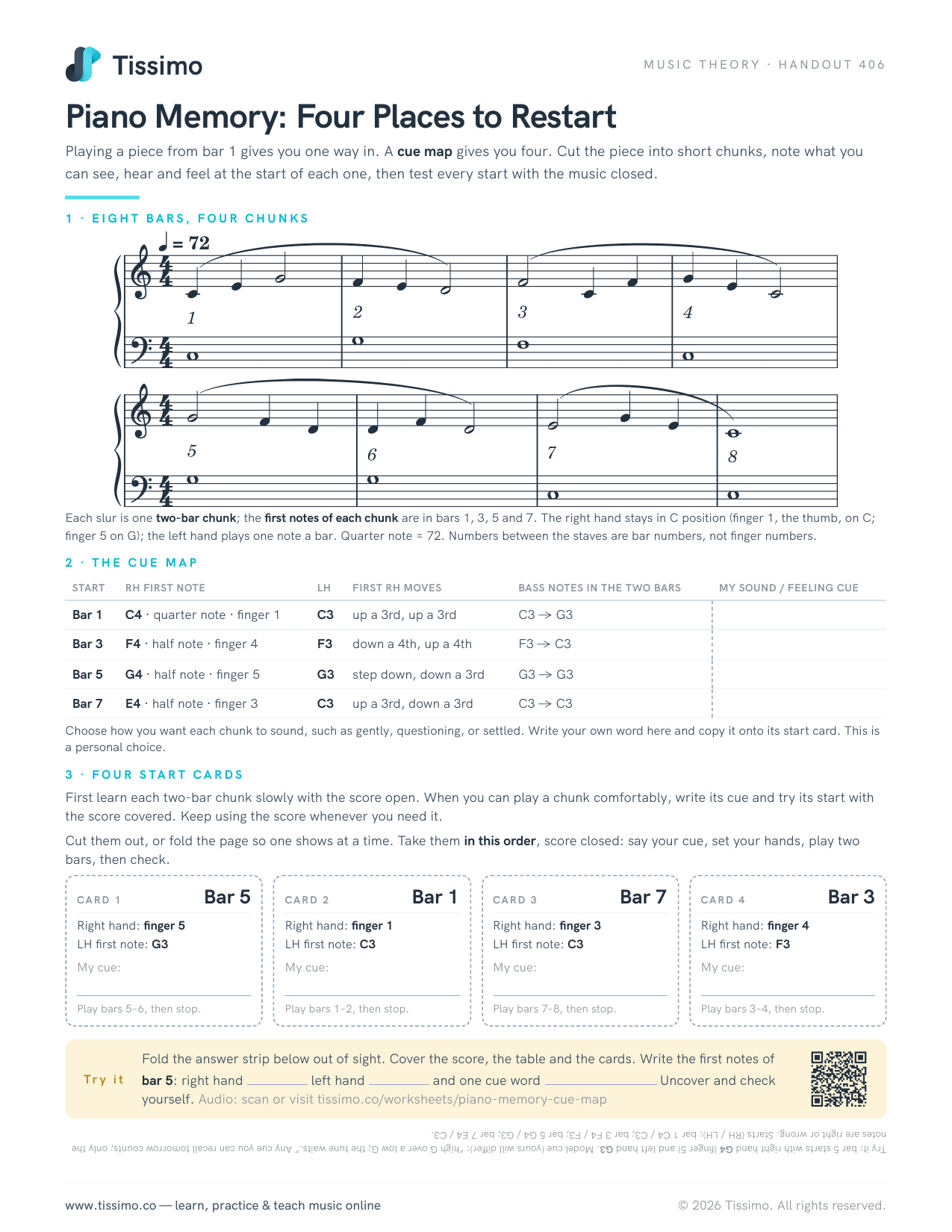 Piano Memory: Four Places to RestartPlaying a piece from bar 1 gives you one way in. A cue map gives you four. Cut the piece into short chunks, note what you can see, hear and feel at the start of each one, then test every start with the music closed.
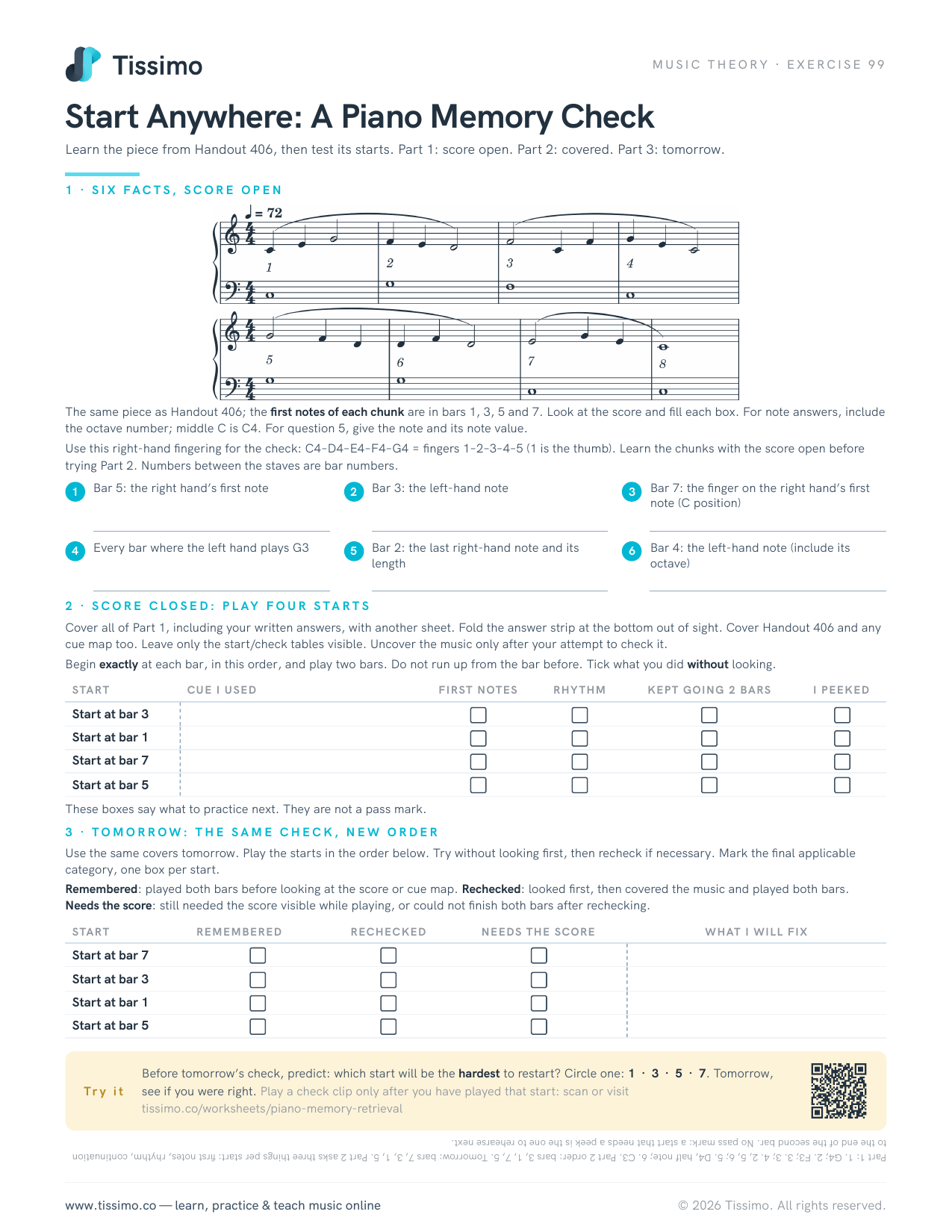 Start Anywhere: A Piano Memory CheckLearn the piece from Handout 406, then test its starts. Part 1: score open. Part 2: covered. Part 3: tomorrow.
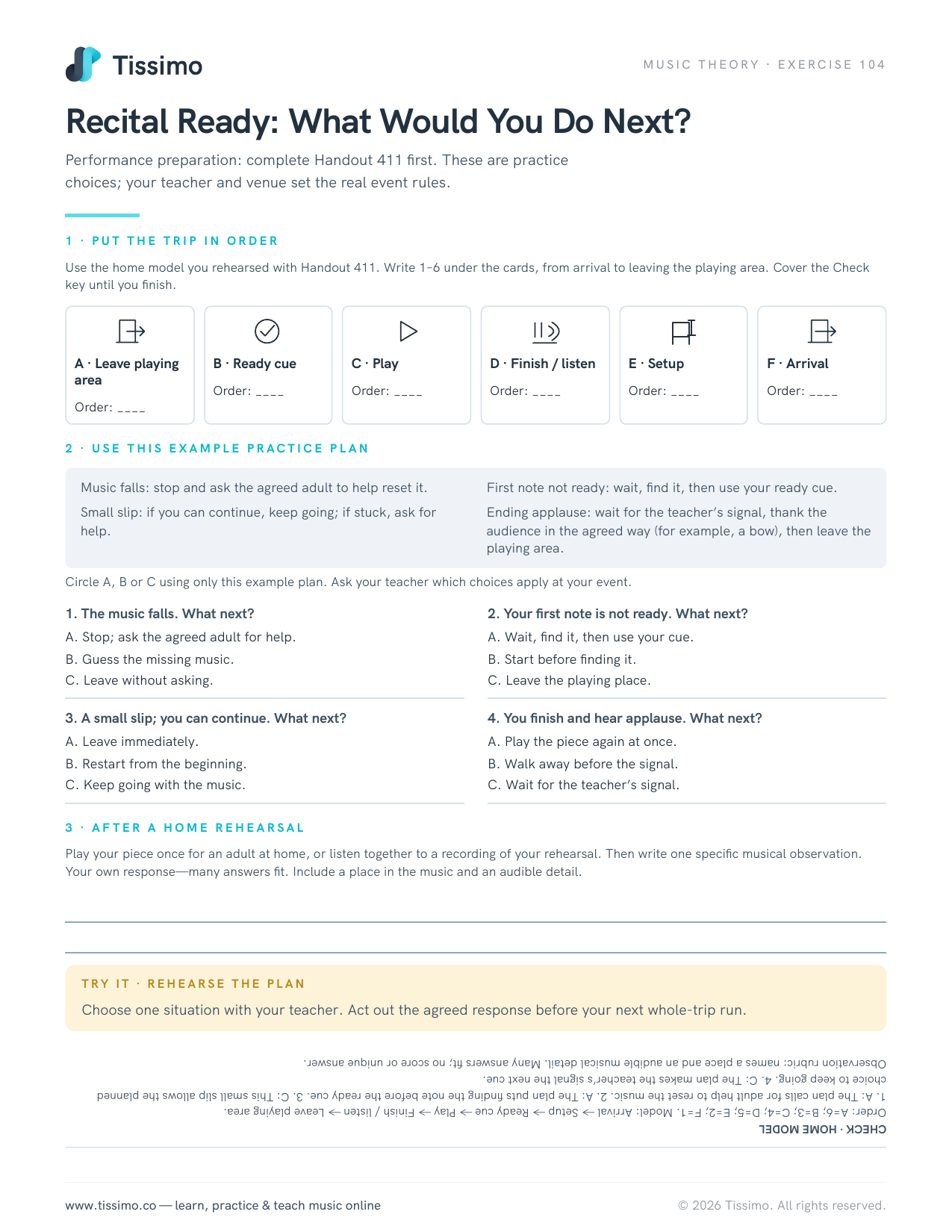 Recital Ready: What Would You Do Next?Performance preparation: complete Handout 411 first. These are practice choices; your teacher and venue set the real event rules.
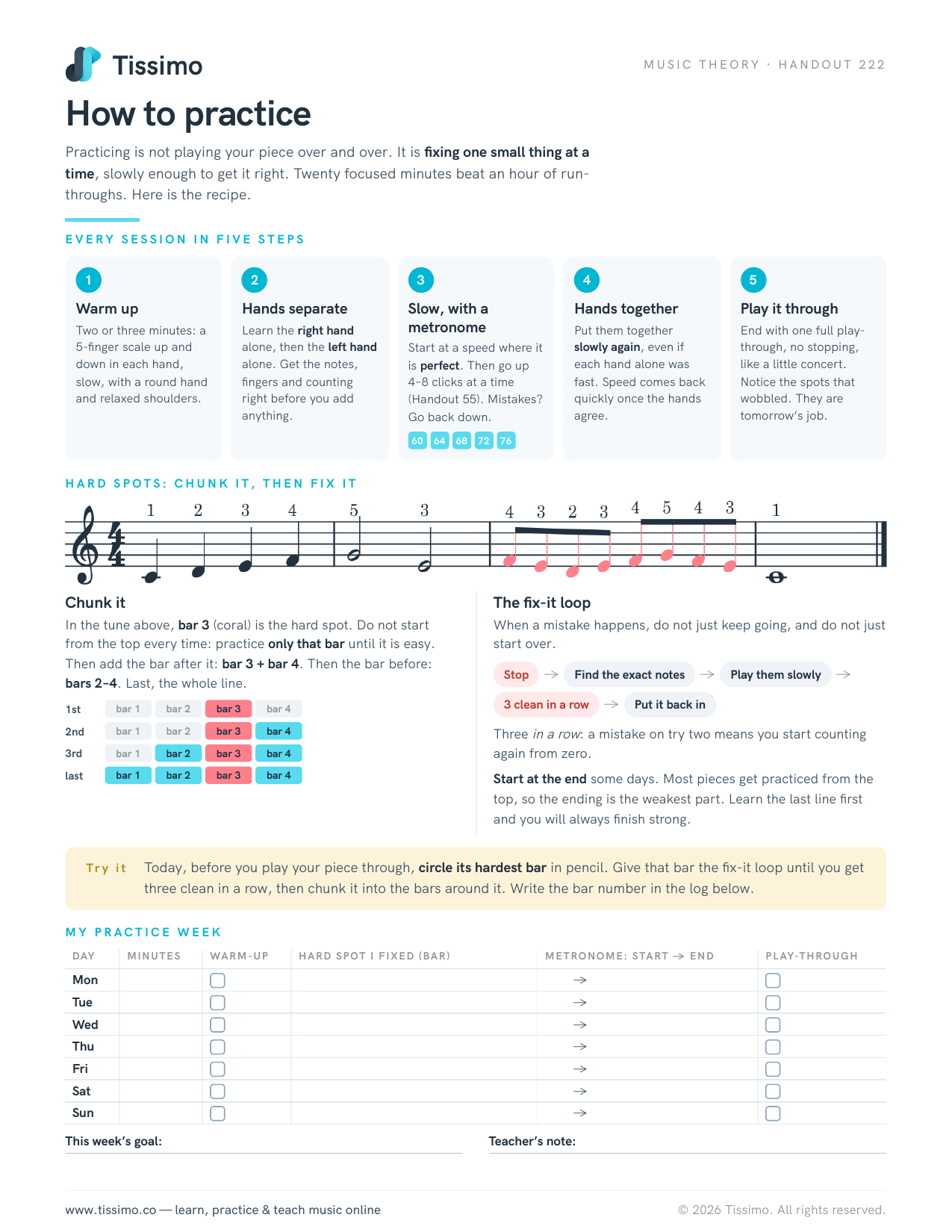 How to practicePracticing is not playing your piece over and over. It is fixing one small thing at a time, slowly enough to get it right. Aim for short, focused sessions, not hour-long run-throughs. Here is the recipe.