Technique & Performance
Hand Crossing
Hand crossing is a keyboard technique in which one hand reaches over, or sometimes under, the other to play notes on the far side of it, such as the left hand crossing over the right for a high note.
Normally the right hand plays the higher notes on a keyboard and the left hand the lower ones. In a hand crossing, one hand travels past the other: the left hand flies over the right to play a high note, or the right hand drops over the left for a low one. Done well, the listener hears one smooth line and never guesses that the hands changed sides.
How crossings are marked
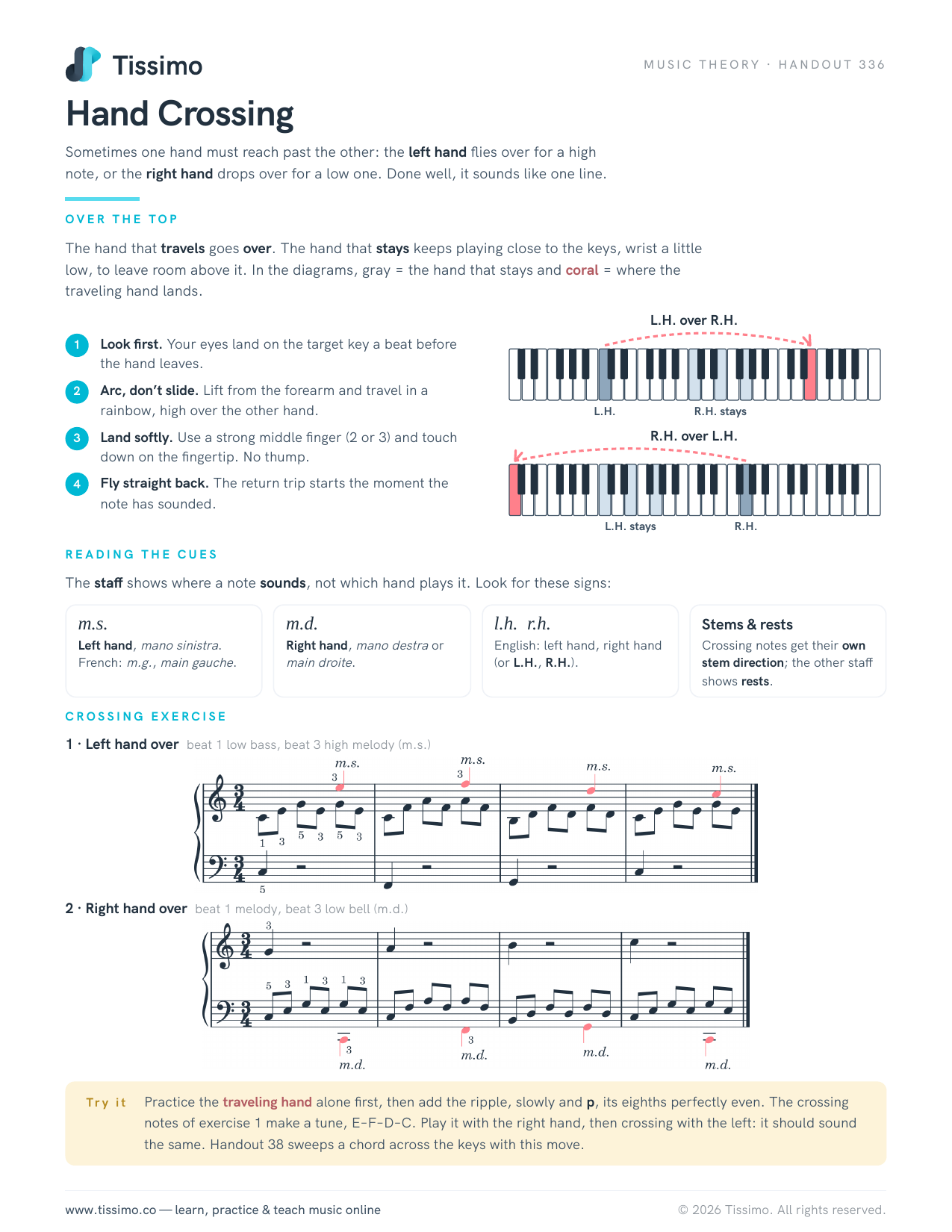
The staff a note is written on shows where it sounds, not which hand plays it. Composers and editors mark crossings with hand signs: m.s. or l.h. for the left hand and m.d. or r.h. for the right; see mano destra and mano sinistra. A crossing note often has its stem turned the other way from the notes around it, and the staff of the traveling hand shows rests. Older prints may show a crossing only by the way the notes are written: in the original print of the Bach gigue described below, the stem directions show which hand takes the jumping notes.
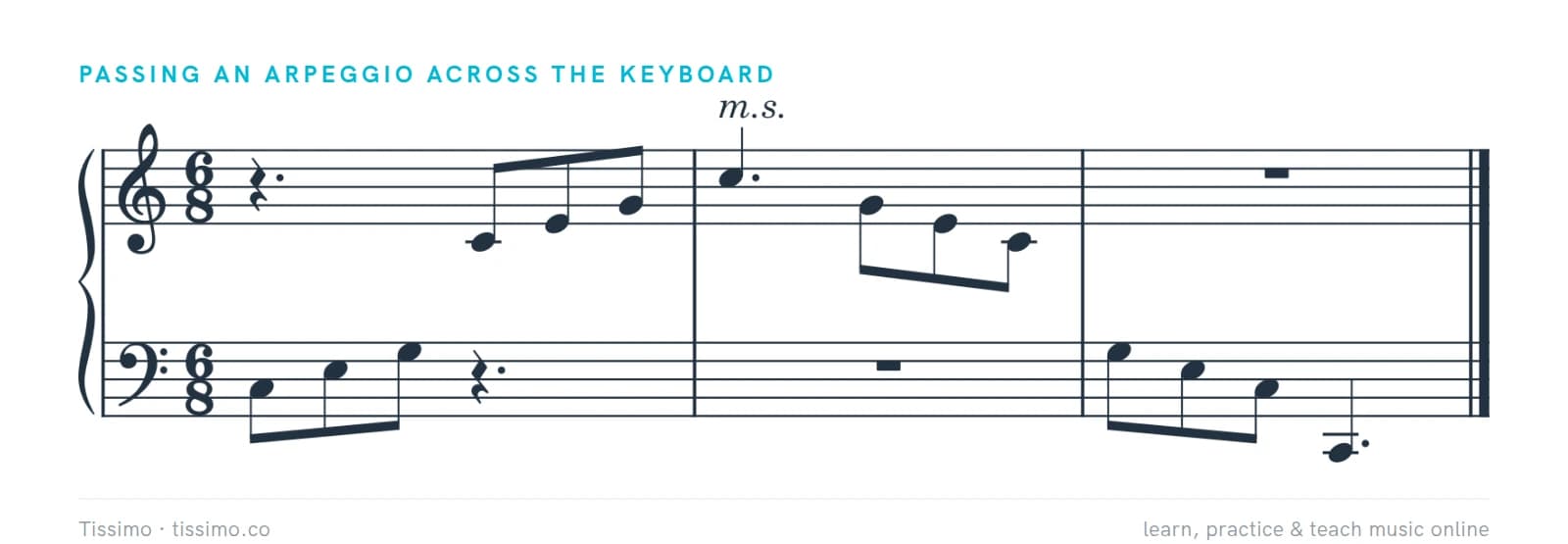
How to play a crossing
- Look first. Your eyes should reach the target key before your hand leaves.
- Make room. The hand that stays plays close to the keys, with a slightly low wrist, so the traveling hand can pass over it.
- Arc, don't slide. Lift from the forearm and travel in a curve, high over the other hand.
- Land softly on the fingertip of a strong finger, usually 2 or 3.
- Go straight back. Start the return as soon as the note has sounded.
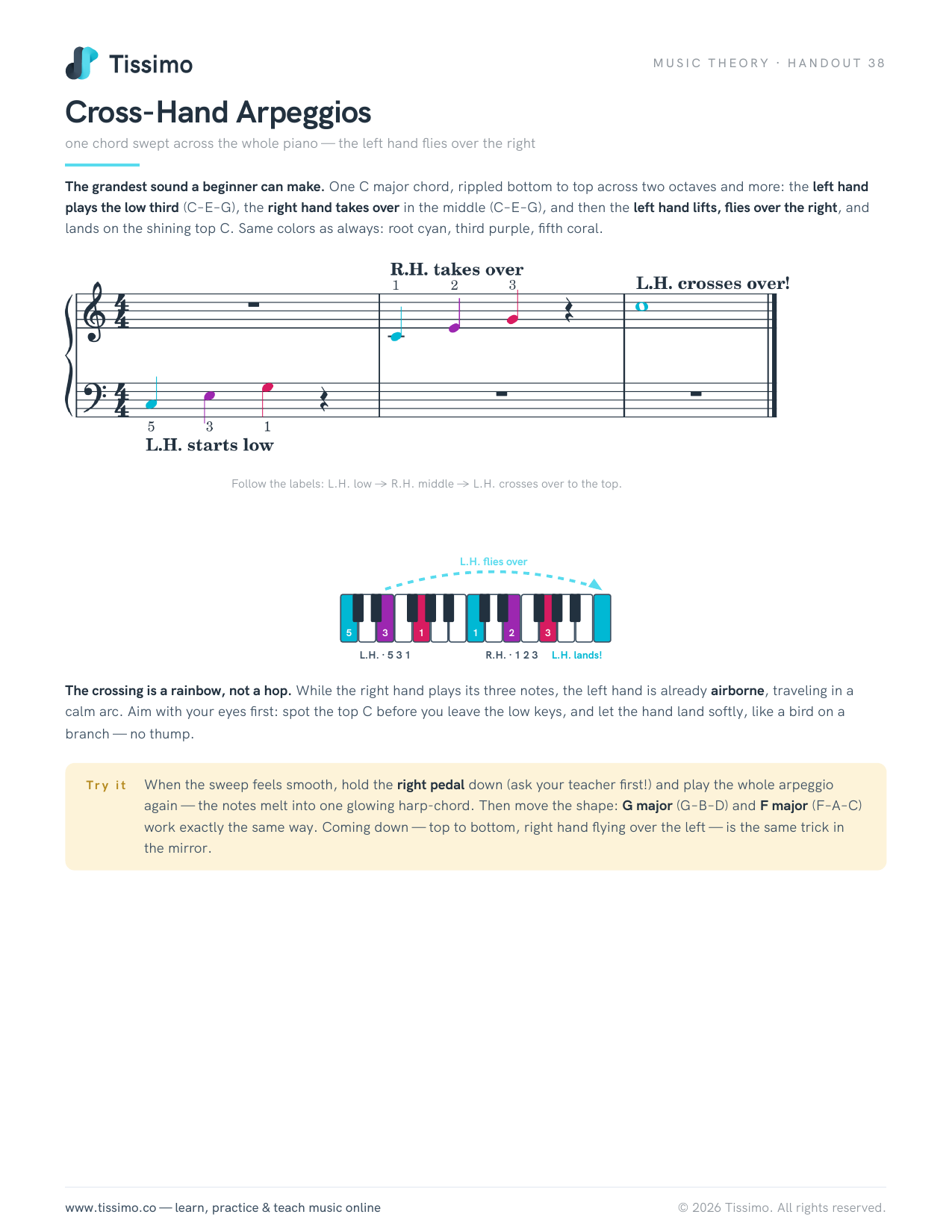
Practice the traveling hand alone, slowly, then add the other hand. Hand Crossing and Cross-Hand Arpeggios give you crossings to try, including an arpeggio swept across the keyboard like the one above.
Crossings in the repertoire
Hand crossing became a showpiece in 18th-century keyboard music. Domenico Scarlatti's harpsichord sonatas are full of crossings, and Jean-Philippe Rameau's harpsichord piece Les trois mains ("The Three Hands") is built on them. J. S. Bach's Partita No. 1 in B-flat major, printed in 1726, ends with a gigue in which one hand keeps jumping over the other. Its original print gives those jumps to the right hand, crossing over the left, yet generations of pianists have played it with the left hand on top. Which hand goes over can be a real choice.
Not the same as finger crossing
Pianists also "cross" fingers in scales, passing the thumb under the hand or a finger over the thumb; see thumb under. That happens inside one hand. A hand crossing moves one whole hand past the other, which takes hand independence of a different kind.
Common questions
Which hand goes on top in a hand crossing?
Usually the traveling hand goes over the top while the other stays low. Some scores say so in words: m.s. Sopra means the left hand crosses over, m.s. Sotto that it passes under.
Can I avoid a hand crossing?
Sometimes the other hand can play the note, and some editions rearrange crossings. But the crossing is often what makes the passage sound and look as the composer meant, so learn it first.
Comments