Notation & Symbols
Mano Destra and Mano Sinistra (m.d., m.s.)
Pronounced MAH-noh DEH-strah, MAH-noh see-NEE-strah
Mano destra (m.d.) and mano sinistra (m.s.) are Italian for "right hand" and "left hand". In keyboard music they say which hand plays a note, usually where one hand reaches over to the other's side.
In piano music the top staff of the grand staff is usually played by the right hand and the bottom staff by the left. But the staff only shows where a note sounds, not which hand plays it. When a composer wants the "wrong" hand, for a crossing or to share out a passage, the note gets a small hand marking:
- m.d.: mano destra (Italian) or main droite (French), right hand.
- m.s.: mano sinistra, left hand (Italian only).
- m.g.: main gauche, left hand (French).
- r.h. and l.h.: the English right hand and left hand (also R.H. and L.H.).
Note that m.d. means "right hand" in both Italian and French, while the left hand is m.s. in Italian but m.g. in French.
How the marking looks
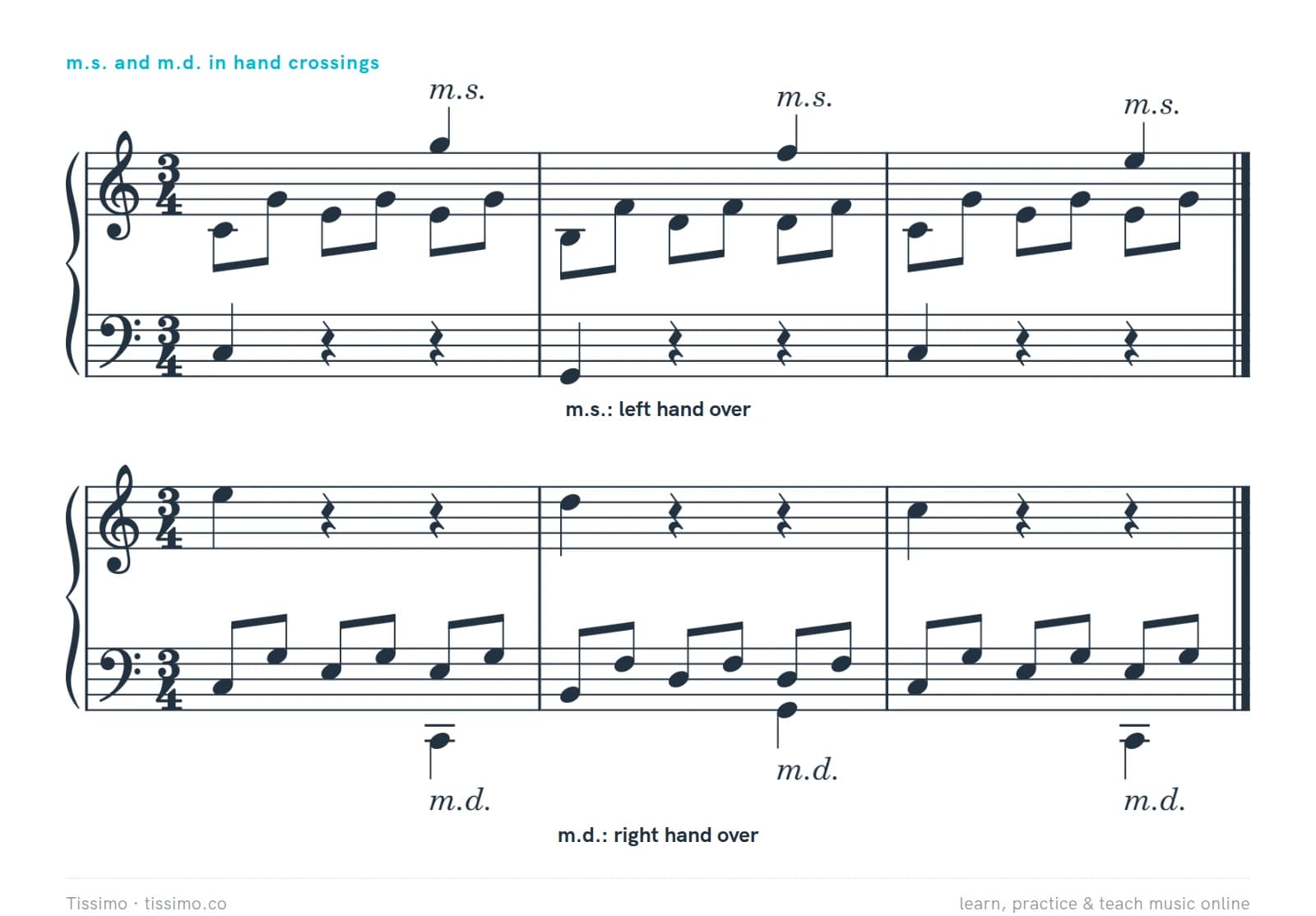
The letters are printed small, often in italics, next to the notes they apply to. A crossing note is usually written on the staff where it sounds, often with its stem turned the other way from the notes around it, and the other staff shows rests while that hand is away.
Crossing over
The commonest reason for these marks is a hand crossing. m.s. above a high note on the treble staff means the left hand travels over the right to play it; m.d. under a low note on the bass staff means the right hand goes down over the left. Some scores add which hand goes on top: m.s. sopra (left hand over) or m.s. sotto (left hand under).
Practicing a crossing
- Find every m.d. and m.s. before you play, and pencil in arrows if they help.
- Play the traveling hand alone, slowly, and look at the target key before you move.
- Keep the other hand quiet and low, so the crossing hand has room above it.
- Release the last note before the jump on time, then let the arm carry the hand across.
Don't read ms. or MS in a source list as a hand marking: there it usually means "manuscript". And a note on the top staff is not automatically for the right hand; when a marking says otherwise, follow the marking.
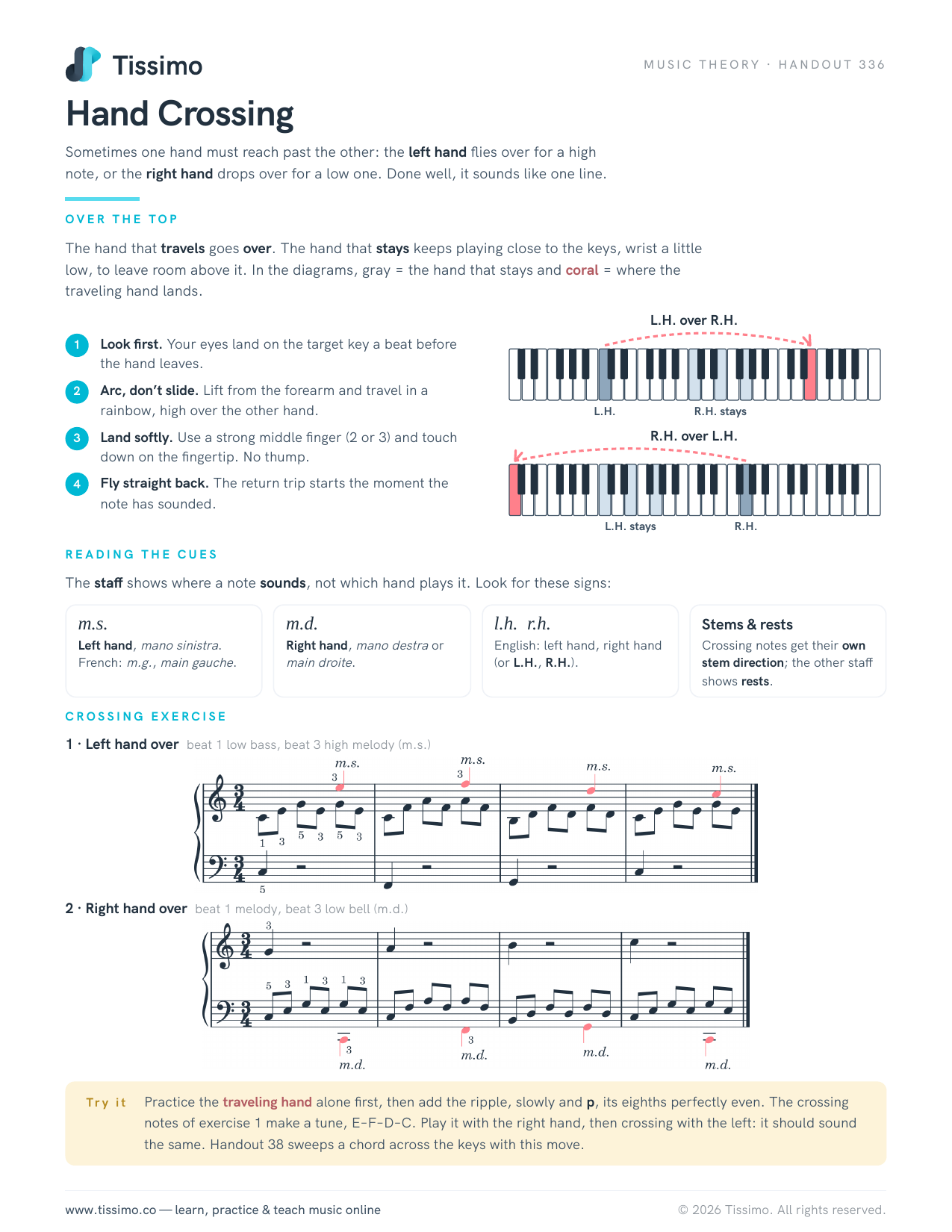
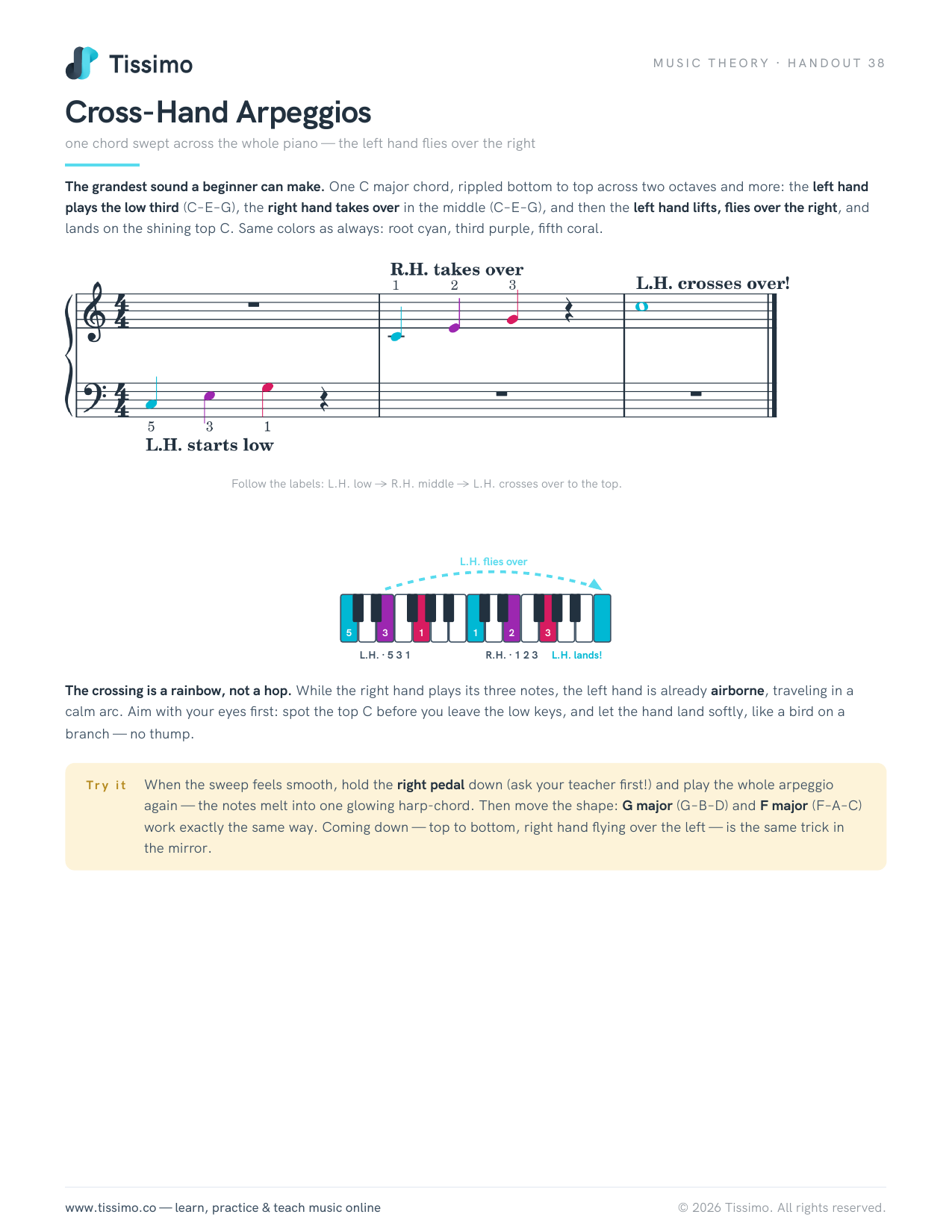
Try the crossings in Hand Crossing and Cross-Hand Arpeggios.
Common questions
What do m.d. and m.s. mean in piano music?
Right hand and left hand: m.d. is mano destra (or French main droite) and m.s. is mano sinistra. They tell you which hand plays the marked notes.
What does m.g. mean?
Main gauche, French for left hand. French scores use m.d. and m.g.; Italian scores use m.d. and m.s.
Comments