Rhythm & Meter
Clave
Pronounced KLAH-vay
Clave is a repeating two-bar rhythm of five strokes, three in one bar and two in the other, that much Afro-Cuban music, salsa and Latin jazz is built around.
Clave is a two-bar rhythmic pattern of five strokes that organizes much Afro-Cuban music, as well as salsa and Latin jazz. The pattern repeats without change through a song, and the other rhythmic parts are built on it. It is often played on the claves, a pair of hardwood sticks that share its name. It can also be left unplayed: no one sounds it, yet the other parts are still arranged around it.
Three strokes, then two
One bar of the pattern has three strokes and the other has two, so musicians speak of its 3-side and its 2-side. In the son clave, the 3-side sounds on 1, the "&" of 2 and 4, and the 2-side sounds on 2 and 3. Start with the 3-side and you have 3-2 clave; start with the 2-side and you have 2-3 clave. The strokes and the spaces between them are the same; only the first bar changes.
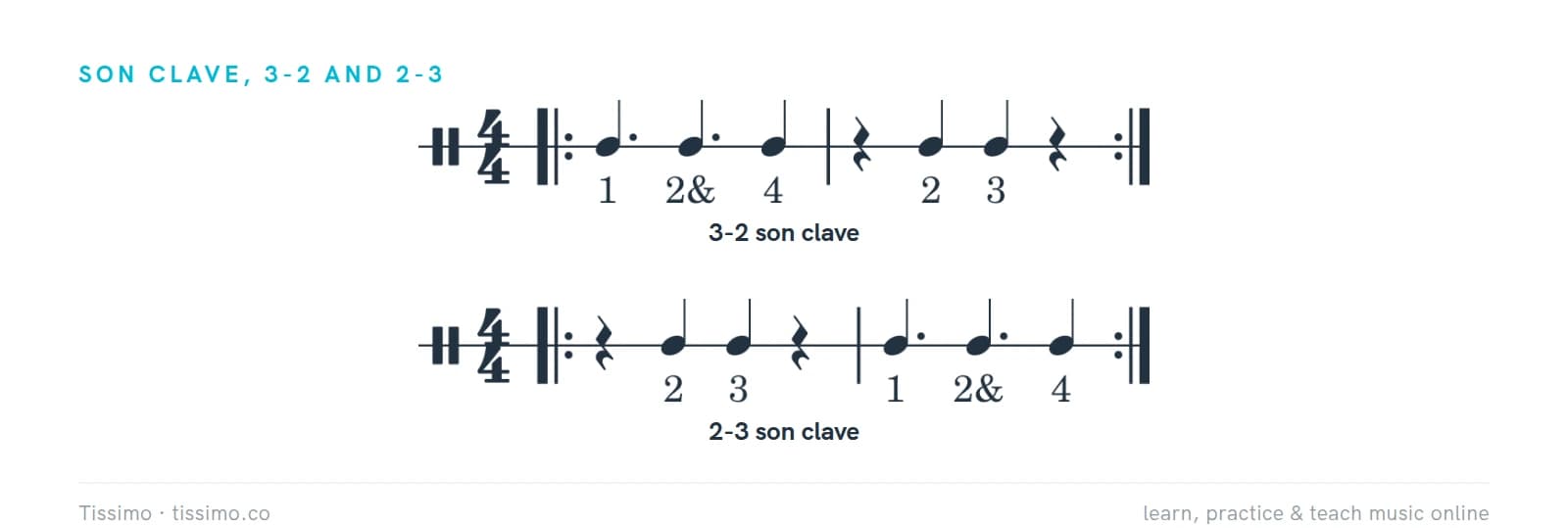
The second stroke is the one to watch. It comes on the "&" of 2, half a beat before beat 3, and it is easy to let it drift onto the beat. Count eighth notes aloud, "1 & 2 & 3 & 4 &", and clap only on the counts shown.
Rumba clave
The rumba clave keeps the same 2-side but moves the last stroke of the 3-side one eighth note later, from beat 4 to the "&" of 4. That single delayed stroke is the whole difference, and the rumba clave can also be played 3-2 or 2-3.
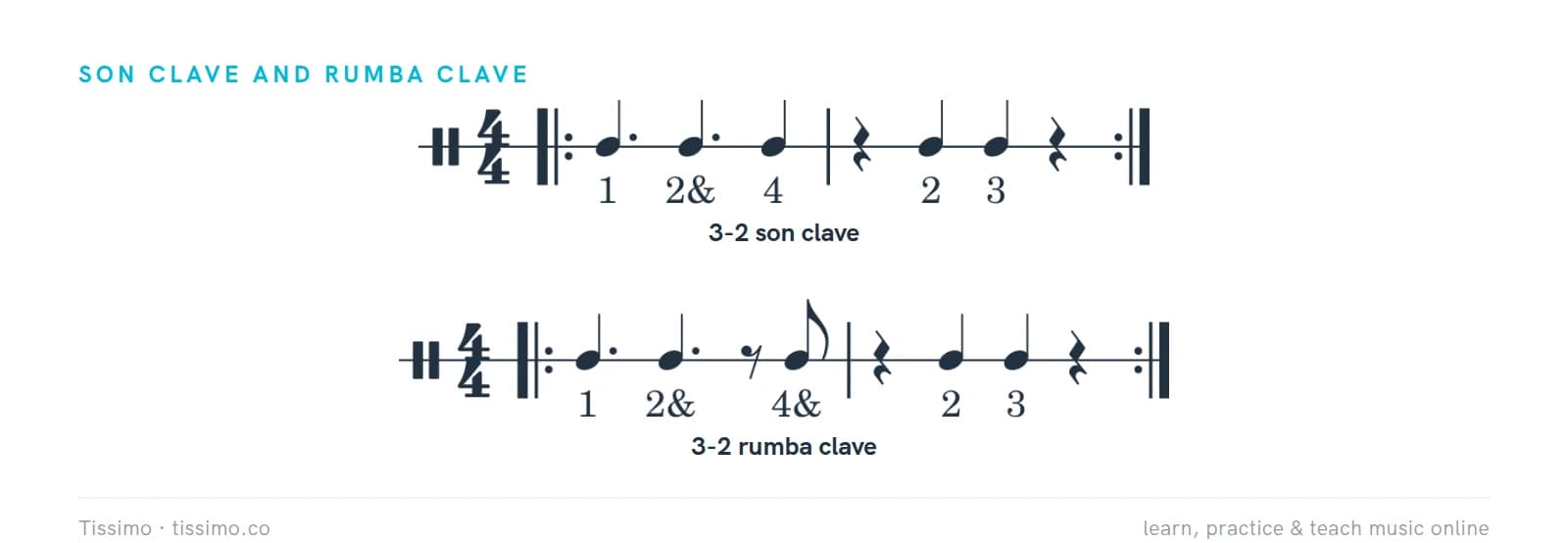
Reading and writing clave
The 3-2 and 2-3 names are standard in salsa and Latin jazz teaching, and they describe which side of the pattern a song or section lines up with. Charts write the pattern in more than one way: two bars of 4/4 as here, two bars of cut time, or a single bar of 4/4 in sixteenth notes. All of them describe the same rhythm.
Clave is a fixed syncopated pattern: as written here, all five strokes sit on one steady grid of eighth notes. In the son clave one stroke falls between the beats, and in the rumba clave two do. The rhythm associated with bossa nova is a close relative that places one stroke differently.
Clave or claves?
The instrument is usually called claves, plural, because it is a pair of sticks. The rhythm is clave. You can play the rhythm on any instrument, and claves can play other rhythms too.
Learn both directions and the rumba version with Son Clave: 3-2 and 2-3, then test yourself with Clave Direction Check.
Common questions
What is the difference between 3-2 and 2-3 clave?
Only the starting bar. 3-2 clave begins with the bar of three strokes and 2-3 clave with the bar of two strokes; the five strokes and the spaces between them are the same.
What is the difference between son clave and rumba clave?
One stroke. They share the same 2-side, but rumba clave plays the last stroke of the 3-side an eighth note later, on the & of 4 instead of on beat 4.
Practice it: free worksheets
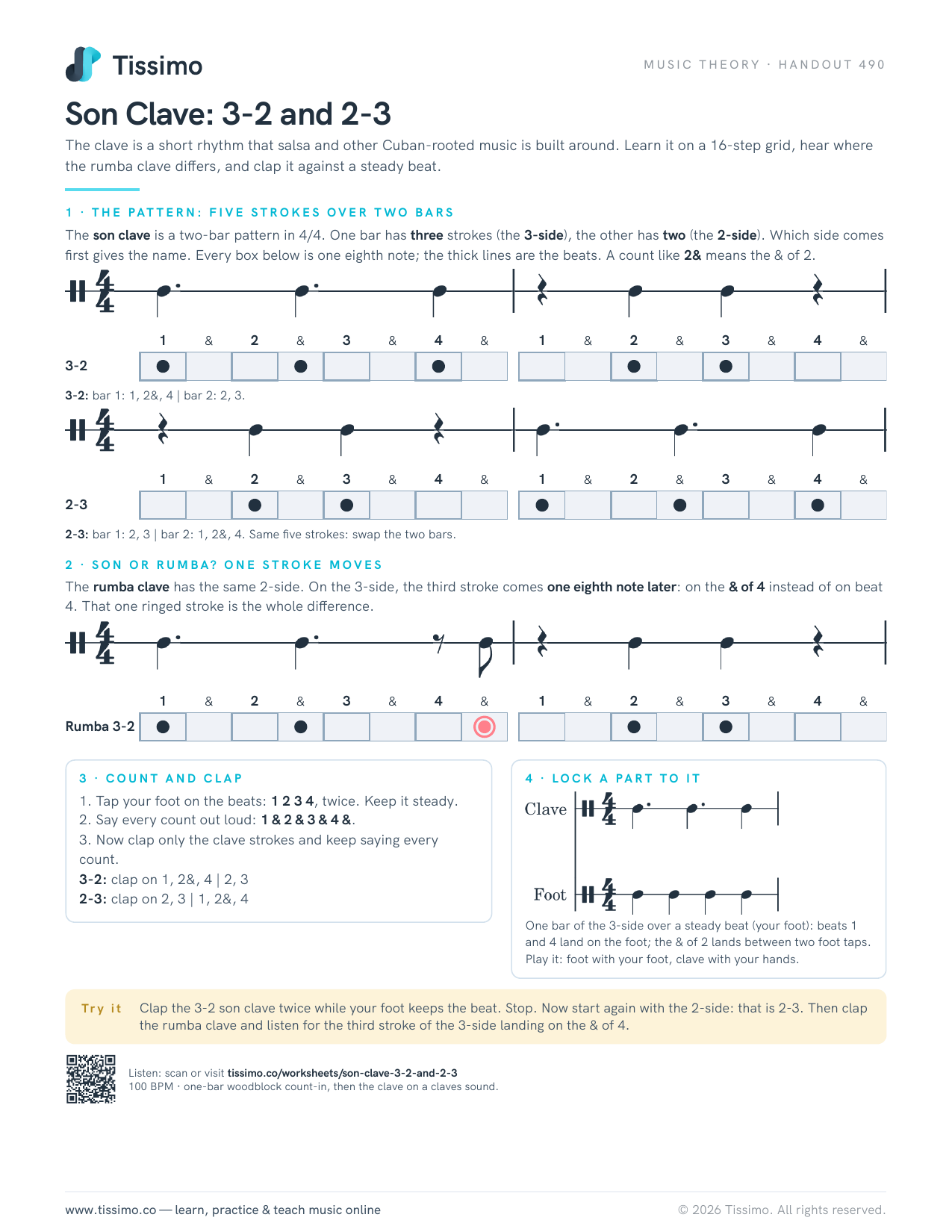 Son Clave: 3-2 and 2-3The clave is a short rhythm that salsa and other Cuban-rooted music is built around. Learn it on a 16-step grid, hear where the rumba clave differs, and clap it against a steady beat.
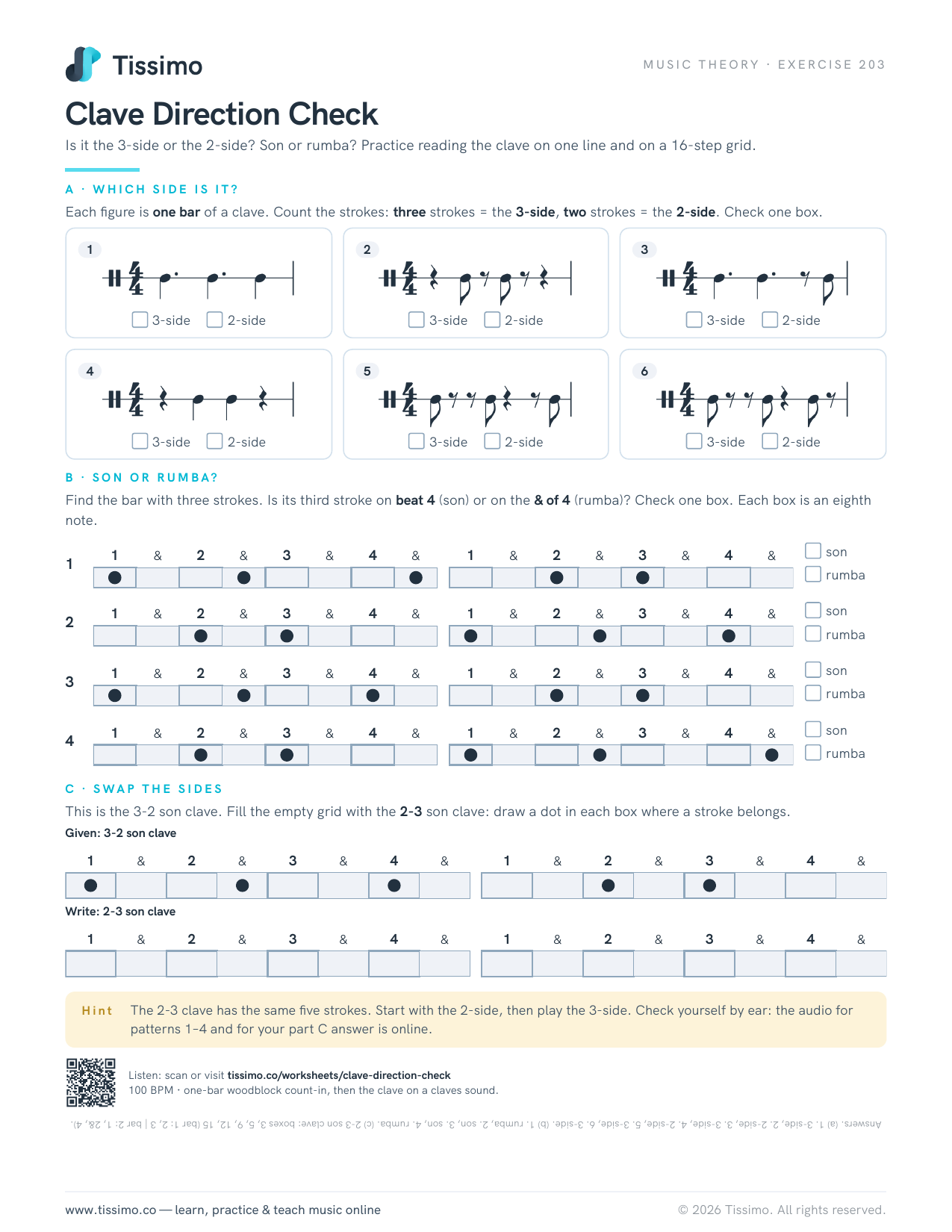 Clave Direction CheckIs it the 3-side or the 2-side? Son or rumba? Practice reading the clave on one line and on a 16-step grid.
Comments