Rhythm & Meter
Breve (Double Whole Note)
Pronounced BREEV
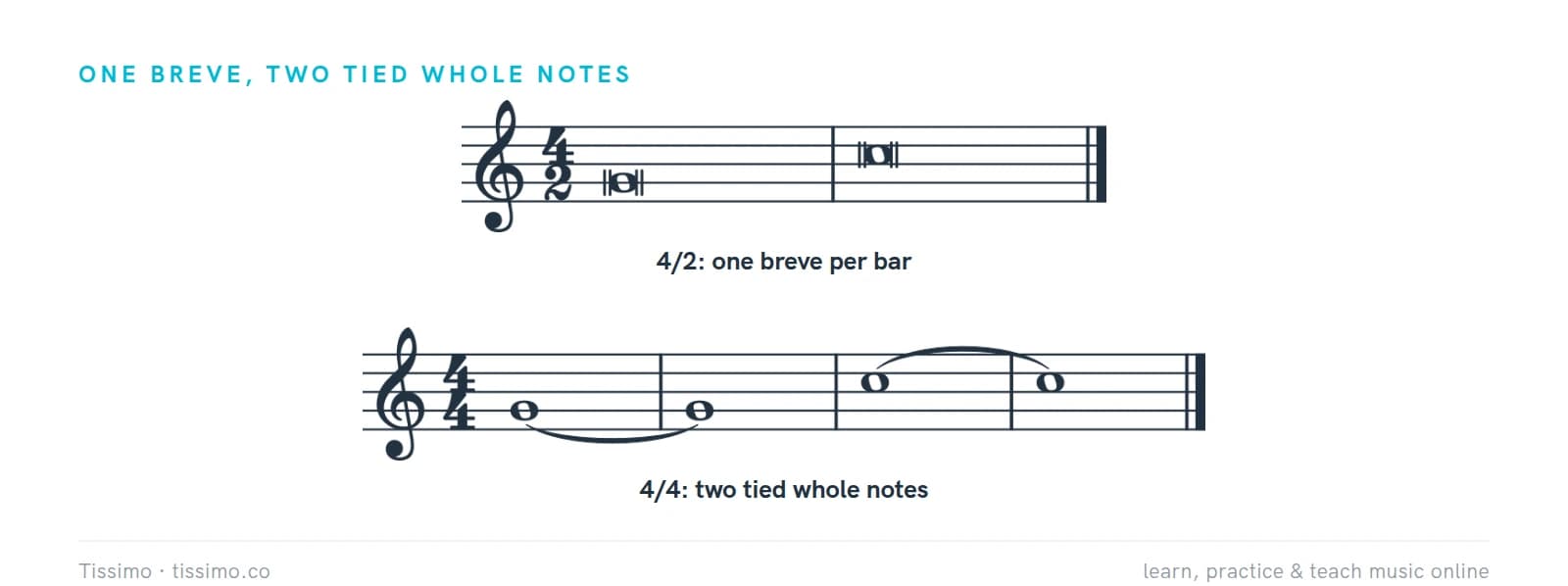
A breve, or double whole note, lasts as long as two whole notes: eight quarter-note beats. It is an open notehead with short vertical lines at its sides, and you meet it mostly in 4/2 time and older music.
The breve is the longest note value you are likely to meet in modern notation. It lasts twice as long as a whole note, so it is worth two whole notes, four half notes or eight quarter notes. In American English it is called the double whole note. British musicians call the whole note a semibreve, "half a breve", and that name only makes sense once you know the breve.
How it looks
The usual modern breve is an open, hollow notehead like a whole note, with one or two short vertical lines on each side of it. Like the whole note, it has no stem. Some editions, especially of early music, draw it instead as a square or rectangular notehead, the shape the note had in medieval and Renaissance notation.
Where you meet it
A breve lasts eight quarter-note beats, longer than a whole bar of 4/4. So in most music the same length is written as two whole notes joined by a tie across the bar line. The breve fits exactly into one bar of 4/2, a rarer quadruple meter with four half-note beats, and that is where you are most likely to see it, along with modern editions of older music.
The breve rest
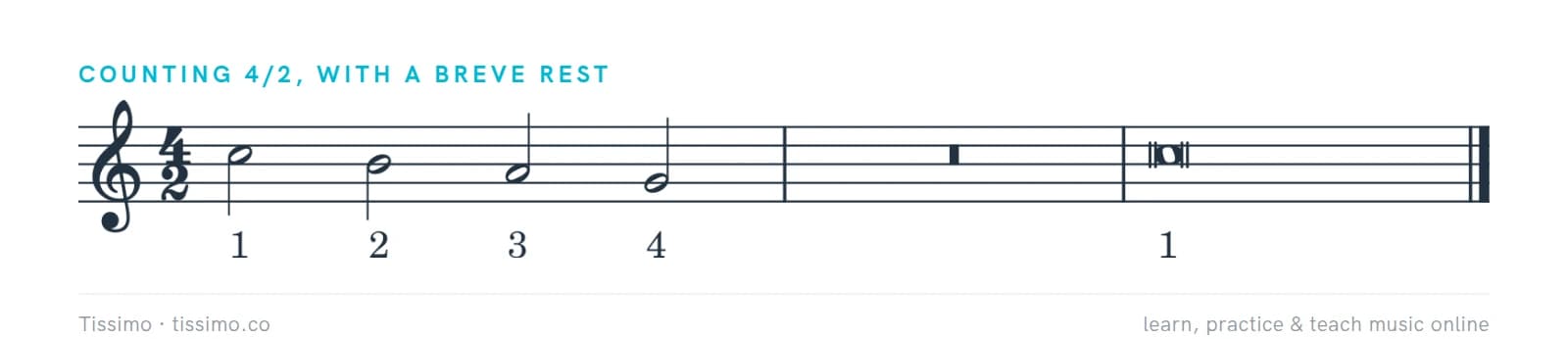
The rest of the same length is the breve rest (or double whole rest). It is a solid block that fills the whole space between the third and fourth lines of the staff, where a whole rest only hangs halfway down from the fourth line. In 4/2, a completely silent bar is usually shown with a breve rest, centered in the bar.
Why is the longest note called "short"?
Breve comes from the Latin brevis, "short". In medieval notation the brevis really was one of the short notes, set against the longer longa. Over the following centuries musicians added shorter and shorter values (the semibreve, the minim and the rest of the family), and the old notes came to be held longer and longer. The name stayed while the note grew long. It also survives in alla breve, the Italian name for cut time.
Counting a breve
In 4/2, count the four half-note beats, "1, 2, 3, 4", and hold the breve through all of them. In 4/4, where the same length is two tied whole notes, count two full bars without lifting: "1, 2, 3, 4, 2, 2, 3, 4". If whole notes still feel long, secure them first with The whole note; the breve simply doubles them.
Common questions
How many beats is a breve?
Eight quarter-note beats, twice as long as a whole note. In 4/2, where the half note gets the beat, it fills the whole bar: four half-note beats.
Is a breve the same as a semibreve?
No. Semibreve is the British name for the whole note, which is half as long. The breve is the double whole note; "semi-breve" means half of it.
Comments