Technique & Performance
Alternate Picking
Alternate picking is a guitar technique in which the pick strikes the strings in strict alternation, a downstroke then an upstroke, so that a fast line of single notes flows evenly with no wasted motion.
Alternate picking is how most guitarists play fast single-note lines with a pick. Instead of striking every note with a downstroke, the pick goes down on one note and up on the next: down, up, down, up. A run of downstrokes alone has to bring the pick back up past the string without playing it. Alternate picking plays a note on that return trip as well, so no motion is wasted, and lines come out smoother and faster.
Downstrokes and upstrokes
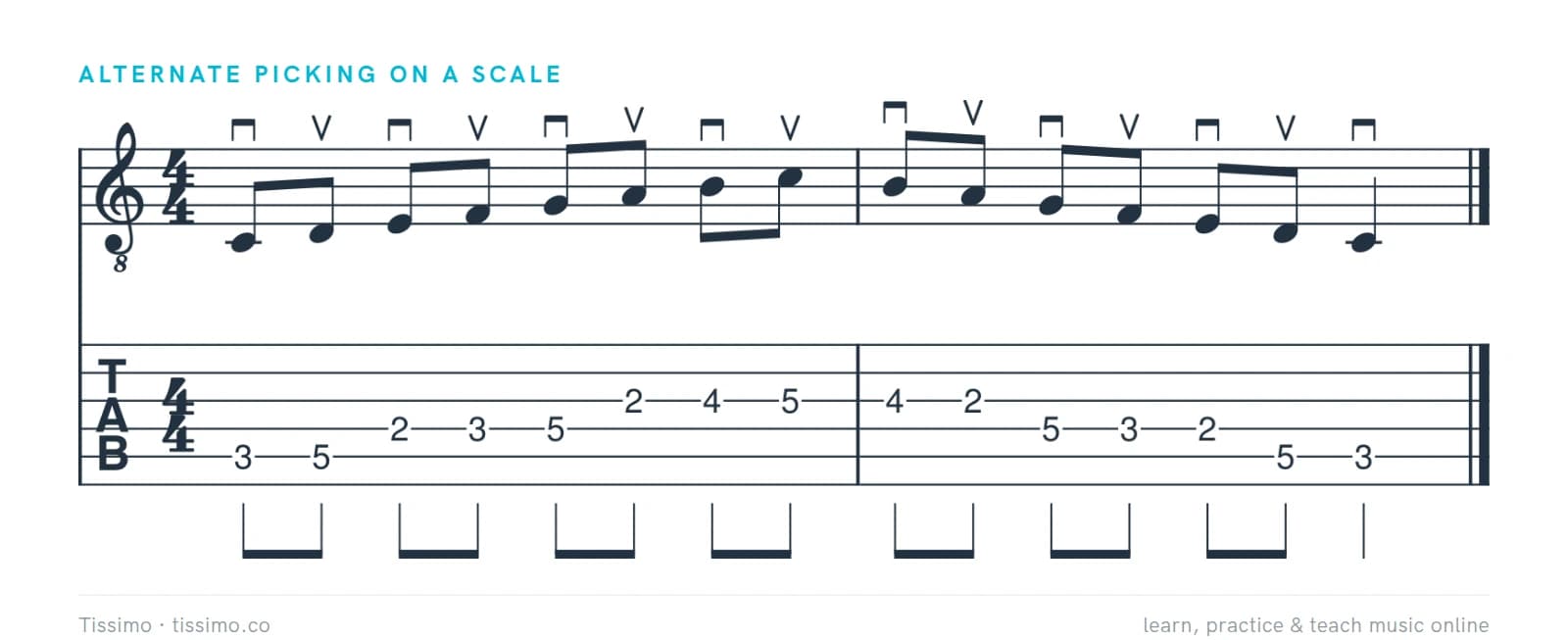
- Downstroke: the pick starts just above the string, on the ceiling side, and strikes it moving toward the floor. Guitar parts mark it ⊓, a box open at the bottom.
- Upstroke: the pick starts just below the string and strikes it moving toward the ceiling. It is marked V.
They are the same signs string players use for down-bow and up-bow; see bowing. In a line of even eighth notes that starts on the beat, every downstroke lands on a beat and every upstroke on an "and", the in-between half of the beat.
How to practice it
- Start on one string. Pick one note eight times while you watch the picking hand. If every stroke goes down, slow down and add the upstrokes.
- Use a metronome and start slowly. Keep the wrist, elbow and shoulder relaxed; tension makes the hand stiff and uneven.
- Keep the motion small. Keep the pick close to the strings, with as little up-and-away movement as possible.
- Then cross strings. Scales are harder than one string, because the pick has to change string between a downstroke and an upstroke. Patterns with two notes on each string, such as many pentatonic shapes, are among the hardest at speed.
- Start on an upstroke too. A phrase that begins on an "and" starts with an upstroke, so practice both ways.
The Movable Major Scale Shape gives a one-position scale to practice with strict alternate picking. Very fast alternate picking on one note, kept going for the length of the note, is called tremolo picking.
Alternate picking or economy picking?
Strict alternate picking never breaks the down-up pattern, even when the line moves to a new string. Economy picking breaks it on purpose. When the next string lies in the direction the pick is already moving, the pick carries on and plays two strokes in the same direction. In the example above, economy picking would play the A in bar 1, the first note on string 3, with a downstroke, continuing the motion from the G on string 4. Economy picking saves motion and leads into sweep picking, where one stroke runs across several strings. Alternate picking gives a more even, clearly separated attack. Many guitarists use both.
All downstrokes have their place too: many heavy riffs and rhythm parts are down-picked. Fingerstyle players get the same evenness by alternating two fingers, usually the index and middle (i and m); see fingerpicking and Alternate the Plucks, Not the Beats.
Common questions
What do the ⊓ and V symbols mean in guitar tab?
They show the pick direction. ⊓ (a box open at the bottom) is a downstroke, toward the floor; V is an upstroke, toward the ceiling.
Should alternate picking start with a downstroke?
Most exercises start with a downstroke on the beat. A phrase that starts on an offbeat "and" usually starts with an upstroke, so practice starting both ways.
Practice it: free worksheets
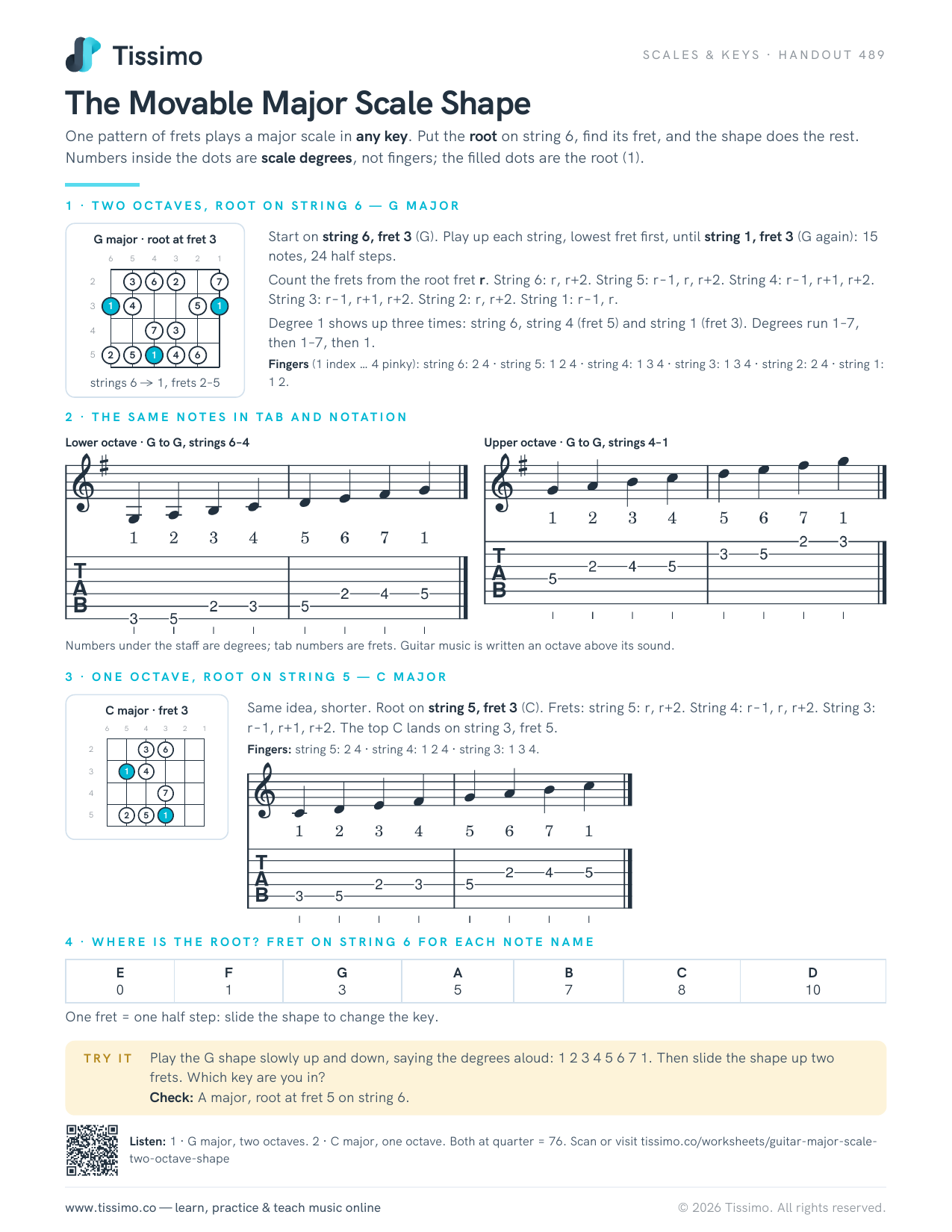 The Movable Major Scale ShapeOne pattern of frets plays a major scale in any key. Put the root on string 6, find its fret, and the shape does the rest. Numbers inside the dots are scale degrees, not fingers; the filled dots are the root (1).
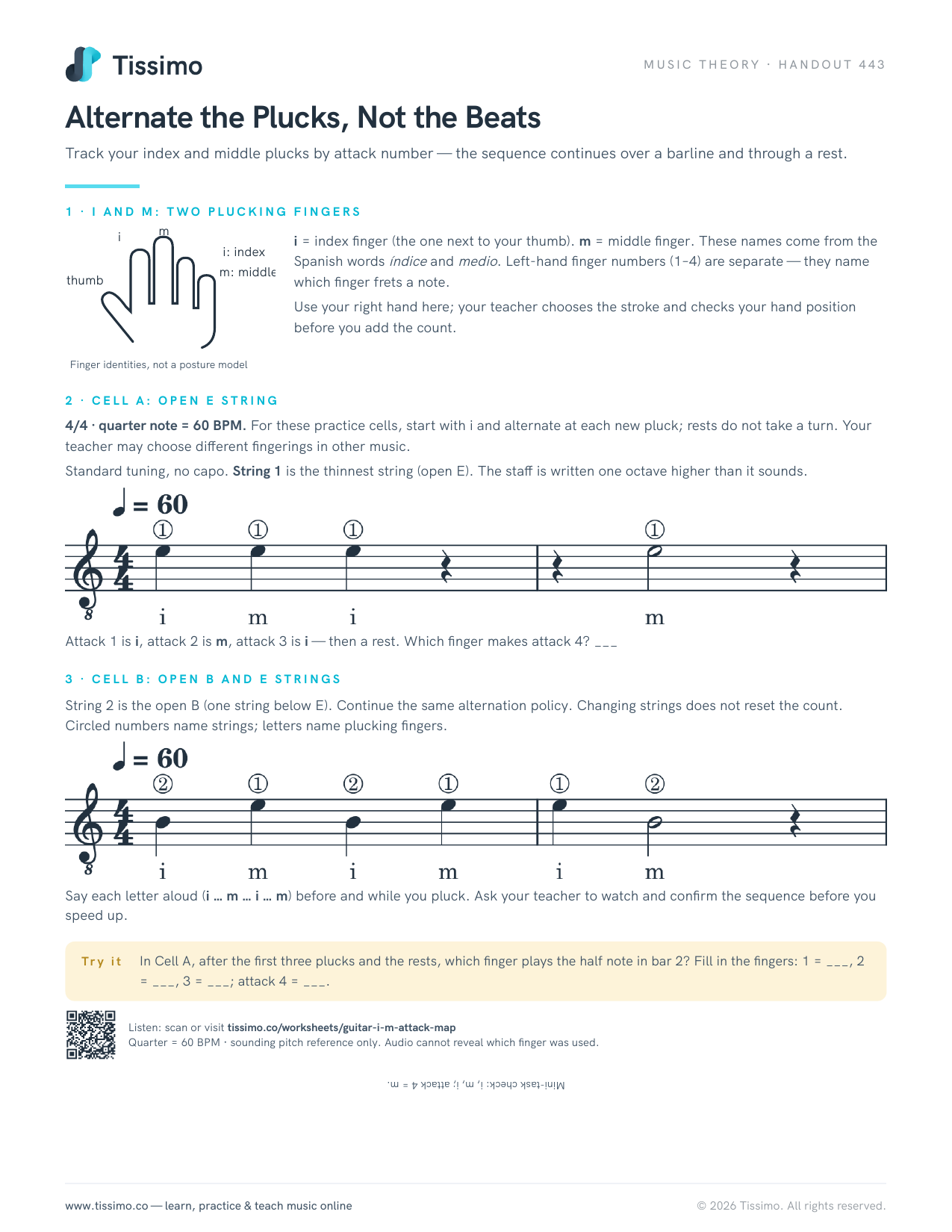 Alternate the Plucks, Not the BeatsTrack your index and middle plucks by attack number — the sequence continues over a barline and through a rest.
Comments