Rhythm & Meter
Tresillo
Pronounced treh-SEE-yoh
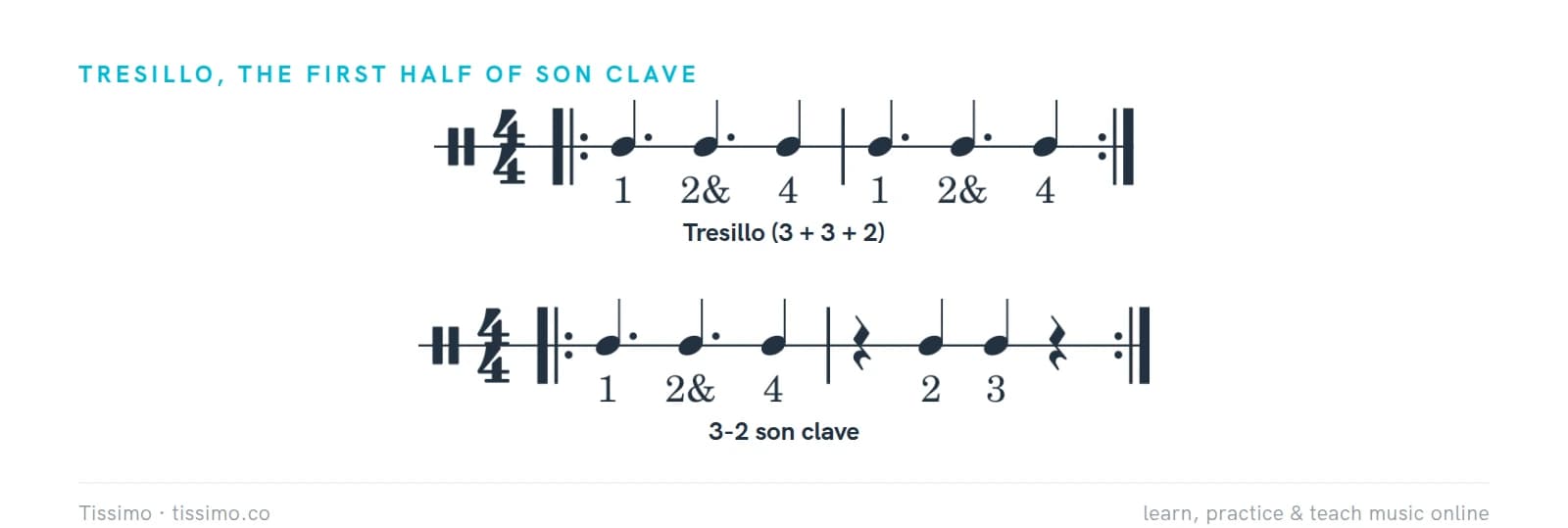
Tresillo is a three-stroke rhythm that divides eight even pulses as 3 + 3 + 2: in 4/4, a dotted quarter, a dotted quarter and a quarter. It is a basic cell of Cuban music and the 3-side of son clave.
Tresillo is a rhythm of three strokes spread over eight even pulses in groups of 3 + 3 + 2. In 4/4 with an eighth-note pulse, the strokes fall on beat 1, the "&" of 2 and beat 4: a dotted quarter, a dotted quarter and a quarter. It is one of the basic rhythmic cells of Cuban music, and in Cuba the name tresillo is given to this pattern, the 3-side of the son clave (the first bar of 3-2 clave).
Counting it
Count eighth notes, "1 & 2 & 3 & 4 &", and clap only on 1, the "&" of 2, and 4. The middle stroke is the syncopation: it lands between beats 2 and 3 instead of on a beat. Keep the last stroke, on beat 4, exactly in place, so that the shorter final group (2 instead of 3) leads back to beat 1.
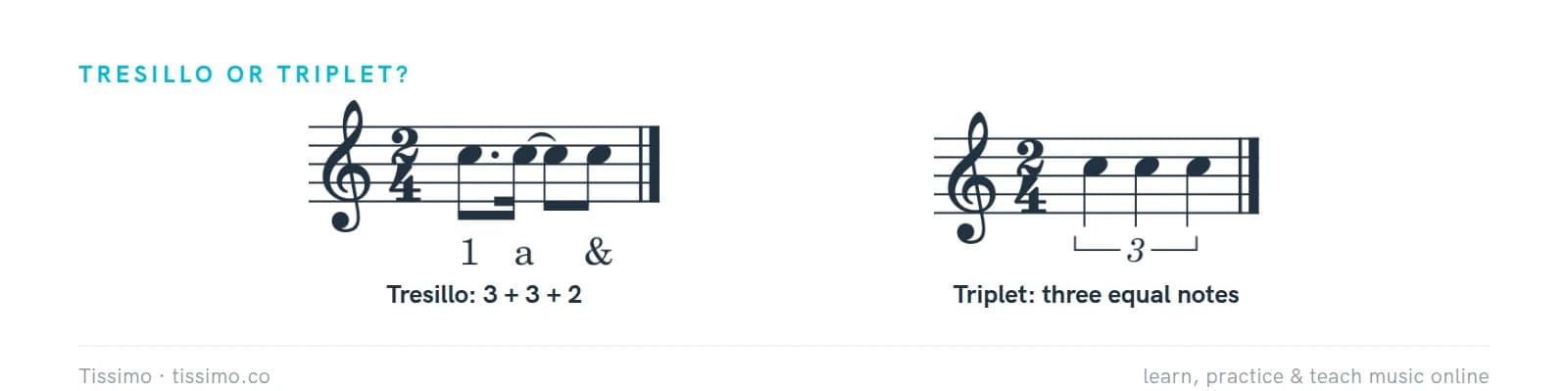
Some charts write the same rhythm in 2/4 with sixteenth notes: a dotted eighth, a sixteenth tied to an eighth, and an eighth. That is the same 3 + 3 + 2, on a grid of eight sixteenths instead of eight eighths.
Where you hear it
- Cuban and other Latin American music: the 3 + 3 + 2 grouping turns up in bass lines and accompaniments, and as the 3-side of son clave. Learn the full clave with Son Clave: 3-2 and 2-3 and Clave Direction Check.
- Early jazz: Jelly Roll Morton called the Latin American elements in jazz its "Spanish tinge", and his "New Orleans Blues" features the tresillo.
- Pop and dance music today: the dembow beat of reggaeton sets a snare on the last two strokes of a tresillo over a four on the floor bass drum.
Relatives: habanera and cinquillo
Strike the beat in the middle of the pattern as well (beat 3 in 4/4, beat 2 in the usual 2/4 spelling) and tresillo becomes the habanera rhythm. Its five-stroke cousin, the cinquillo, fills the same eight pulses as 2 + 1 + 2 + 1 + 2. Explore more off-beat patterns with Syncopation.
Tresillo or triplet?
In Spanish, tresillo is also the everyday word for a triplet: three equal notes in the time of two. The Afro-Cuban rhythm is not a triplet. Its three strokes are uneven (3, 3 and 2 pulses), and they sit on the ordinary grid of eighth notes. So when a Spanish-language music book asks for a tresillo de corcheas, it means an eighth-note triplet, not this rhythm.
Common questions
What is the tresillo rhythm?
A three-stroke pattern that divides eight pulses as 3 + 3 + 2. In 4/4 it is a dotted quarter, a dotted quarter and a quarter, on 1, the "&" of 2 and 4.
Is a tresillo a triplet?
Not the rhythm. In Spanish the word tresillo also means a triplet, three equal notes in the time of two, but the Afro-Cuban tresillo has three unequal strokes on an even eighth-note grid.
Practice it: free worksheets
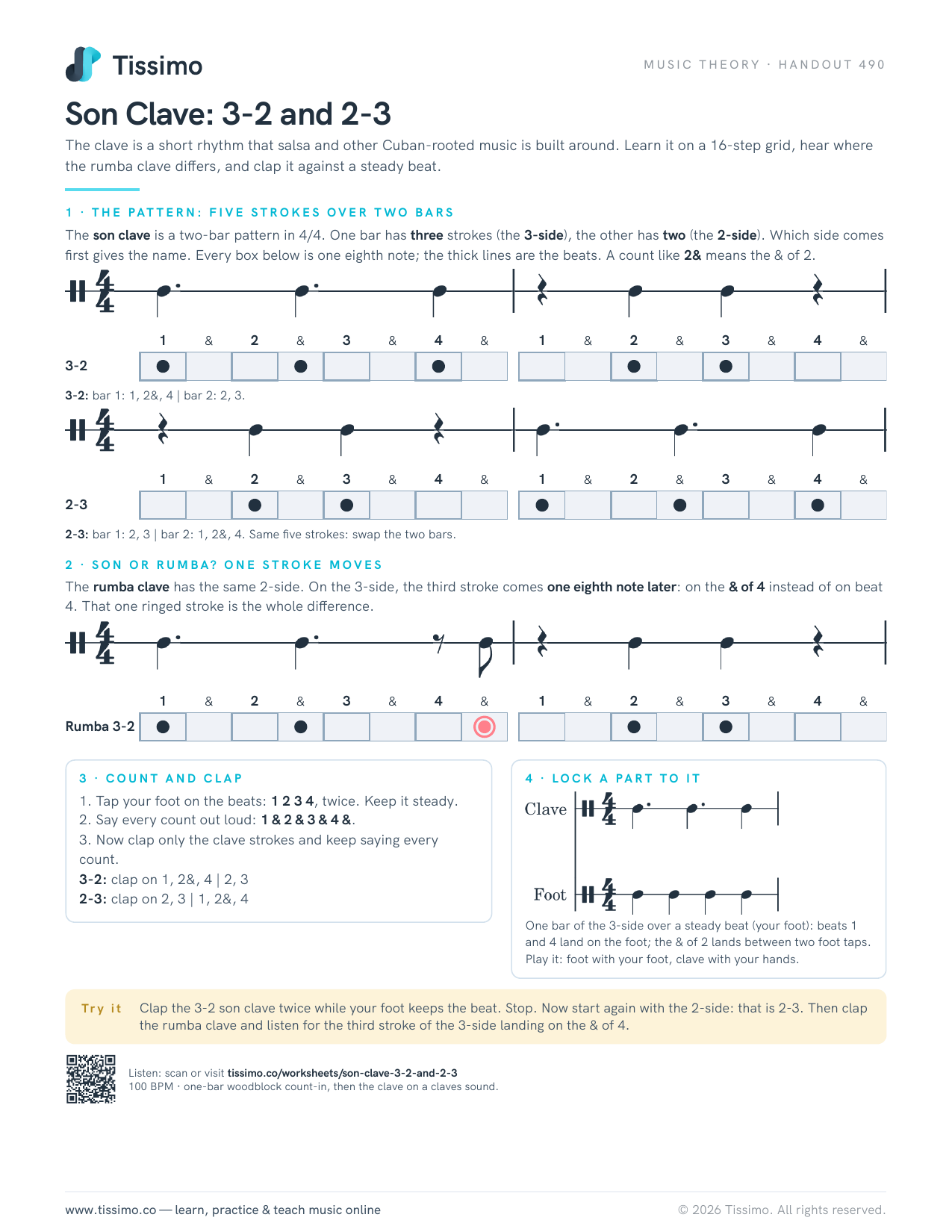 Son Clave: 3-2 and 2-3The clave is a short rhythm that salsa and other Cuban-rooted music is built around. Learn it on a 16-step grid, hear where the rumba clave differs, and clap it against a steady beat.
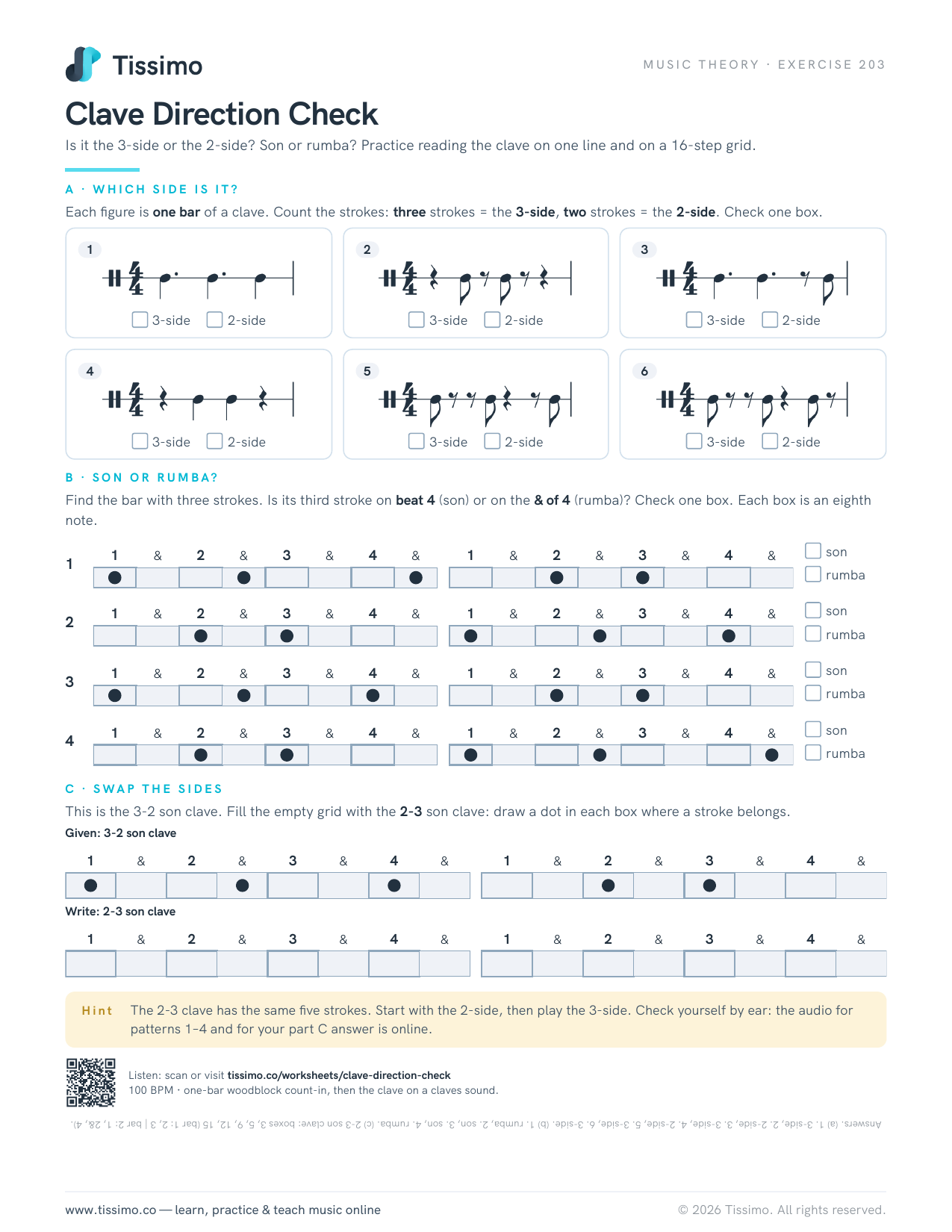 Clave Direction CheckIs it the 3-side or the 2-side? Son or rumba? Practice reading the clave on one line and on a 16-step grid.
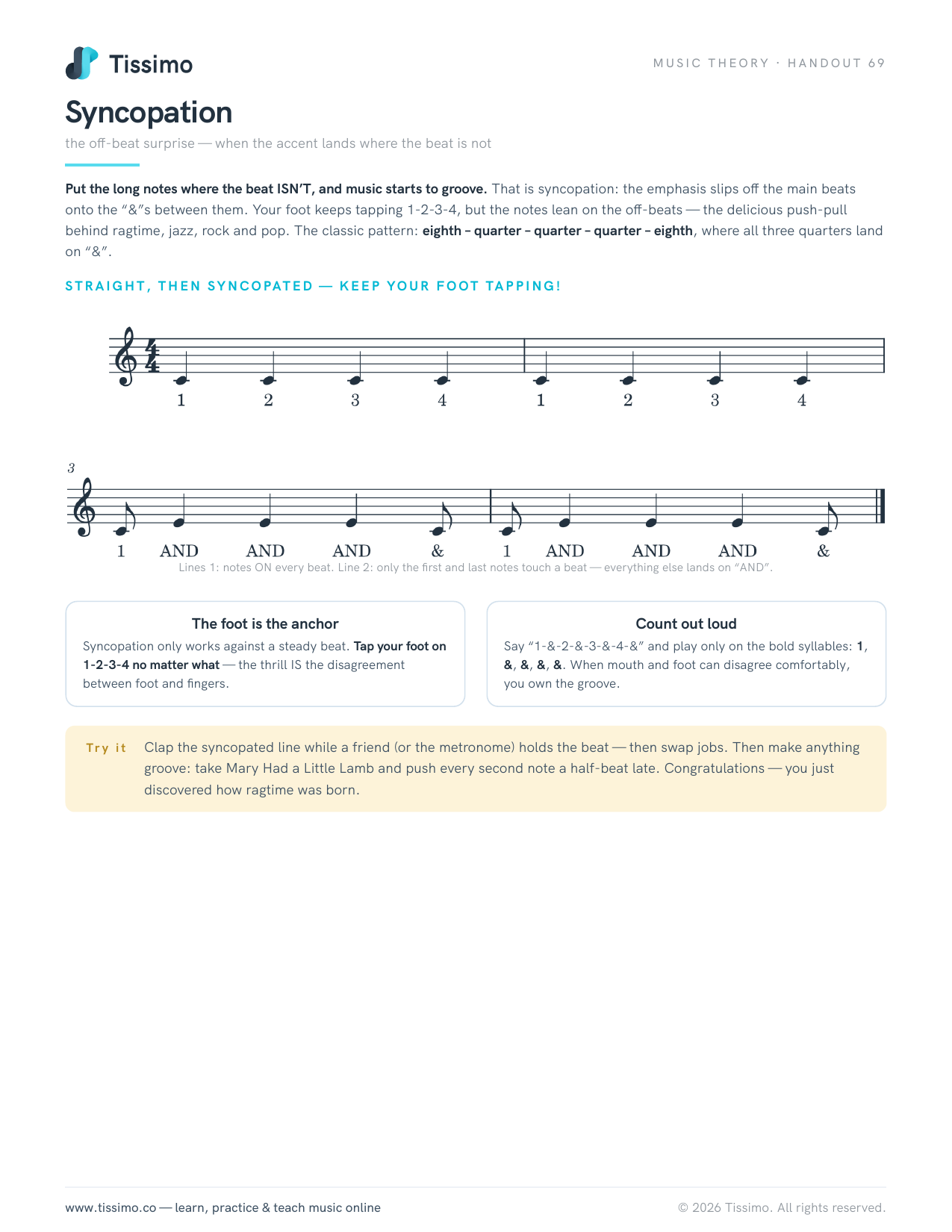 Syncopationthe off-beat surprise — when the accent lands where the beat is not
Comments