Rhythm & Meter
Habanera Rhythm
Pronounced ah-bah-NEH-rah
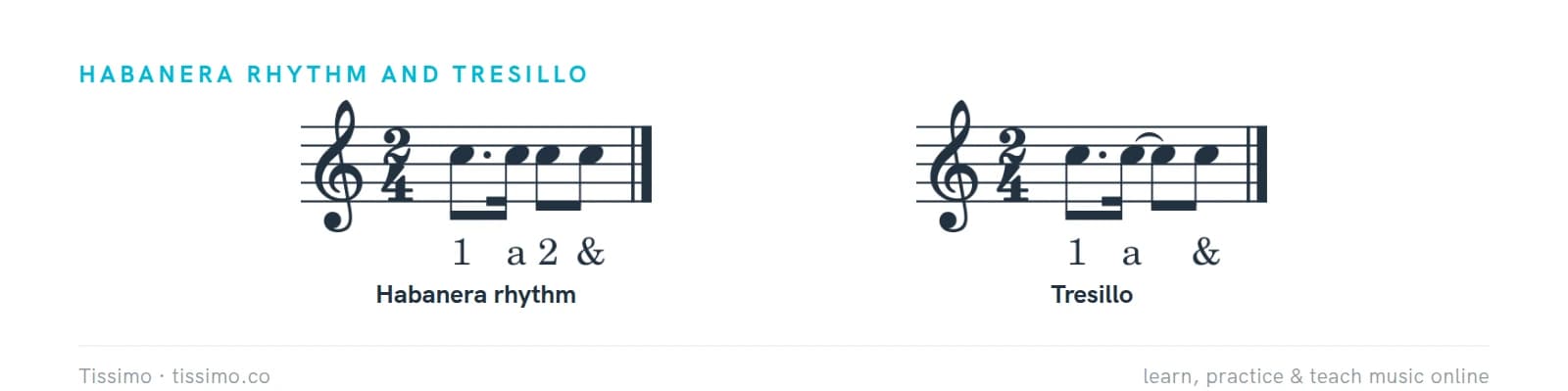
The habanera rhythm is a one-bar figure in 2/4: a dotted eighth, a sixteenth and two eighth notes. Named after the habanera, a 19th-century Cuban dance and song, it is often played in the bass.
The habanera rhythm fills one bar of 2/4 with four notes: a dotted eighth on beat 1, a sixteenth just before beat 2, and two eighth notes on beat 2 and its "&". Counted in sixteenths, "1 e & a 2 e & a", the notes fall on 1, the "a" of 1, 2 and the "&" of 2. Repeated bar after bar, often in the bass, it gives music a lilting, swaying motion.
Where the name comes from
The rhythm is named after the habanera (Spanish for "from Havana"), a Cuban dance and song genre of the 19th century, closely tied to the Cuban contradanza. In the European contradanza the accompaniment often moved in plain, even eighth notes; by most accounts, Black musicians in Cuba reshaped that steady pattern into this figure, though exactly when is not settled. The figure spread widely. The same figure is also found in the Spanish tango of Andalusia, and some writers call it the "tango rhythm".
The most famous habanera in classical music is the one sung by the title character of Bizet's opera Carmen (1875): the habanera rhythm is heard right at the start, in the low instruments.
Habanera and tresillo
The habanera rhythm is closely related to the tresillo. Written in 2/4, tresillo is a dotted eighth, a sixteenth tied to an eighth, and an eighth. Remove the tie, so that beat 2 is struck again, and you have the habanera rhythm. In both, the sixteenth before beat 2 is the syncopated note that gives the figure its lift.
A habanera bass line
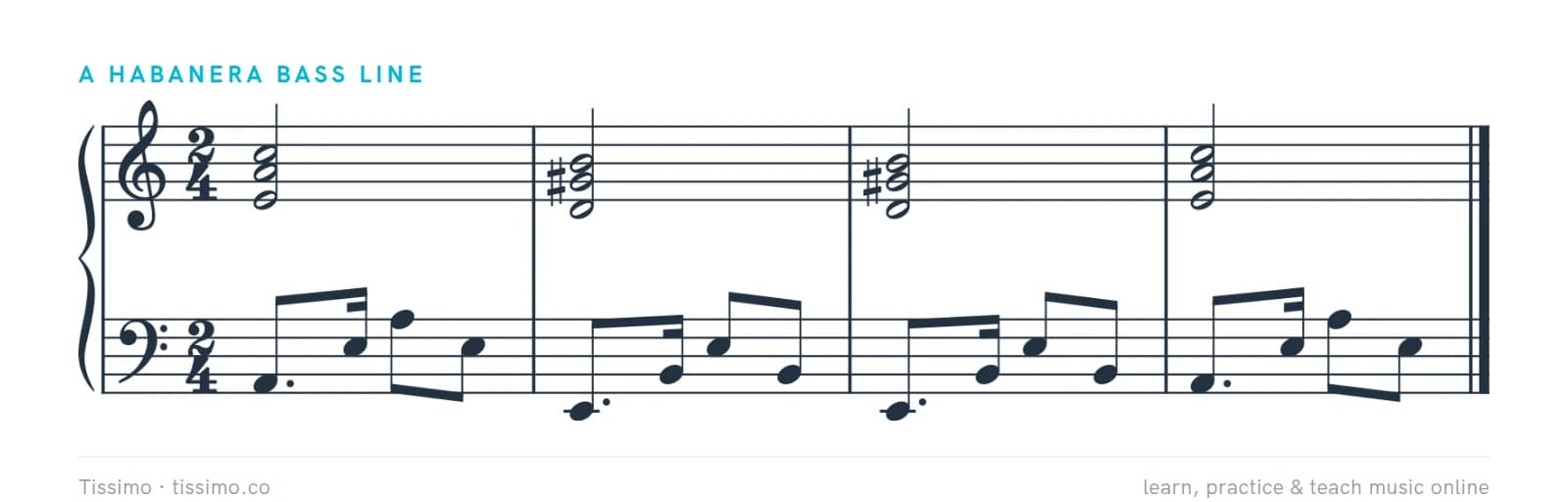
On the piano the left hand usually carries the rhythm, often moving between the notes of the chord, while the right hand plays the chords or the melody above it. Keep the dotted eighth full length and the sixteenth light and late, right before beat 2; if the two eighth notes on beat 2 are steady, the bar sways without rushing.
Common questions
What is the habanera rhythm?
A one-bar figure in 2/4: a dotted eighth, a sixteenth and two eighth notes, on 1, the "a" of 1, 2 and the "&" of 2. It comes from the habanera, a 19th-century Cuban dance and song.
What is the difference between habanera and tresillo?
One note. In 2/4, tresillo ties the sixteenth over into beat 2; the habanera rhythm strikes beat 2 again, giving four notes instead of three.
Comments