Form & Structure
Toccata
Pronounced tuh-KAH-tuh
A toccata is a showpiece, usually for a keyboard instrument, built on fast, brilliant passagework that displays the player's touch. The name comes from the Italian toccare, to touch, and is one of the oldest names for a keyboard piece.
A toccata is a keyboard piece that shows off the player's touch: fast runs, broken chords and repeated notes, played with speed and precision. It is one of the oldest names for a keyboard piece. The word first appeared in print in a lute book of 1536, and the earliest printed keyboard toccatas, by Sperindio Bertoldo, date from 1591.
The early toccata
The first toccatas were often short and free, close to a prelude: a player tried out the instrument, the key and the fingers before something else. In the 16th century toccata could even mean much the same as prelude or fantasia. In Rome, Girolamo Frescobaldi published his first book of toccatas in 1615. His toccatas string together sections of brilliant runs and calmer passages in several voices, and his preface asks the player to take the tempo freely, according to the feeling of each passage. That improvisatory freedom stayed with the toccata for a long time.
The word was not only for keyboards: Monteverdi's opera Orfeo (1607) opens with a short Toccata for trumpets.
Bach and the organ toccata
In the Baroque period the toccata was often joined to a fugue. Bach wrote toccatas and fugues for the organ and a set of multi-movement toccatas for harpsichord. The most famous of all, the Toccata and Fugue in D minor, BWV 565, has long been attributed to Bach, but since 1981 some scholars have questioned whether he wrote it; others defend the attribution, and the question is still open.
Later toccatas
Many later toccatas are perpetual-motion pieces, driving forward without a pause:
- Schumann: Toccata in C major, Op. 7, a nonstop study in double notes (two notes at a time in one hand).
- Widor: the Toccata that ends his Organ Symphony No. 5, with nonstop sixteenth notes in the right hand over a melody that leaps in octaves in the pedals.
- Prokofiev: the Toccata, Op. 11 (1912), a perpetual motion that he said was inspired by Schumann's, although the two share little beyond their repeated sixteenth notes.
How a toccata keeps moving
Many toccatas keep up a nonstop stream of fast notes. One way to make it possible at speed is to let the hands take turns, so that neither hand has to repeat notes alone.
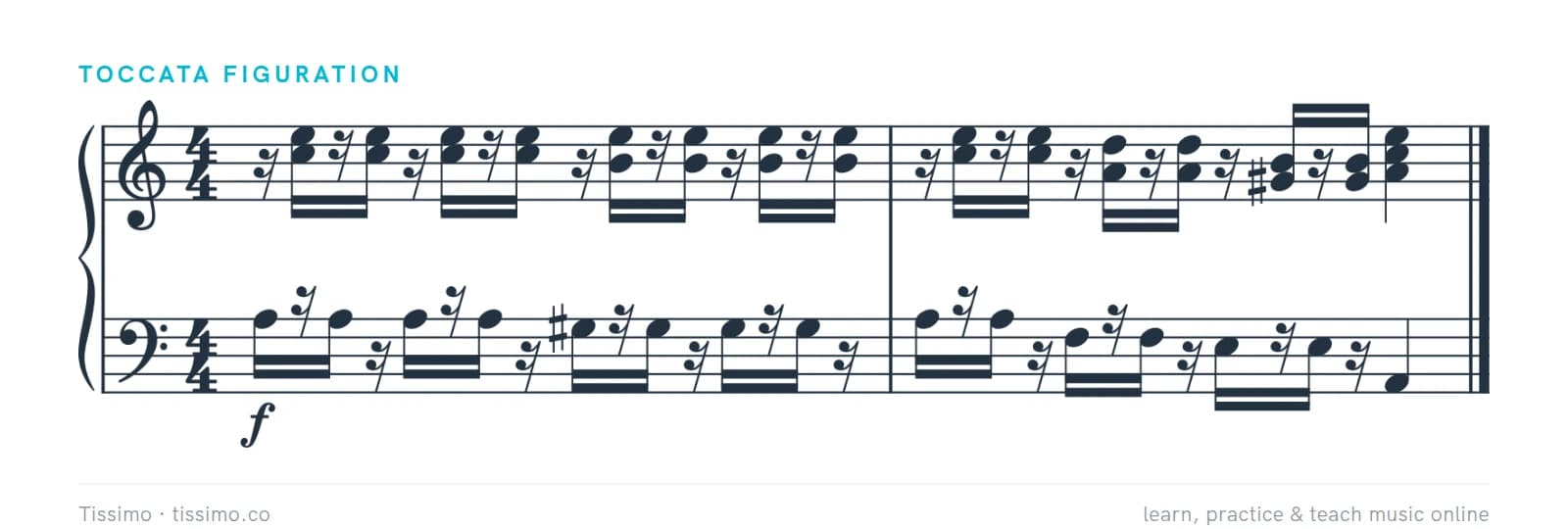
Practice a passage like this slowly, with each hand alone and then together, until the stream sounds perfectly even; the hands should sound like one player. Études build the same skills.
Common questions
What does toccata mean?
It comes from the Italian toccare, "to touch": a toccata is a keyboard piece that shows off the player's touch, with fast, brilliant passagework.
Did Bach write the Toccata and Fugue in D minor?
It has long been known as Bach's, BWV 565, but since 1981 some scholars have questioned the attribution, while others defend it. The question has not been settled.
Comments