Chords & Harmony
Picardy Third
A Picardy third is the raised third in a major tonic chord used to end a minor-key piece or section. It changes the expected minor tonic into major while keeping the same tonic note.
A Picardy third changes the quality of a minor-key ending by making its final tonic chord major. The tonic itself stays the same; the chord's third rises by one half step. The French name is tierce de Picardie.
The note that changes
In D minor, the tonic triad is D–F–A. For a Picardy-third ending, use D–F♯–A instead. D remains the tonic, and A remains the fifth. F♯ is the changed note, producing a major third above D rather than a minor third.
In roman numeral analysis, the final tonic is written I instead of i. The major chord belongs to the parallel major, not the relative major: the relative major of D minor is F major, which has a different tonic.
An ending, not just any major chord
The device is associated with a closing tonic, at the end of a piece or a section. A major dominant in a minor key is not a Picardy third, because it is not the tonic. A passage that establishes the parallel major for an extended section is a broader change of mode, rather than merely a changed final chord.
Try it
Play D minor, G minor, A major, D minor. Repeat the progression but finish with D major. Keep the tempo, voicing and loudness similar so you can hear the effect of F becoming F♯. Mark the altered third on paper and compare the two endings without changing the bass note.
Common questions
Does a Picardy third change the tonic?
No. It changes a closing minor tonic chord into major by raising its third. D minor ends on D major, for example, not on its relative major, F.
Practice it: free worksheets
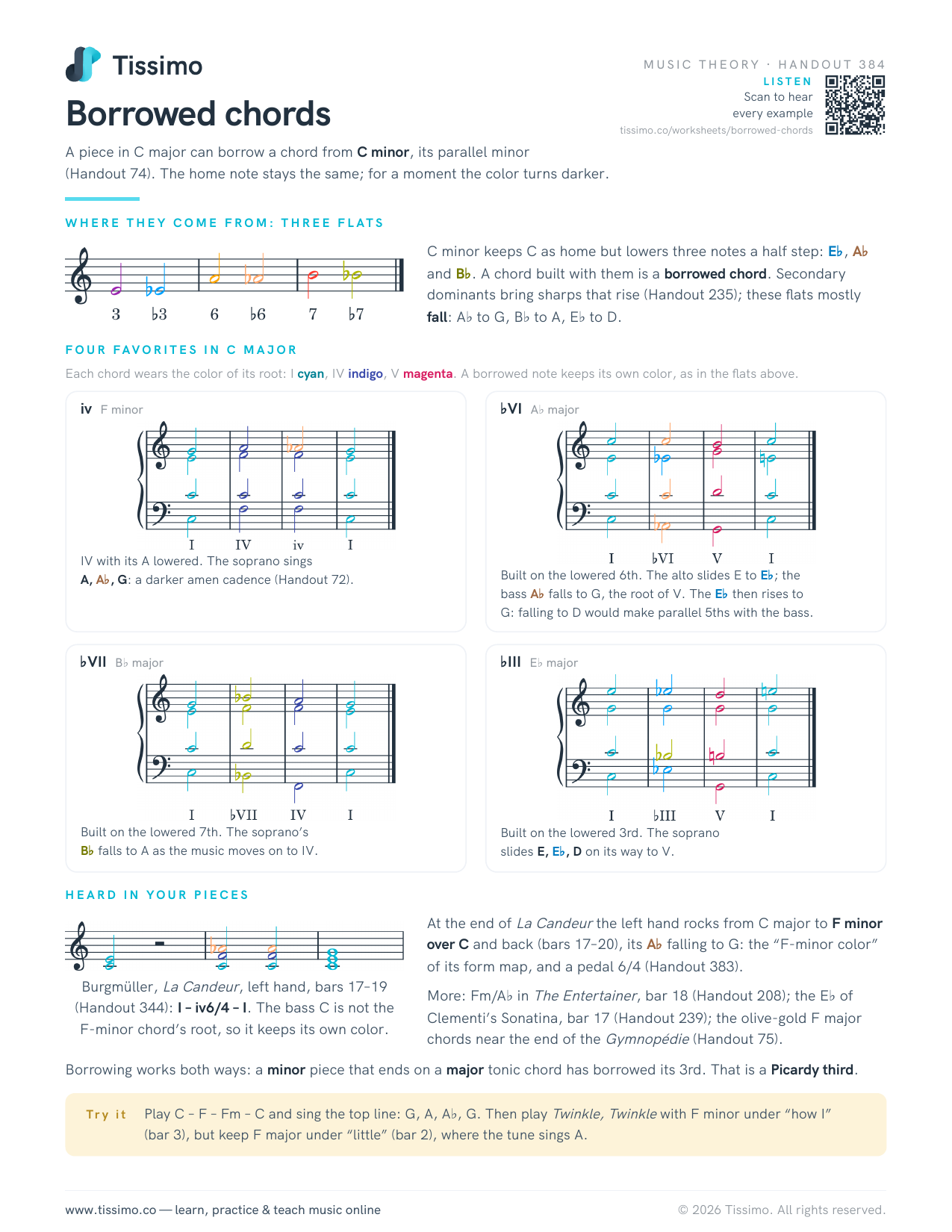 Borrowed chordsA piece in C major can borrow a chord from C minor, its parallel minor (Handout 74). The home note stays the same; for a moment the color turns darker.
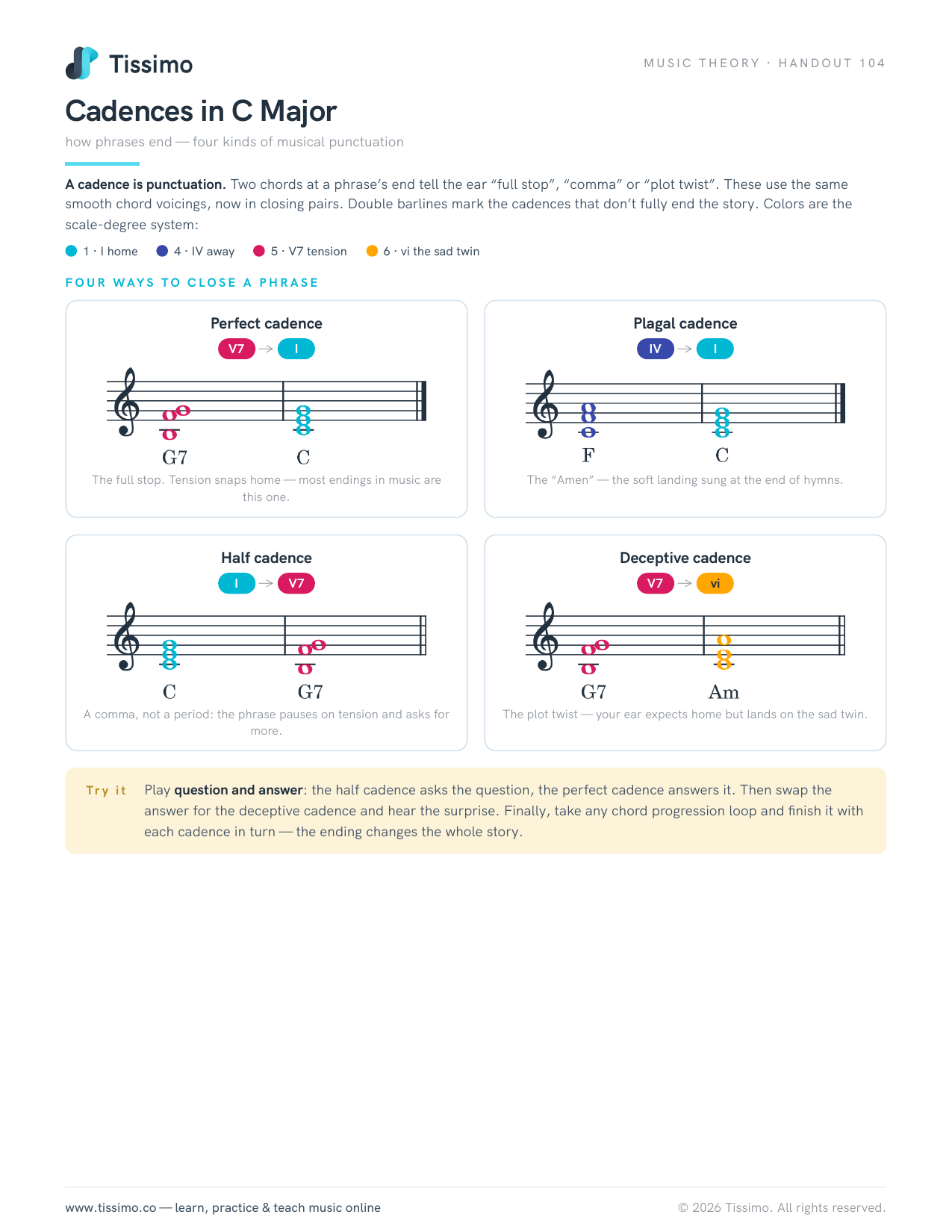 Cadences in Every KeyHow phrases end — the four kinds of musical punctuation, written out in all 24 keys.
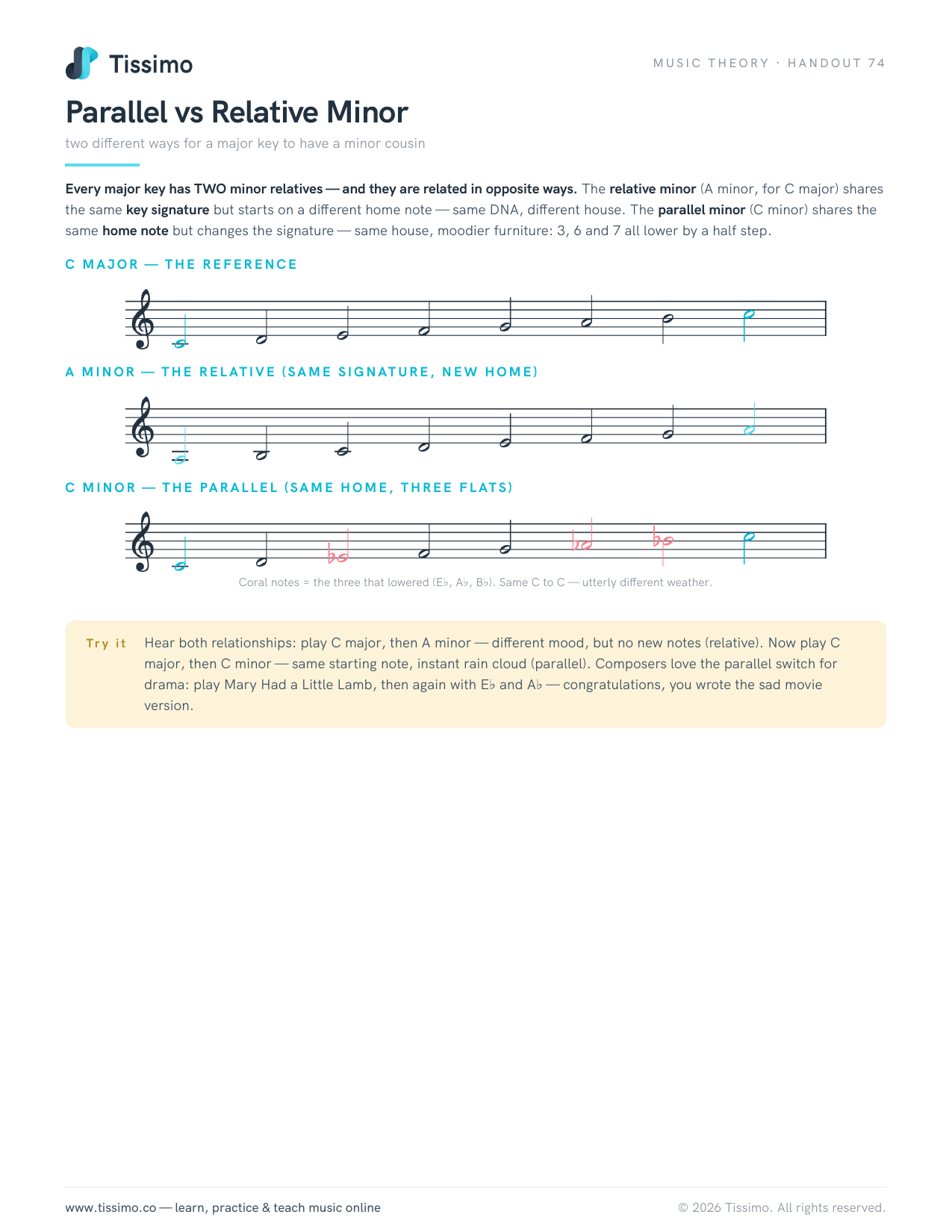 Parallel vs Relative Minortwo different ways for a major key to have a minor cousin