Melody, Texture & Counterpoint
Obbligato
Pronounced ob-lih-GAH-toh
Obbligato marks an instrumental part that must be played because the music depends on it, most often an independent solo line that accompanies a singer, such as a violin obbligato in an aria.
Obbligato is Italian for "obligatory". Written after the name of an instrument, as in violin obbligato or cello obbligato, it says that the part is essential: it cannot be left out, and it is usually prominent and individual rather than a plain accompaniment. The French equivalent is obligé.
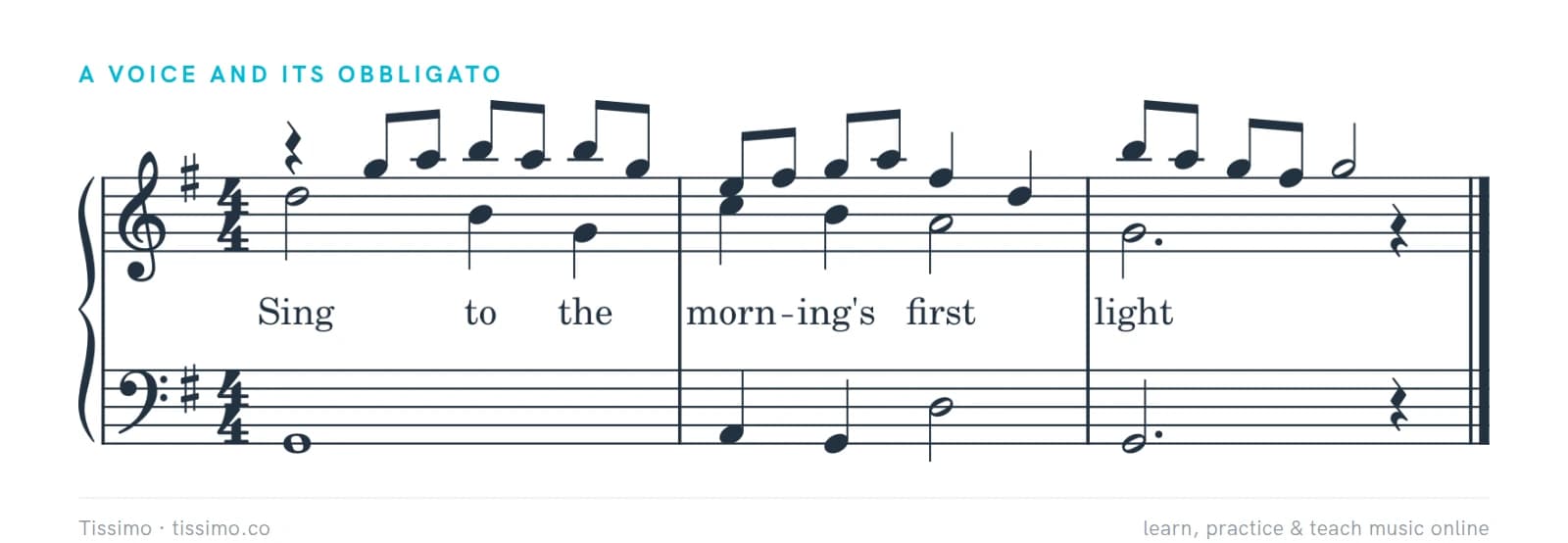
The obbligato aria
The word is most at home in Baroque vocal music. In an aria with an obbligato instrument, a solo violin, flute, oboe, trumpet or horn plays its own melody alongside the singer, often as elaborate as the voice part itself, while the continuo supplies the bass and harmony. The two soloists imitate, answer and decorate each other.
Bach's Mass in B minor has well-known examples: the Laudamus te, for soprano with a violin obbligato, and the Quoniam, for a low male voice with a horn obbligato. You also meet the word in recitative: an accompanied recitative, with written-out orchestral parts rather than continuo alone, is sometimes called recitativo obbligato.
Obbligato and other added lines
- A countermelody is any secondary melody heard against the main tune. An obbligato part usually carries one, but the word obbligato is about the status of the part: it is required, and it often belongs to a named solo instrument.
- An accompaniment supports the melody; an obbligato competes with it on almost equal terms.
- Ad libitum is the opposite instruction: a part marked ad lib. may be left out.
A common confusion
Some later printed music uses obbligato for an optional extra line, the reverse of its meaning. The Concise Oxford Dictionary of Music calls that use wrong, and the same goes for the spelling obligato, which you will still see in programs and sheet music. If a part is truly optional, it should say ad libitum.
When you play an obbligato, think like a duet partner, not an accompanist. Your line has its own shape and should be heard, but it must leave room for the singer's words and breathe with the singer's phrases.
Common questions
Does obbligato mean optional?
No. It means obligatory: the part is essential and must be played. Using it for an optional part reverses its meaning; the instruction for an optional part is ad libitum.
Is it spelled obbligato or obligato?
Obbligato, with a double b, is the Italian spelling and the one music dictionaries use. Obligato is a common variant spelling, which the Concise Oxford Dictionary of Music calls wrong.
Comments