Form & Structure
Motet
Pronounced moh-TET
A motet is a piece for several voices, usually unaccompanied, on a sacred text that is not one of the fixed texts of the Mass. It began in the 13th century and reached its height in the Renaissance.
A motet is a choral piece for several voices, usually unaccompanied, that sets a short sacred text. A Mass setting uses the fixed texts of the service; a motet usually sets other words, such as a psalm, a prayer or a text for a particular feast. In its long history the motet has changed more than almost any other genre.
The medieval motet
The motet began in the 13th century, when new words were added to existing polyphony. Its lowest voice, the tenor, sang a fragment of chant in long notes. Above it, one or more voices sang faster lines, often each with its own text, in Latin or French, sacred or secular, all at the same time. The upper voice with the added words was called the motetus (from French mot, "word"), and the name passed to the whole piece. Guillaume de Machaut was one of its masters (see medieval music).
The Renaissance motet
After about 1400 the motet became a polyphonic setting of a short sacred text. Ockeghem, Josquin des Prez, Palestrina, Victoria, Tallis and Byrd were among its great composers, and in the 16th century it reached its peak (see Renaissance music). In a typical Renaissance motet the voices enter one after another on the same melody, often starting on a different note: a point of imitation. A new phrase of the text brings a new point, and here and there all the voices come together in chords to make certain words stand out.
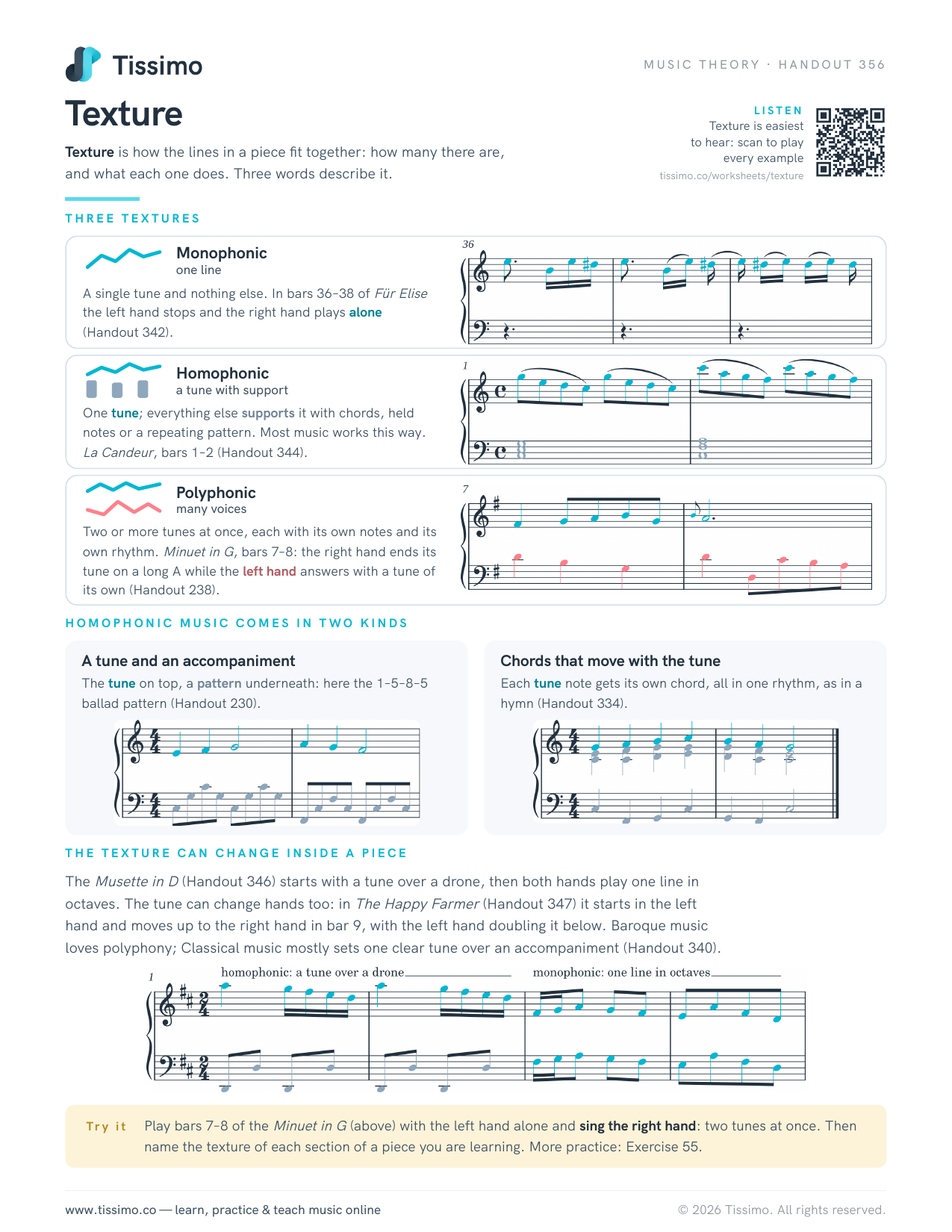
Many motets in this style are sung a cappella by a choir. To hear how the independent lines fit together, try the Texture worksheet.
Later motets
Bach wrote motets, among them Singet dem Herrn ein neues Lied, and four of his motets are for eight voice parts. Later composers used the word more loosely, for church pieces with accompaniment and even for solo songs, and a few motets have words that are not religious at all. Today a motet usually means a choral piece for church on a Latin text that is not fixed in the liturgy.
Motet, Mass or madrigal?
- A Mass sets the fixed texts of the Ordinary (Kyrie, Gloria, Credo, Sanctus, Agnus Dei); a motet sets other sacred words.
- A madrigal is the motet's secular counterpart: a poem about love, nature or a joke, in Italian or English instead of Latin.
- An anthem is the English-language counterpart that grew out of the Latin motet in the Anglican church: a piece for the choir alone, often with organ.
Common questions
What is the difference between a motet and a madrigal?
Both are pieces for several voices, usually unaccompanied. A motet sets a sacred text, traditionally in Latin; a madrigal sets a secular poem, usually in Italian or English.
Where does the word motet come from?
From French mot, "word." In the medieval motet, the motetus was the voice that sang new words above a chant melody, and its name passed to the whole piece.
Comments