Form & Structure
Hymn
A hymn is a religious song of praise, written in verses for a whole congregation to sing. Every verse is sung to the same tune, and hymnals often print that tune in four-part harmony.
A hymn is a song of praise to God, written for a whole congregation to sing. Strictly speaking, a hymn speaks to God or celebrates God, which sets it apart from a more personal devotional song. "A Mighty Fortress Is Our God" (Martin Luther) and "Immortal, Invisible, God Only Wise" (Walter C. Smith) are two well-known examples. Congregational hymn singing is central to many Protestant churches, among them the Lutheran, Methodist and Anglican traditions.
Words and tune
A hymn has two parts that often have different authors: the text (the words) and the tune (the music). In English hymnals, tunes have names of their own, often a town or a village: Ralph Vaughan Williams called his tune for "Come down, O love divine" Down Ampney, after the village where he was born.
Hymn meter
Each hymn also has a meter: the number of syllables in each line of a verse. The most common have abbreviations:
- C.M. (Common Meter): 8.6.8.6
- S.M. (Short Meter): 6.6.8.6
- L.M. (Long Meter): 8.8.8.8
- D after any of them (C.M.D., for example) means the pattern is doubled.
Because hymnals usually print the meter with each tune, the same words can be sung to a different tune with the same meter, as long as the stressed syllables fit the music.
How a hymn looks on the page
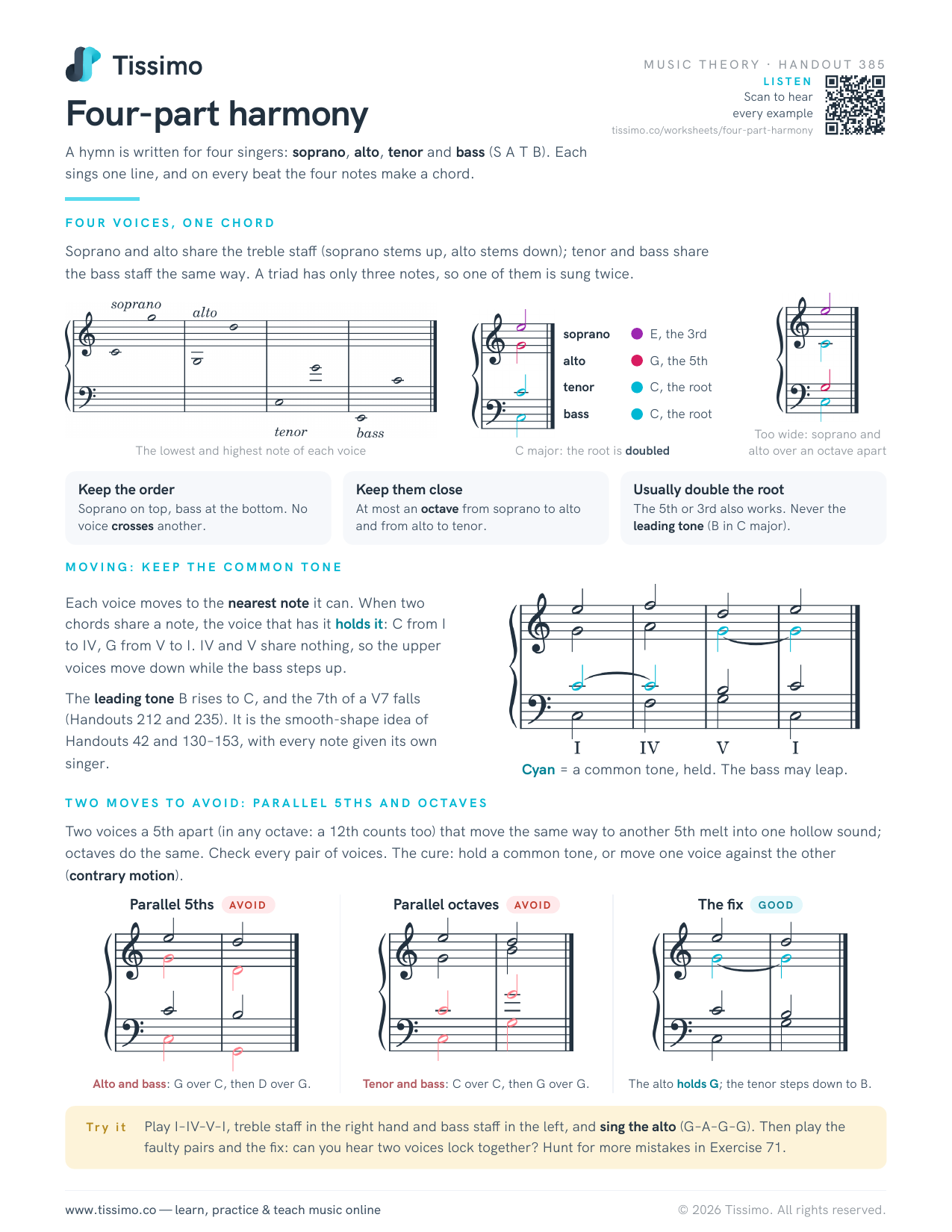
Hymnals often print the tune in four-part harmony, soprano and alto on the treble staff, tenor and bass on the bass staff, with the words of each verse stacked between the staves. Nearly every syllable gets its own chord, so the texture is homophonic, and the sound is that of four-part harmony.
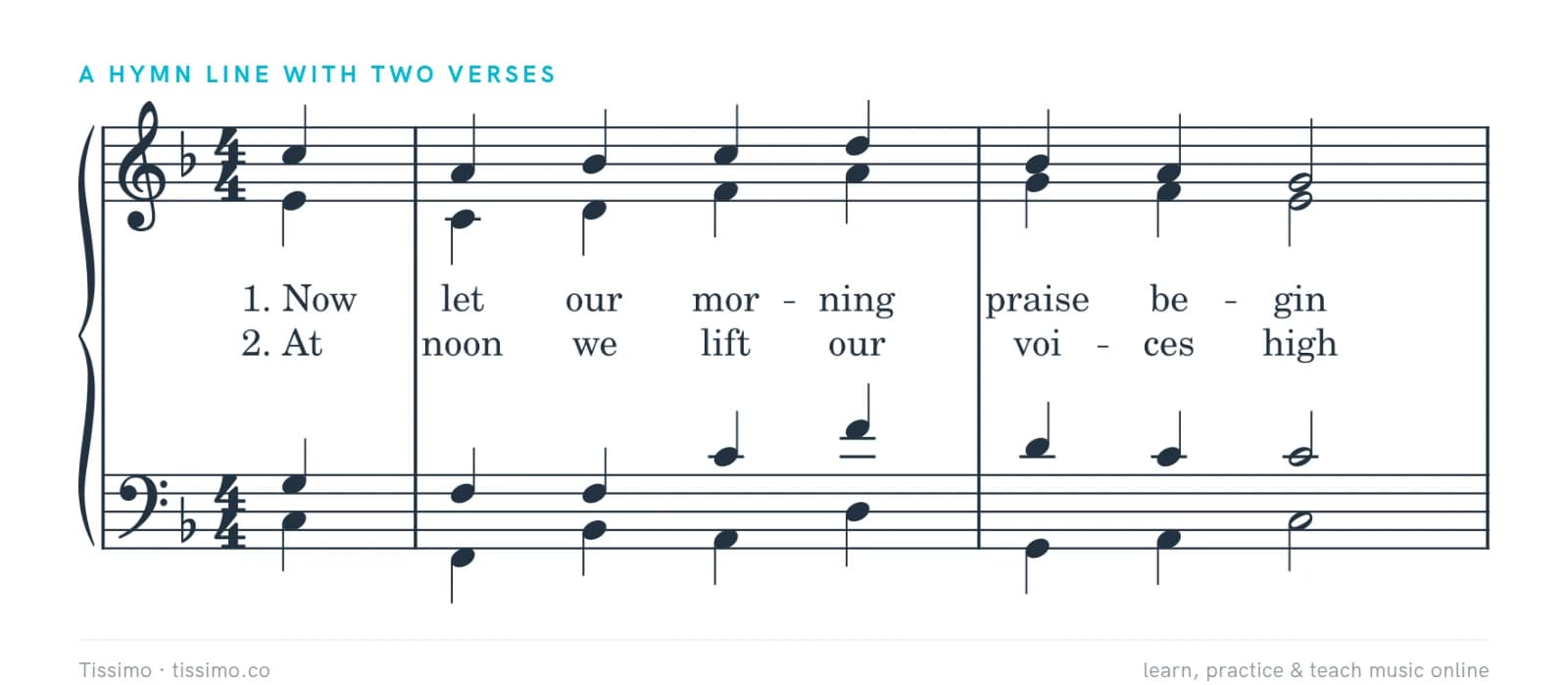
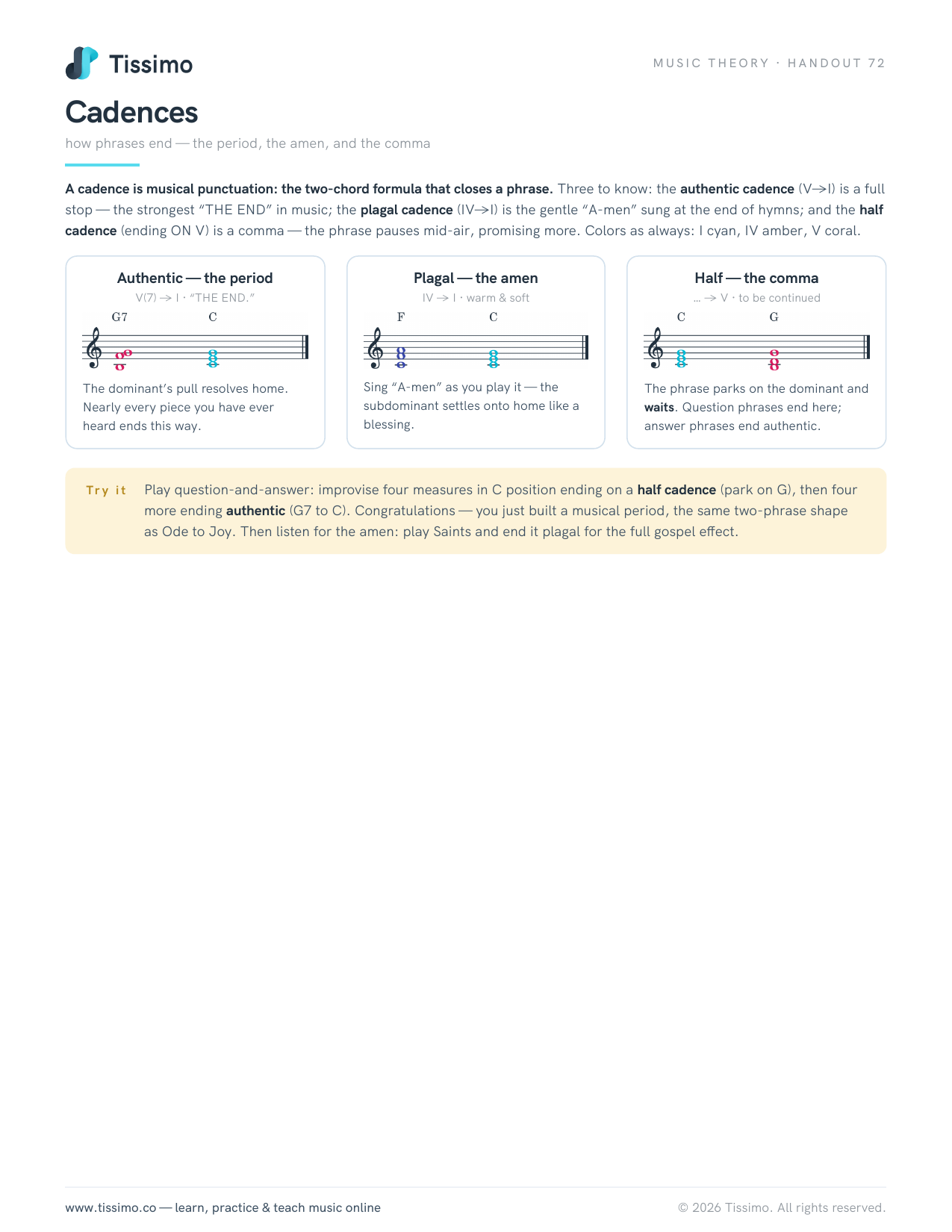
Every verse is sung to the same music, which makes a hymn strophic. Many traditional hymns close with an "Amen" set to IV–I, the plagal cadence. To practice writing in hymn style, try Four-part harmony and Cadences.
Hymn, chorale or carol?
- A chorale is a hymn of the German Lutheran church; in music theory the word often means a four-part setting like Bach's.
- A carol is a festive song, today above all for Christmas. Many carols are sung as hymns in church.
- Writers on hymns sometimes set a hymn in the strict sense apart from a gospel song or a more personal devotional song.
Common questions
What is the difference between a hymn and a song?
A hymn is a particular kind of song: a religious song of praise, written in verses for a congregation to sing together, with every verse sung to the same tune.
What does 8.6.8.6 mean in a hymnal?
It is the hymn's meter: eight syllables in the first line, six in the second, eight in the third and six in the fourth. This pattern is called Common Meter (C.M.).
Comments