Instruments & Voices
Flugelhorn
The flugelhorn is a valved brass instrument in B-flat, close to the trumpet but with a wider, almost fully conical bore and a darker, mellower tone. It sounds a major second lower than written.
The flugelhorn is a member of the brass family played much like a trumpet: you buzz into a cup mouthpiece and use three valves with the same fingerings. Its tubing, though, widens steadily almost all the way from the mouthpiece to the bell (apart from the valve tubing), and its mouthpiece has a deeper cup. The result is a round, dark, velvety sound, closer to a horn than to a trumpet.
Written and sounding pitch
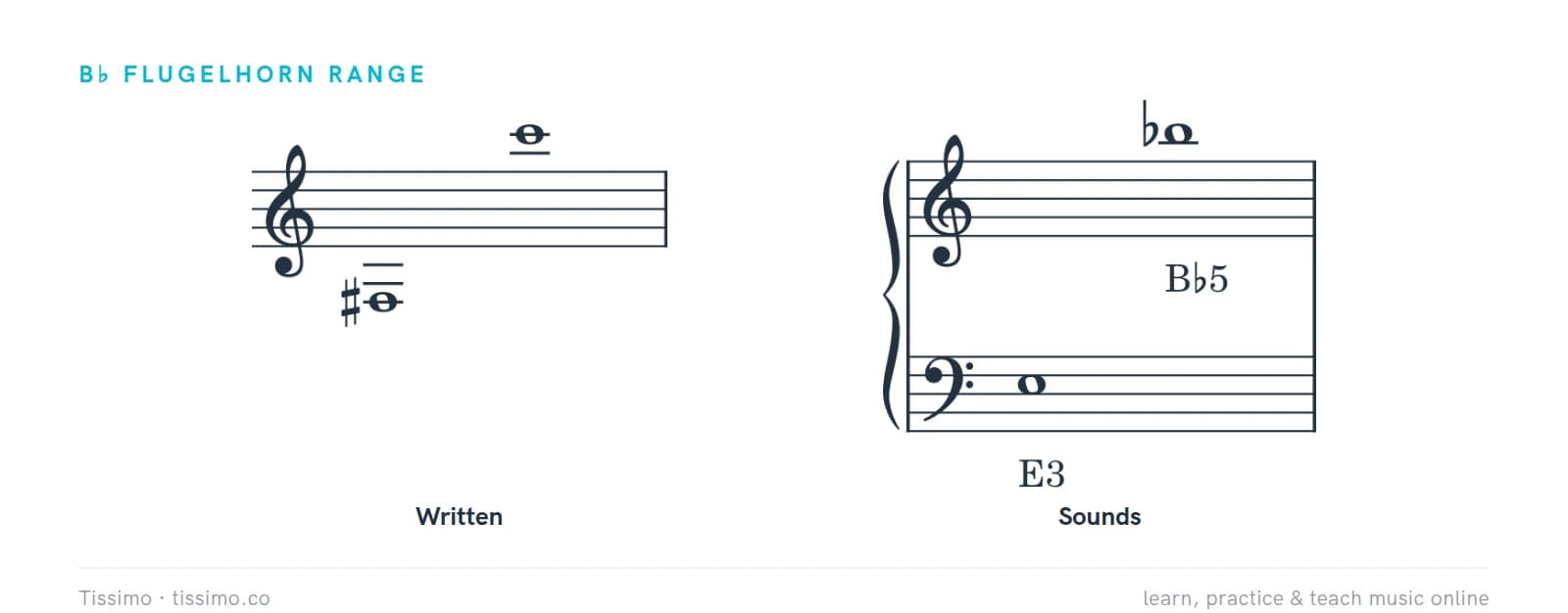
Like the trumpet and the cornet, the flugelhorn is in B♭ and reads treble clef parts a major second above concert pitch: written C sounds B♭. Its written range matches the trumpet's, from F♯3 to about C6, sounding E3 to B♭5, but the top notes are harder to play than on the trumpet. Some flugelhorns have a fourth valve that lowers the pitch a perfect fourth and extends the range downward.
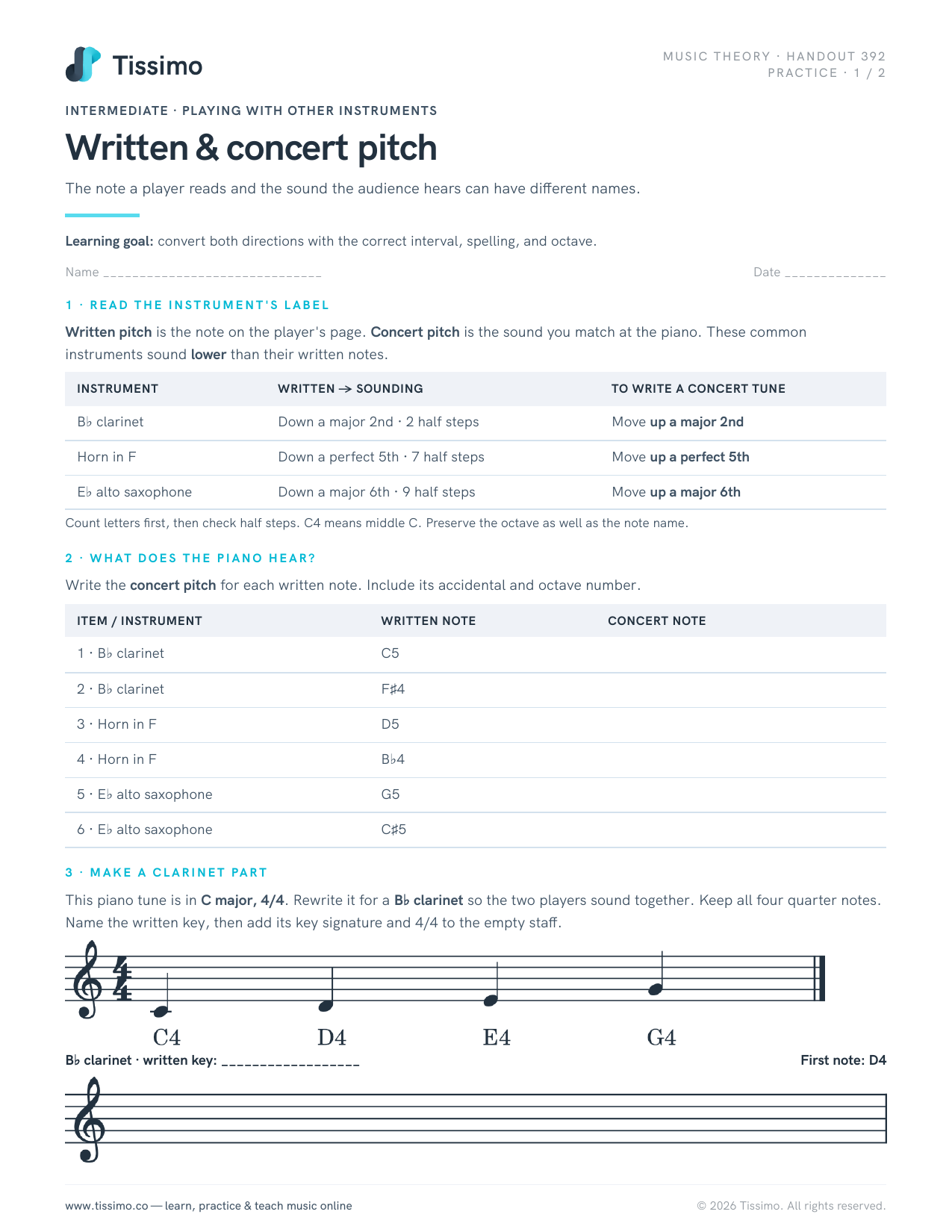
Practice reading these parts at concert pitch with Written & Concert Pitch.
Where you hear it
In a British-style brass band, one flugelhorn forms a bridge between the cornets and the tenor horns, and it often plays solos. In jazz, trumpet players have used the flugelhorn as a second, softer voice since the mid-20th century, and it has a place in bands, big bands and popular music.
A common confusion
The trumpet, cornet and flugelhorn share a key, a range and fingerings, so the difference is mostly in the bore and the tone. The trumpet's tubing is mostly cylindrical and its sound the brightest. The cornet's is about two-thirds conical and mellower. The flugelhorn's is almost entirely conical and the darkest. A trumpeter can switch between them quickly, but each one needs its own mouthpiece.
Common questions
What is the difference between a flugelhorn and a trumpet?
They use the same fingerings, key (B♭) and written notes, but the flugelhorn's tubing widens almost all the way to its bell and its mouthpiece is deeper. That gives a darker, softer, mellower sound, and high notes are harder to reach.
Is the flugelhorn a transposing instrument?
Yes. The usual flugelhorn is in B♭, so its part is written a major second higher than it sounds: a written C sounds as concert B♭, as on the B♭ trumpet.
Comments