Melody, Texture & Counterpoint
Word Painting
Word painting is setting words to music that imitates their meaning: a melody that rises on "ascend," falls on "down," runs on "running" or sings alone on "alone."
Word painting is the art of making the music do what the words say. When the text speaks of rising, the melody climbs; when it speaks of falling, it sinks; a word like "running" gets quick notes, and "alone" may be sung by a single voice. The listener hears the meaning as well as the word. It is also called text painting, or tone painting, a name that is sometimes used more broadly for music that depicts things without words.
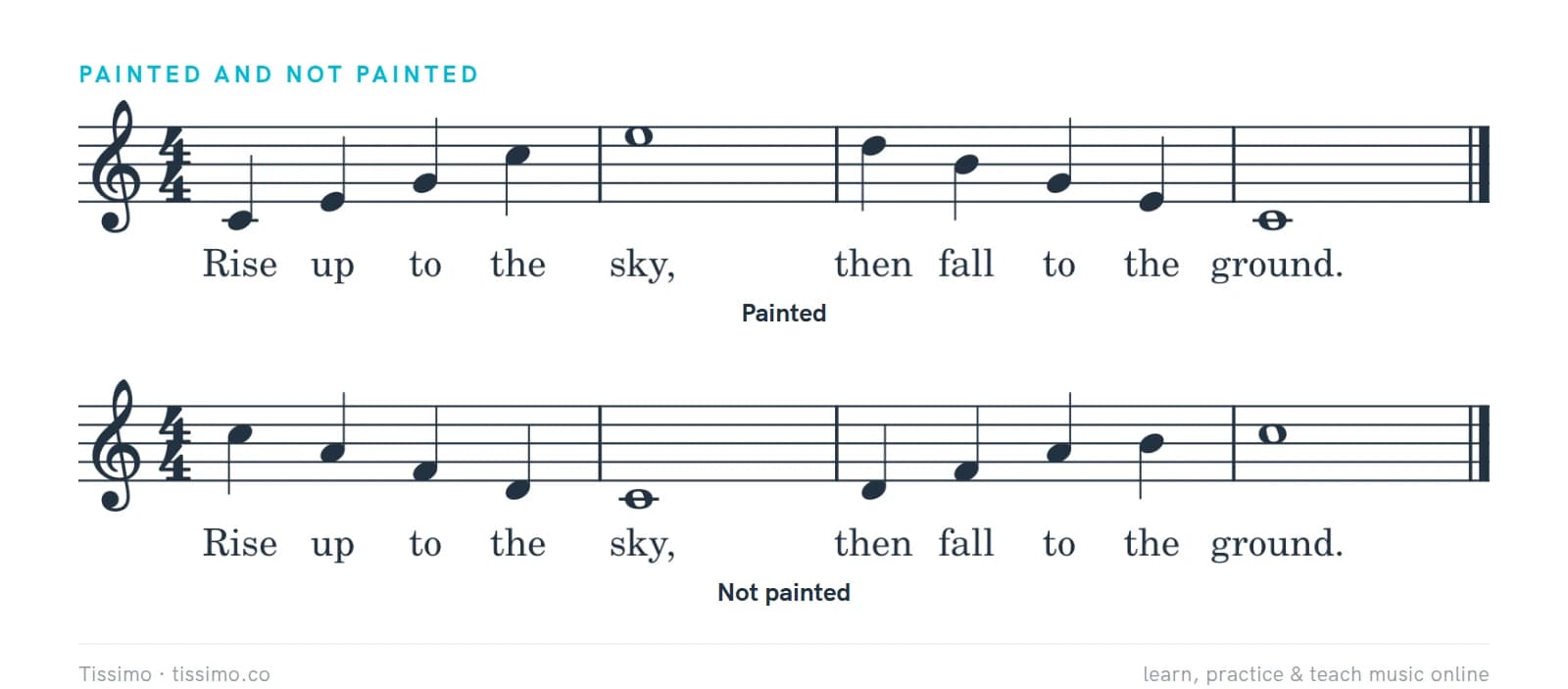
Ways to paint a word
- Direction: up for "rise," "heaven," "high"; down for "fall," "descend," "low." This is the most common kind, and it works through the contour of the line.
- Speed and rhythm: fast notes for "running" or "flying," long held notes for "rest" or "forever."
- Number of voices: one voice on "alone," two on "two by two," everyone together on "all."
- Harmony: a sudden dissonance on "pain" or "grief," a minor key for sorrow and a major one for joy.
- Melisma: a long run of notes on one syllable, a melisma, can make a word like "glory" shine.
Madrigals and Messiah
Word painting became so typical of the Italian and English Renaissance madrigal that such devices are sometimes called madrigalisms. In Thomas Weelkes's madrigal "As Vesta Was from Latmos Hill Descending" (1601), the voices descend on "descending" and ascend on "ascending," and the number of singers follows the words "two by two," "three by three" and "all alone."
Baroque composers kept the habit. In the tenor aria "Ev'ry valley" from Handel's oratorio Messiah, "exalted" is a long rising melisma, "mountain" goes high and "low" goes low, "crooked" wavers between two notes, and "straight" and "plain" are held on long notes.
Word painting today
Composers of art songs, film songs and musicals still use it, and so do songwriters: listen for a melody that jumps up on "fly" or drops on "down." Like any device it works best in moderation. If every word is painted, the music can sound like a cartoon.
Common questions
What is an example of word painting?
In Handel's Messiah, the aria "Ev'ry valley" sets "exalted" to a long rising run, puts "mountain" high and "low" low, and makes "crooked" waver and "plain" hold still. Weelkes's madrigal "As Vesta Was from Latmos Hill Descending" has descending lines on "descending" and rising ones on "ascending."
What is a madrigalism?
Another name for word painting, from the Renaissance madrigal, where composers illustrated the meaning of the words so often that the devices came to be named after the genre.
Comments