Melody, Texture & Counterpoint
Leitmotif
Pronounced LITE-moh-teef
A leitmotif is a short musical idea linked to a character, object, place or feeling in an opera or film. It returns whenever its subject appears, often changed to fit the drama.
A leitmotif is a short musical idea that stands for something in a story: a character, an object, a place, an idea or a feeling. Each time the music brings it back, you are reminded of what it stands for, even when the words or the pictures say nothing about it. The German spelling is Leitmotiv; English writers usually spell it leitmotif.
What makes a motif a leitmotif
Any motif is a short, recognizable idea. A leitmotif is a motif with a meaning attached. What defines it is not its length but its job in the drama: it is introduced together with its subject, and from then on it can point to that subject, recall it, or hint that it is near.
How a leitmotif changes
A leitmotif rarely comes back exactly the same. Composers change it to follow the story: in a minor key when things go badly, slower and softer in a moment of memory, upside down or broken into fragments when its subject is under threat. The example shows one original two-bar idea in minor, slowed down and turned upside down.
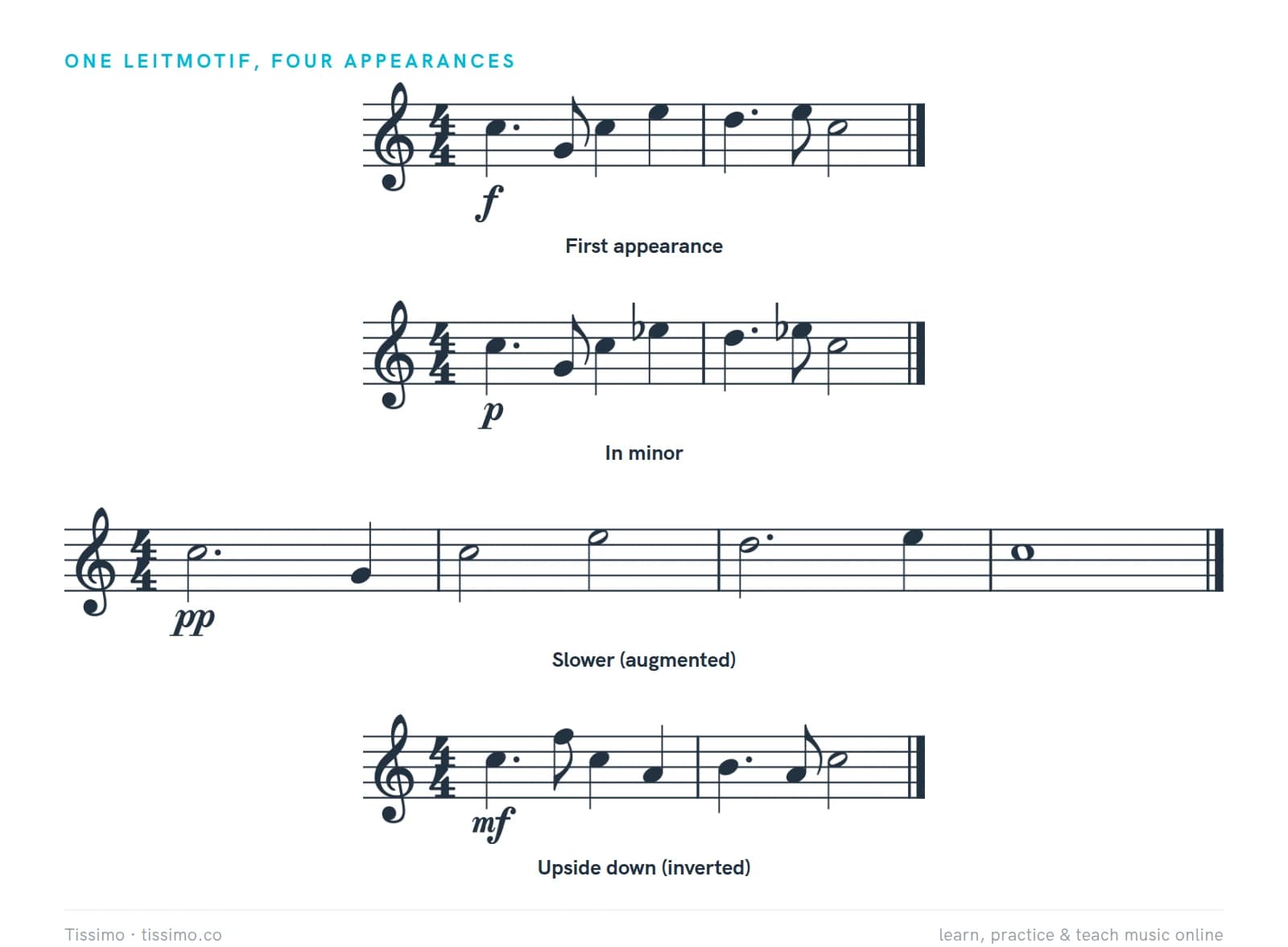
Listen for what changes and ask what it tells you. The instrument matters too: the same idea played by quiet strings and by loud brass can mean very different things.
Wagner and the Ring
Composers such as Weber and Berlioz used recurring themes before him (Berlioz called the theme of his Symphonie fantastique an idée fixe), but Richard Wagner made the technique the backbone of his music dramas, above all the four-opera Ring cycle. Many leitmotifs combine and transform there into a continuous orchestral web. In the final scene of Die Walküre, for example, a descending line in the low brass stands for the god Wotan's spear, and quick figures in the high woodwinds for the fire he summons.
The word itself came from writers about Wagner, not from Wagner. The familiar names for the Ring's leitmotifs, such as "the Sword" or "Fate," were spread by guidebooks like Hans von Wolzogen's, published for the cycle's first performances, and scholars still argue about some of the labels.
Leitmotifs in film
Film composers took the idea over. John Williams's music for Star Wars (1977) gives characters their own themes, such as Princess Leia's, and later films return to them as the story moves on. When a theme in a film score comes back each time a character appears, it is working as a leitmotif.
Common questions
What is the difference between a motif and a leitmotif?
A motif is any short musical idea that a piece develops. A leitmotif is a motif tied to a meaning in a story, such as a character or an object, so that its return reminds you of that subject.
Is it spelled leitmotif or leitmotiv?
Both are used. Leitmotiv is the German spelling and means "leading motive"; leitmotif is the usual English spelling.
Comments