Technique & Performance
Scat Singing
Scat singing is jazz singing on wordless syllables such as "doo", "ba" and "bop", usually improvised. The singer uses the voice like a horn, inventing a solo over the chord changes.
In scat singing, a jazz singer leaves the words behind and sings on syllables that mean nothing, shaping each phrase the way a trumpet or saxophone player would. Scat is the usual way for a jazz singer to take an improvised solo: after the tune, the singer scats over its chord changes, just where an instrumentalist would play a solo. See improvisation.
The syllables
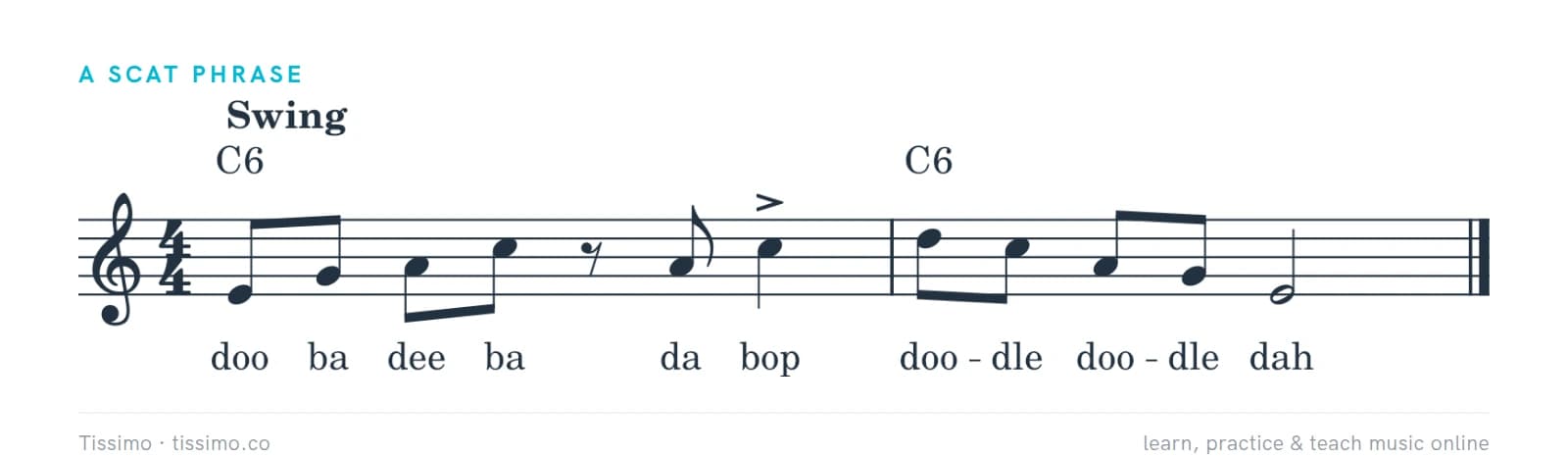
Scat syllables are chosen for their sound. Syllables that start with d and b, such as "doo", "ba" and "dee", became the staples of scat: they give each note a clear start, and "doo" is close to the syllable horn players use for a smooth, legato attack. A brighter vowel can stand out like an accent, and a short closing syllable such as "bop" or "bap" ends a phrase crisply. The word bebop probably comes from that kind of syllable.
Good scat singers build their own vocabulary. The singer Betty Carter once told a young singer that syllables like "shoo-bee-doo-bee" belonged to Sarah Vaughan and to the 1950s, and advised: "What you have to do is find your own syllables."
A short history
Louis Armstrong's 1926 recording of "Heebie Jeebies" made scat famous and shaped the singers who followed him. It is often called the first scat recording, but earlier ones exist, including one by Don Redman. The popular story that Armstrong dropped his lyric sheet and had to improvise is most likely a legend. Cab Calloway, Ella Fitzgerald, Sarah Vaughan and Betty Carter, among many others, took scat further, and the scat singing of Dizzy Gillespie and Ella Fitzgerald helped spark the bebop craze of the late 1940s.
How to start
- Learn the tune first. Many jazz teachers have students sing melodies on scat syllables to learn them by ear, before they play them.
- Feel the swing. Most scat swings: sing the eighth notes long-short, as in swing. Swing Eighths explains the feel.
- Start small. Choose two or three syllables and a few notes, such as the five notes of a major pentatonic scale, and make short phrases with space between them. Improvising with the Pentatonic gives you a safe set of notes.
- Trade phrases. Answer a pianist's or a friend's phrase with one of your own, as in call and response.
Scat is usually improvised, but not always: some singers worked out parts of their solos in advance.
Common questions
Who invented scat singing?
No one person. Louis Armstrong's 1926 recording of "Heebie Jeebies" made it famous, but earlier recorded examples exist, and Jelly Roll Morton challenged the idea that Armstrong invented it.
Is scat singing improvised?
Usually, yes: it is the jazz singer's way of improvising a solo. Some singers prepare parts of their scat solos in advance.
Practice it: free worksheets
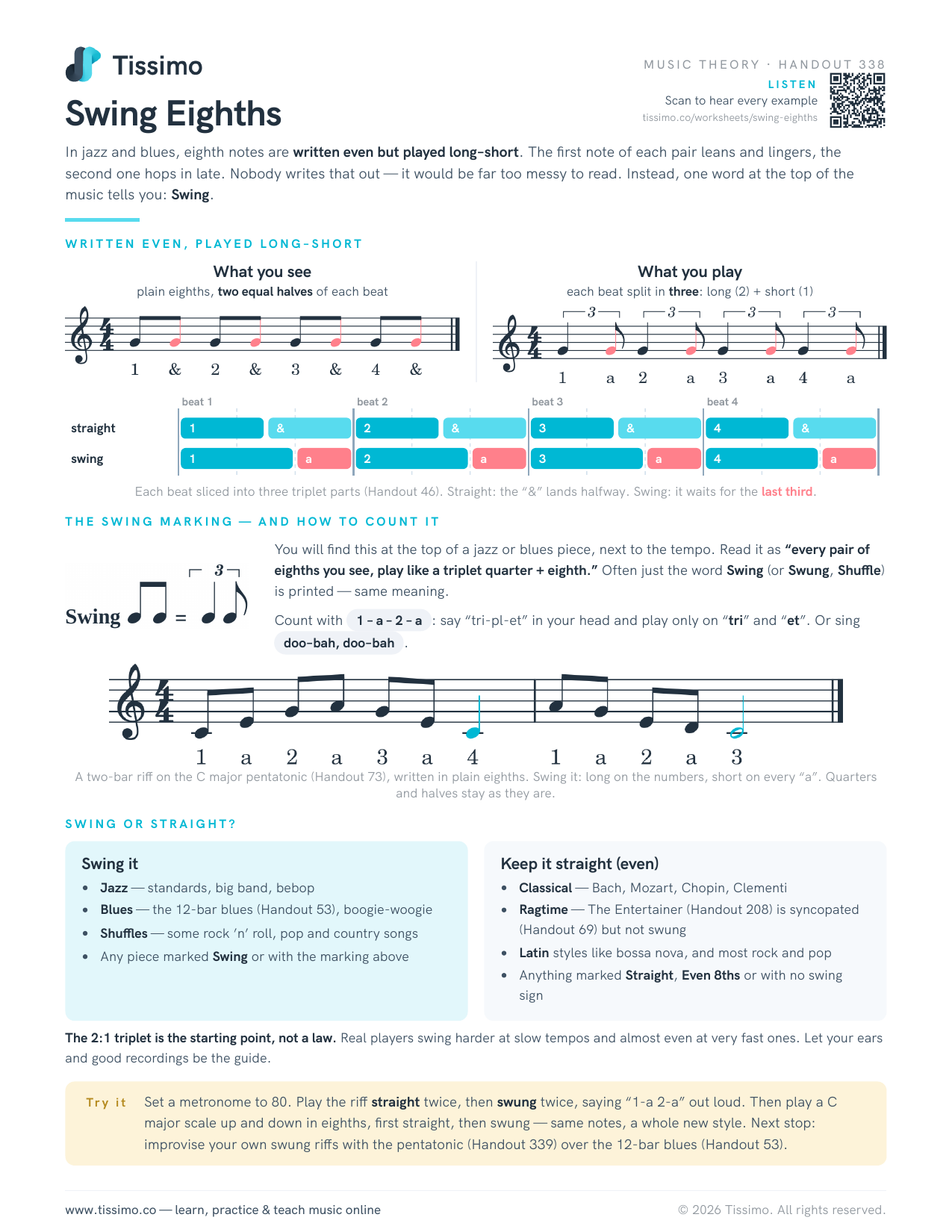 Swing EighthsIn jazz and blues, eighth notes are written even but played long–short. The first note of each pair leans and lingers, the second one hops in late. Nobody writes that out — it would be far too messy to read. Instead, one word at the top of the music tells you: Swing.
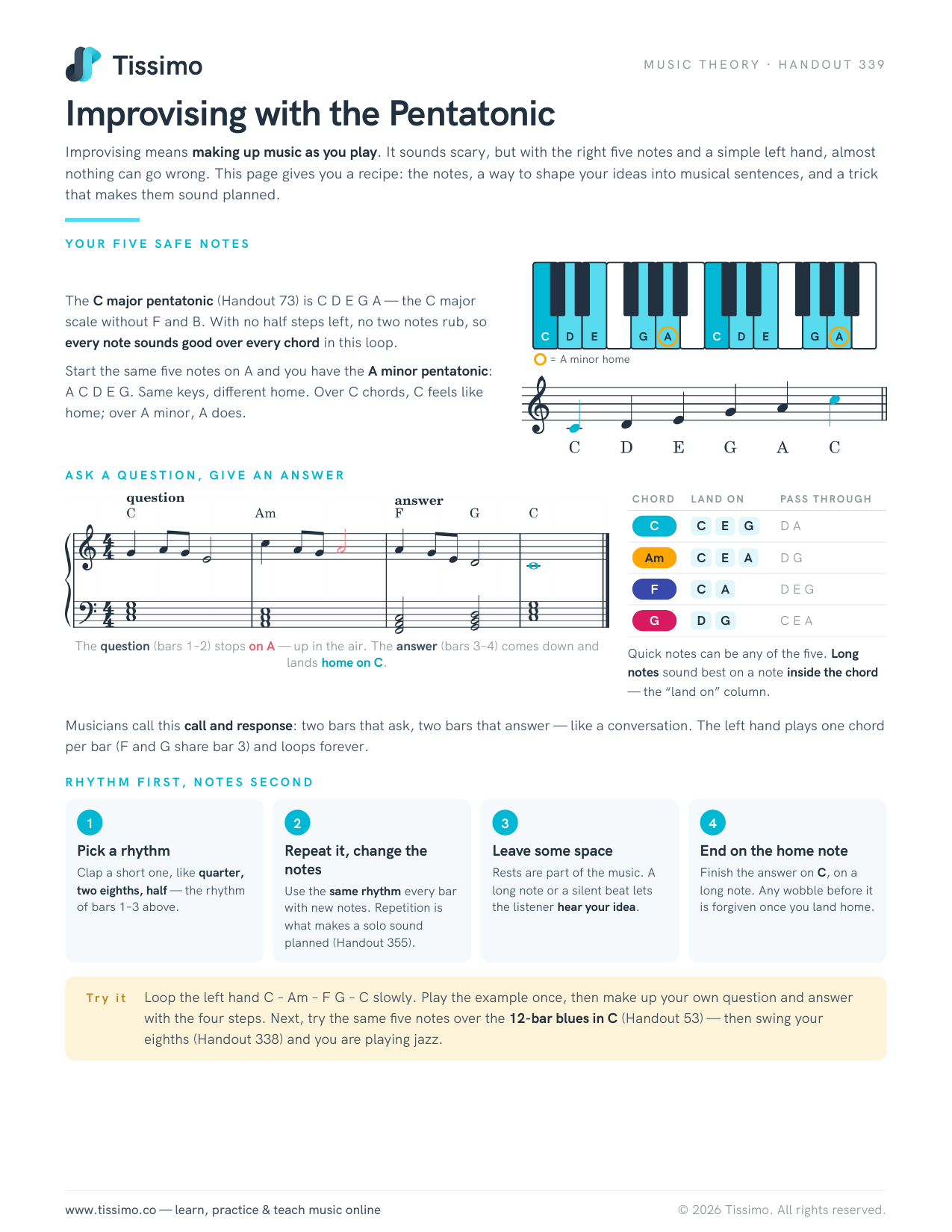 Improvising with the PentatonicImprovising means making up music as you play. It sounds scary, but with the right five notes and a simple left hand, almost nothing can go wrong. This page gives you a recipe: the notes, a way to shape your ideas into musical sentences, and a trick that makes them sound planned.
Comments