Articulation & Ornaments
Fall, Doit and Scoop
Falls, doits and scoops are jazz slides marked by short curved lines at a single note: a fall drops away after the note, a doit rises after it, and a scoop slides up into it from below.
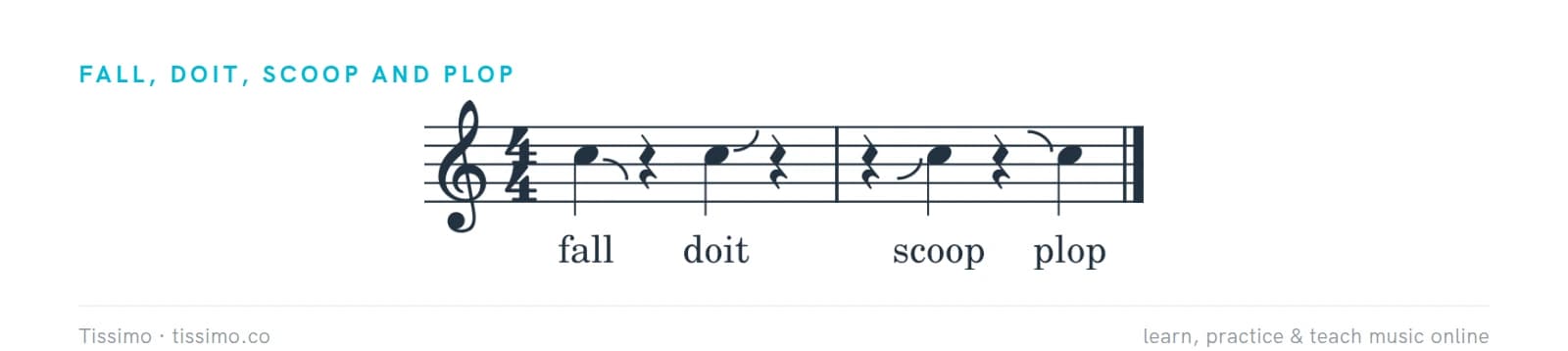
Jazz and big-band horn parts often mark slides that have no written starting or ending pitch. Each one is a short curved line attached to a single note, and its shape tells you two things: whether the slide comes before or after the note, and whether the pitch moves up or down.
- Fall (or fall-off): play the note, then let the pitch drop away quickly to no particular note. The line curves down to the right of the note.
- Doit (said "doyt"): play the note, then slide up away from it. The line curves up to the right.
- Scoop: start a little below the note, often about a half step, and slide up into it. The line rises into the note from the lower left.
- Plop: the reverse of a scoop, a quick drop onto the note from above. The line comes down into the note from the upper left. It is the least common of the four.
Short and long falls
Falls in particular come in different lengths. A short fall drops only a little and is over quickly; a long fall slides further and takes more time. On the page, a longer line asks for a longer fall. Falls are often combined with an accent; arrangers tend to avoid a short, hard marcato on the same note, since a very short note leaves no time to fall.
How to play them
- Trumpet and other valved brass: use the lips, the valves or both. On the way down you can run quickly through the notes below, or press the valves partway down and let the lips bend the pitch.
- Trombone: high falls come mostly from the lips; lower down, the slide moves out as the pitch drops.
- Saxophone: a fall is played as a very fast descending scale, and a doit as a fast ascending chromatic scale.
- Voice: singers use these slides too, with the voice alone.
Scoops and bends are hard to make clean in the lowest notes of a horn, where the notes of the brass harmonic series lie far apart. A doit needs room above the note, so it should not sit at the very top of the range.
Not a glissando, not a bend
A glissando joins two written notes and travels from one to the other. A fall, doit, scoop or plop has only one written note; the other end is open, an unspecified pitch somewhere above or below. A bend is different again: the pitch dips and comes back to the same note. In jazz, players also shape all of these by style and by ear.
Common questions
What is a fall in jazz?
A fall (or fall-off) is a slide down from a note to no particular pitch, played right after the note. It is written as a short line curving down to the right of the note.
What is the difference between a doit and a scoop?
Both slide upward, but at opposite ends of the note. A doit comes after the note and rises away from it; a scoop comes before the note and rises into it from below.
Comments