Music Production
Drum Machine
A drum machine is an electronic instrument that plays drum and percussion sounds in patterns you program, usually on a grid of steps, and plays them back in steady time at the tempo you set.
A drum machine combines two things in one box or program: a set of drum and percussion sounds, and a sequencer that plays them in patterns. Instead of hitting drums, you program which sound plays on which step, set the tempo in BPM, and the machine plays the pattern back as steadily as you like, for as long as you like.
Where the sounds come from
- Synthesized voices. Electronic circuits or software build each drum from oscillators, noise generators and envelopes. These sounds are recognizably electronic rather than copies of an acoustic kit.
- Samples. Short recordings of real drums, or of any other sound, played back on each hit (sampling).
Many machines and apps combine both, and most let you shape each sound's tuning, length and level.
Programming a pattern
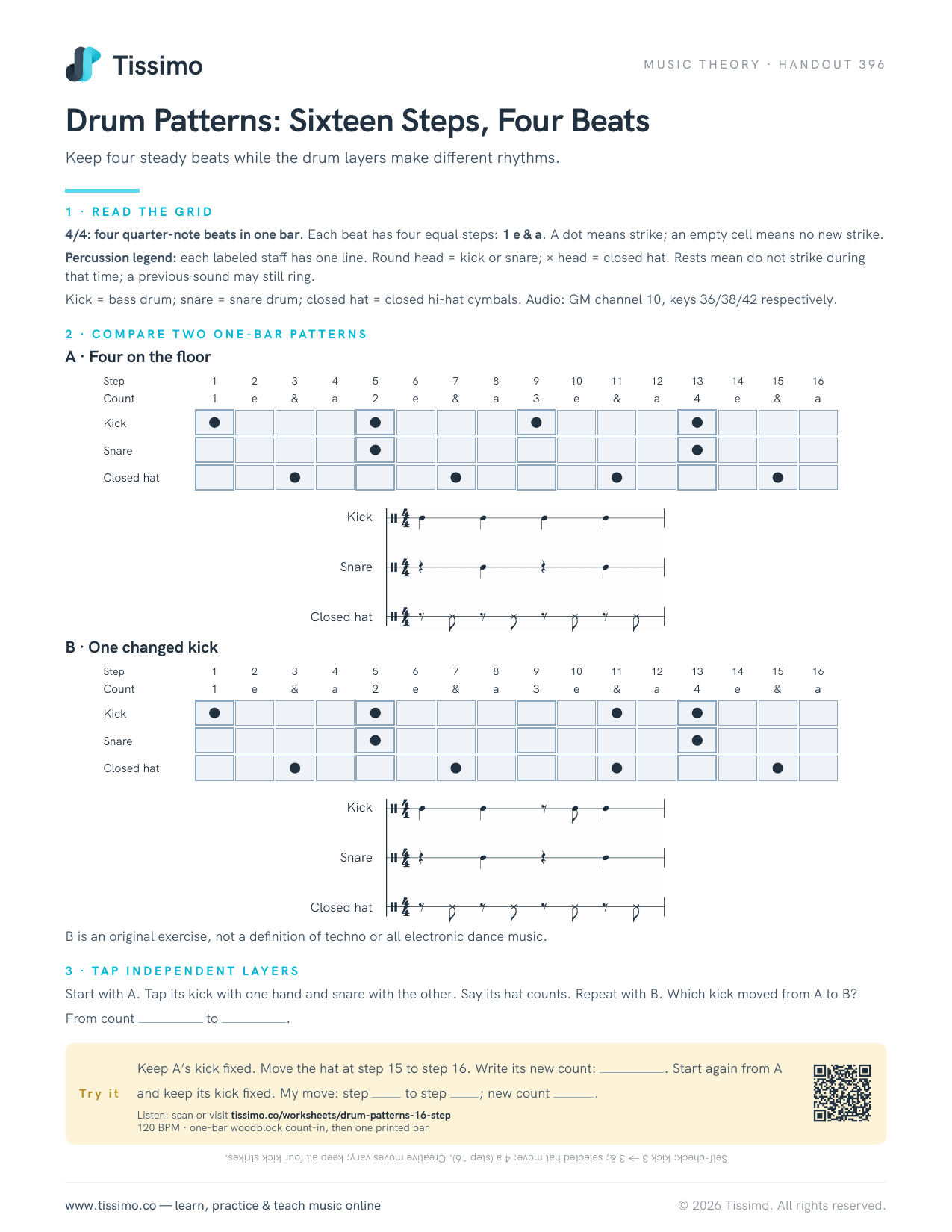
Most drum machines are set up on a grid of 16 steps to a bar of 4/4, one step per sixteenth note, as the sequencer entry explains. Each row of the grid is one sound, such as kick, snare, hi-hat or clap. You switch steps on and off, often while the pattern loops, and many machines also let you tap hits in live and tidy their timing (quantization). Common extras:
- Accent or per-step velocity, so some hits are louder than others;
- Swing or shuffle, which delays the in-between steps for a looser feel (swing);
- Pattern chaining, which strings patterns together into verses, choruses and fills;
- MIDI sync, so the machine follows the tempo of a DAW or another instrument.
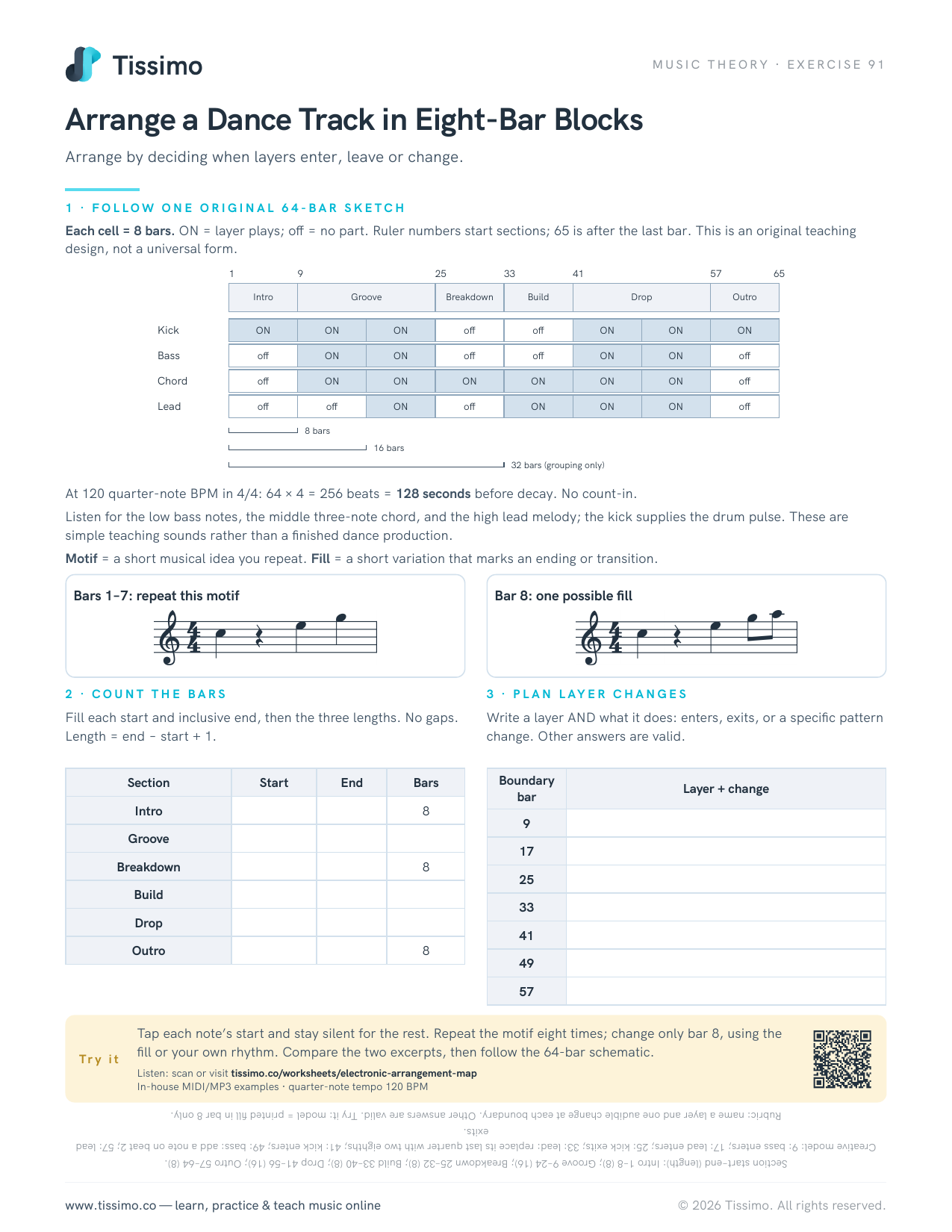
Drum Patterns: Sixteen Steps, Four Beats works through 16-step patterns on paper; four on the floor shows one of them in drum notation, and Arrange a Dance Track in Eight-Bar Blocks turns patterns into a song.
A short history
Early rhythm machines mostly played factory preset patterns, such as a waltz or a bossa nova, and some were designed to accompany home organists. Programmable machines became common around 1980. Roland's CR-78 (1978) could store patterns its owner created. Roland's TR-808 (1980) used analog synthesis instead of samples because memory was then expensive. Many musicians dismissed it at first, and it was discontinued in 1983, but its sounds later became central to hip-hop and electronic dance music. The Linn LM-1, released around the same time, played digital recordings of real drums and quickly appeared on pop hits. Today many drum machines are software inside a DAW, alongside hardware units and apps.
A common confusion
A drum machine is not an electronic drum kit, which a drummer plays with sticks on pads, and it is more than a sequencer or a sampler on its own, although many instruments combine all three. A groove built on a grid still needs a drummer's ear: compare a basic pattern with the backbeat and drum kit entries, and vary the velocities so the pattern does not sound stiff.
Common questions
What is an 808?
The Roland TR-808 Rhythm Composer, a drum machine introduced in 1980. Producers also say "808" for its deep, booming kick drum, which can be sampled and tuned to play a bass line, as in much hip-hop and Miami bass music.
What was the first drum machine?
It depends on what you count. Rhythm units that played preset patterns came first; machines on which you could program and store your own patterns became common only around 1980, with models such as Roland's CR-78 and TR-808 and the Linn LM-1.
Comments