Rhythm & Meter
Dotted Quarter Note
A dotted quarter note is a quarter note with a dot after it. It lasts one and a half beats in 2/4, 3/4 and 4/4, and in 6/8 and other compound meters it is the beat itself.
A dotted quarter note is a quarter note with an augmentation dot after it. The dot adds half of the quarter note's value, so in 2/4, 3/4 and 4/4 it lasts one and a half beats: as long as three eighth notes, or a quarter note tied to an eighth. In British English it is called a dotted crotchet.
The dotted quarter and its eighth
In 2/4, 3/4 and 4/4 a dotted quarter leaves half of a beat still to fill, and its usual partner is an eighth note. Together they fill two beats with a long-short pattern: play on 1, hold through 2, and play the eighth on the "&" of 2. Count it "1, 2 &", saying the 2 out loud while the dotted note holds, so the eighth does not come in early.
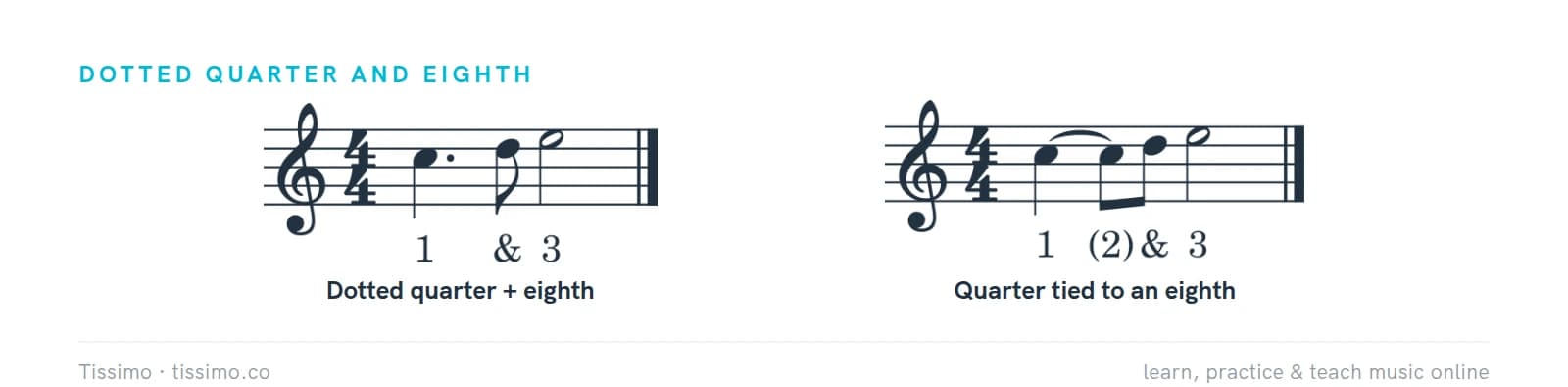
The tied version on the right shows what the dot hides: beat 2 begins in the middle of the long note. Reverse the pair, an eighth note and then a dotted quarter, and the long note starts on an off-beat, a simple syncopation.
In a melody
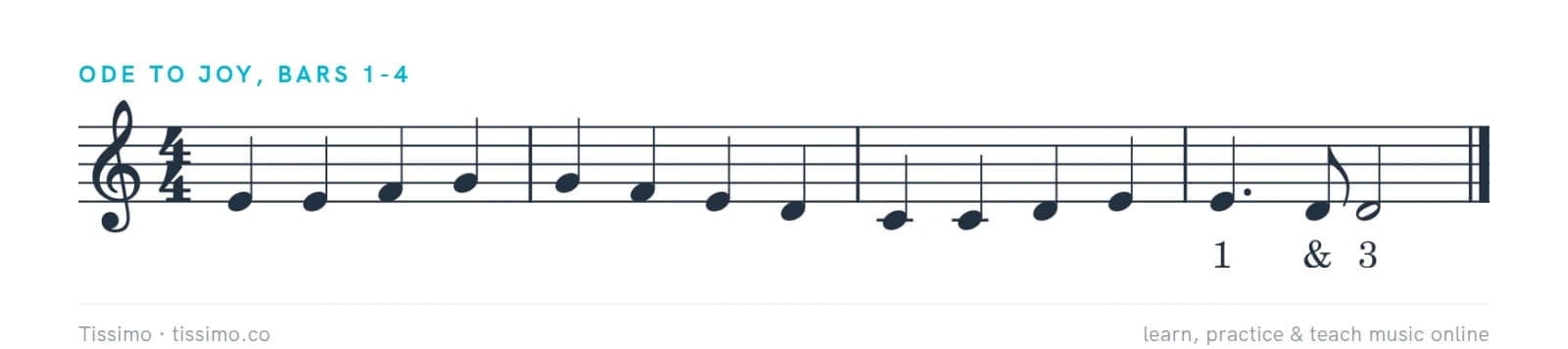
Dotted quarters give many familiar melodies their lilt. Ode to Joy, the tune from the finale of Beethoven's Ninth Symphony, moves in even quarter notes until the end of its first phrase, where a dotted quarter and an eighth lead into the closing half note.
The beat in compound meter
In 6/8, 9/8 and 12/8 the beat itself is a dotted quarter note, which divides into three eighths instead of two. A bar of 6/8 holds two dotted quarters, counted "1, 2", or "1 & a 2 & a" when you count the eighths. So the same symbol lasts one and a half beats in 4/4 and exactly one beat in 6/8: read the time signature first. See compound meter for more.

Learn the value with The Dotted Quarter Note, then count it among other rhythms with Write the Counts 2 and in 6/8 with Time Signatures II: Compound Time. The Dotted Eighth + Sixteenth uses the same long-short idea inside a single beat.
Common questions
How many beats is a dotted quarter note?
One and a half beats in 2/4, 3/4 and 4/4: one beat for the quarter note and half a beat for the dot. In 6/8, 9/8 and 12/8 it is exactly one beat.
How many eighth notes are in a dotted quarter note?
Three. That is why the dotted quarter works as the beat in compound meters, where each beat divides into three eighth notes.
Practice it: free worksheets
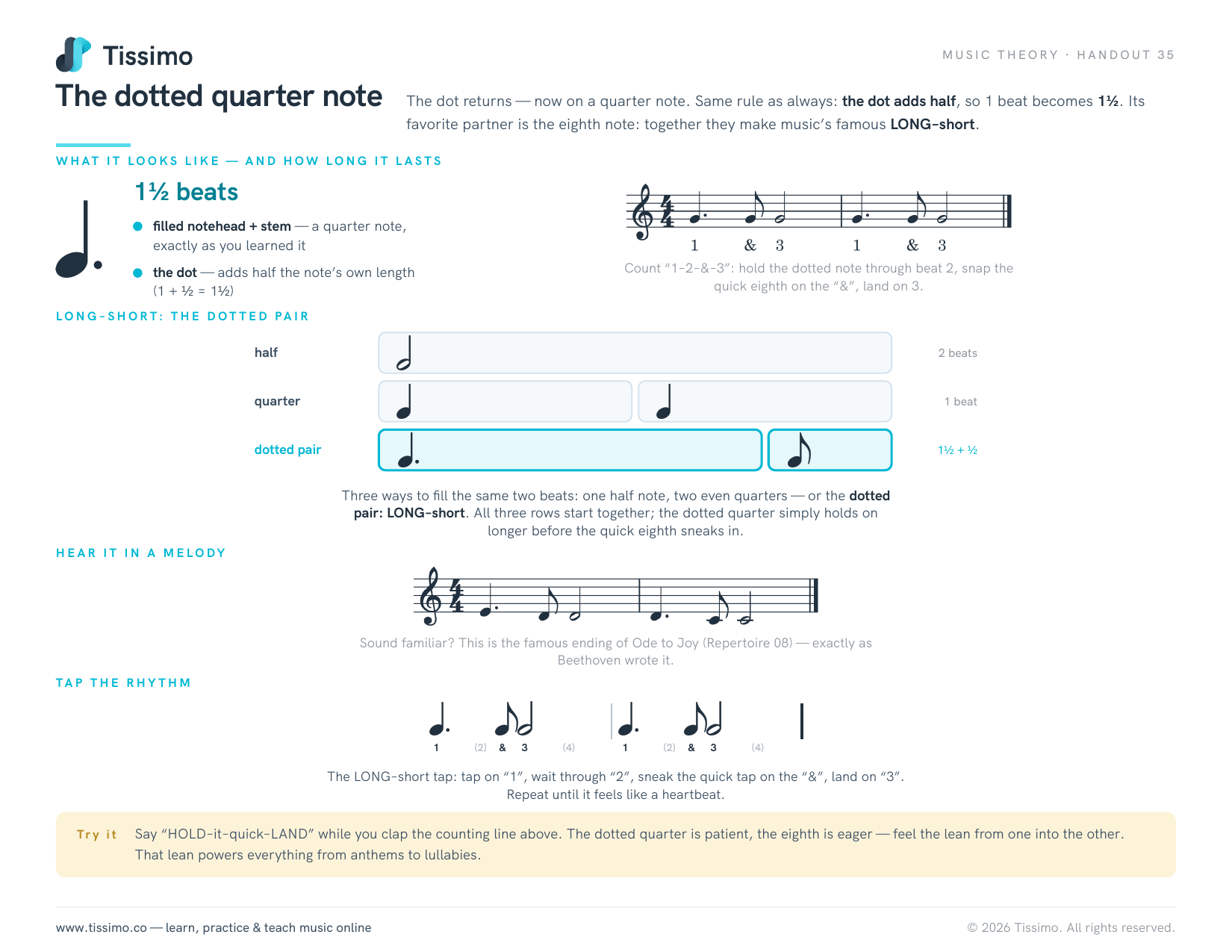 The dotted quarter noteThe dot returns — now on a quarter note. Same rule as always: the dot adds half, so 1 beat becomes 1½. Its favorite partner is the eighth note: together they make music’s famous LONG–short.
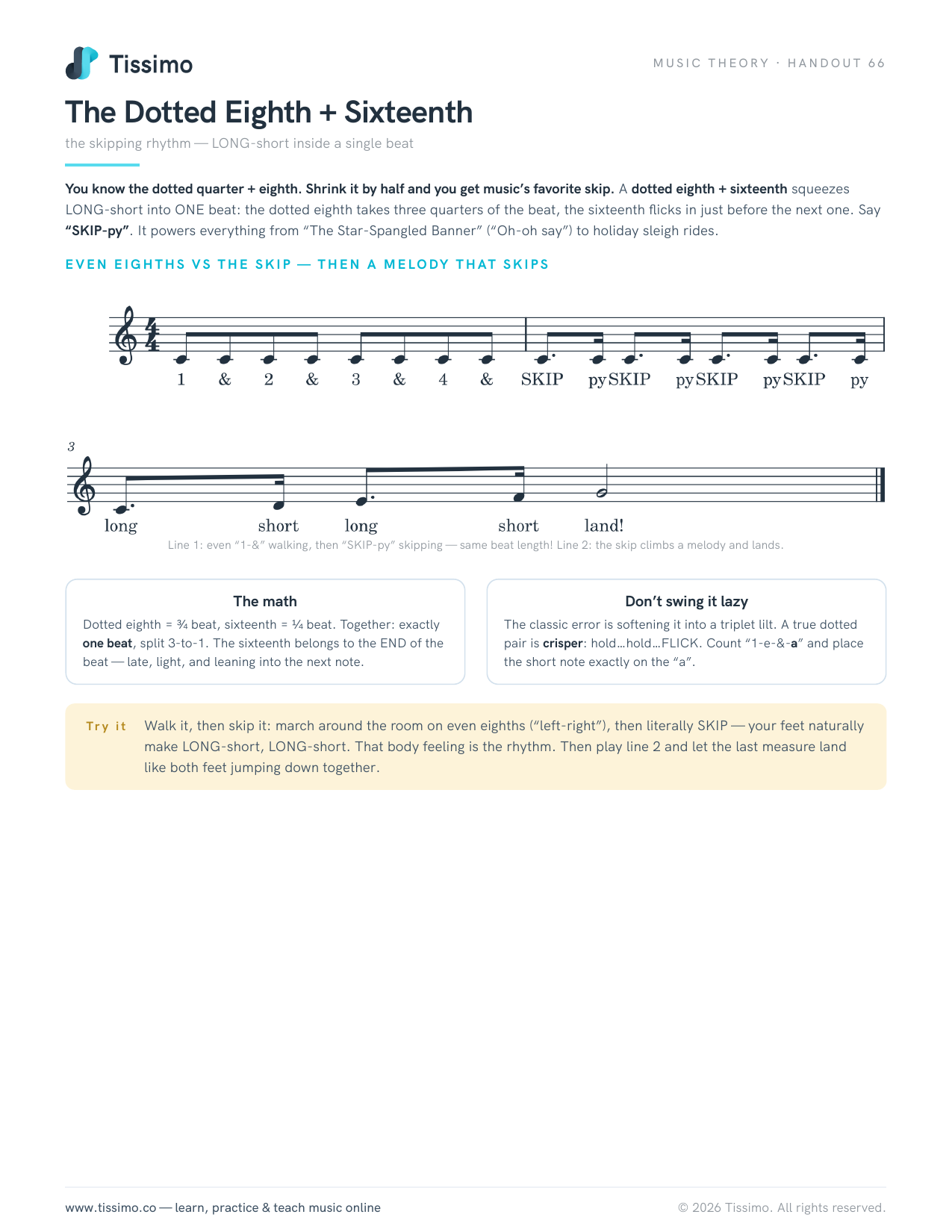 The Dotted Eighth + Sixteenththe skipping rhythm — LONG-short inside a single beat
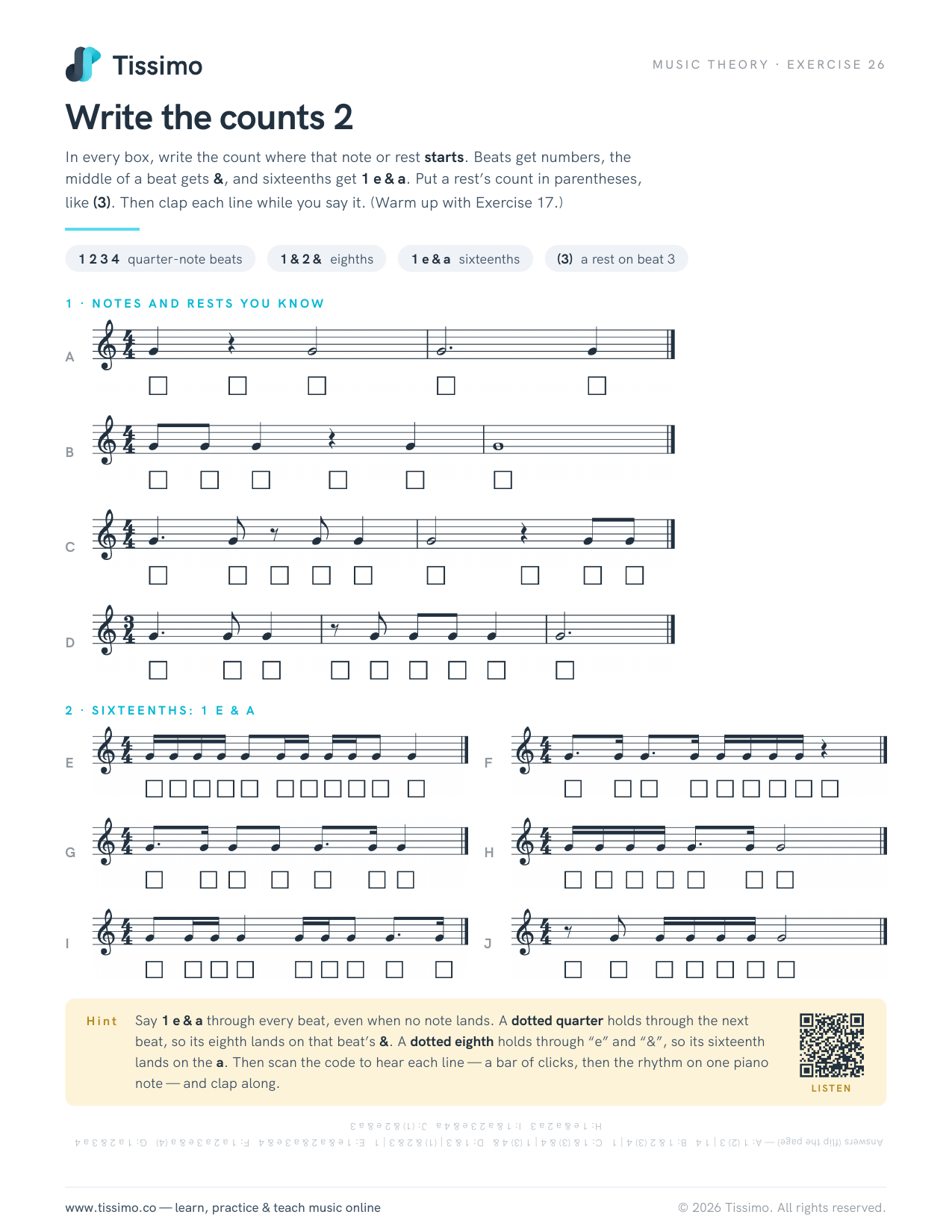 Write the counts 2In every box, write the count where that note or rest starts. Beats get numbers, the middle of a beat gets &, and sixteenths get 1 e & a. Put a rest’s count in parentheses, like (3). Then clap each line while you say it. (Warm up with Exercise 17.)
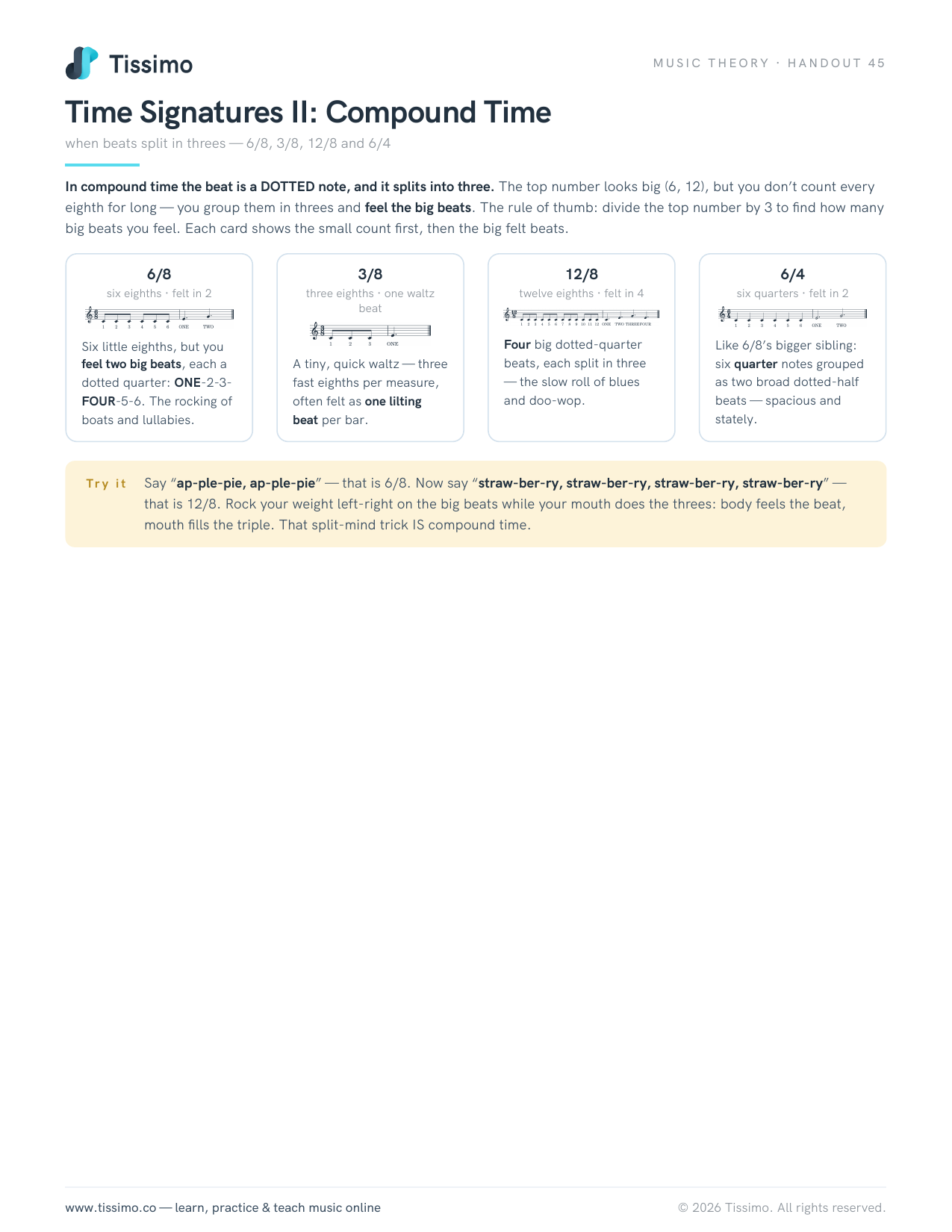 Time Signatures II: Compound Timewhen beats split in threes — 6/8, 9/8, 12/8 and 6/4
Comments