Rhythm & Meter
Changing Meter
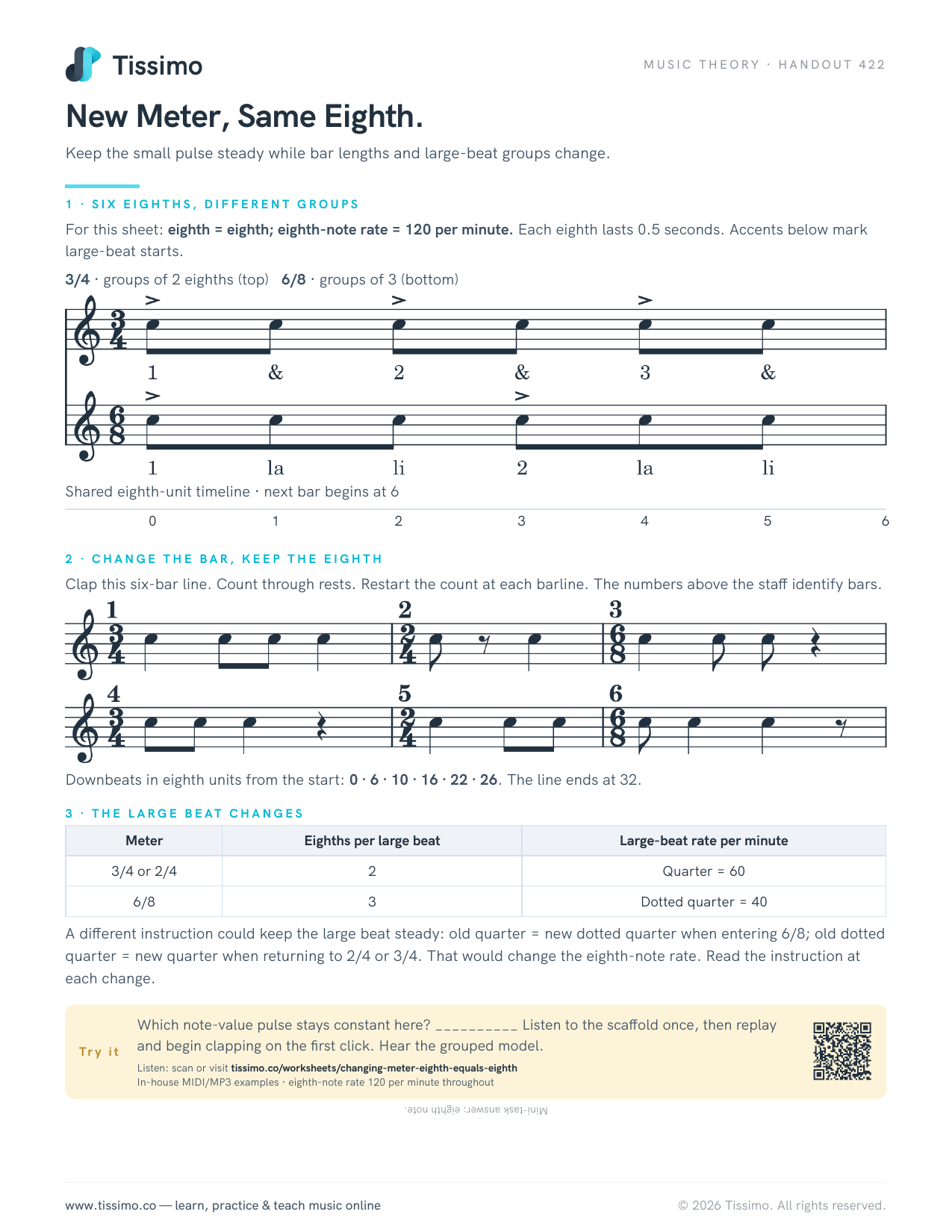
Changing meter means moving from one meter to another as the music proceeds, often shown by new time signatures. The number or grouping of beats changes; the score's tempo instructions determine which note duration, if any, stays constant.
A phrase need not keep the same bar pattern throughout. A passage might move from 3/4 to 2/4 and then 4/4, with each new time signature changing how the beats are grouped. This is changing meter, often called mixed meter. Some authors also use "mixed" for unequal beat groups inside one bar, so the label needs context.
Count the new bar, not an extra beat
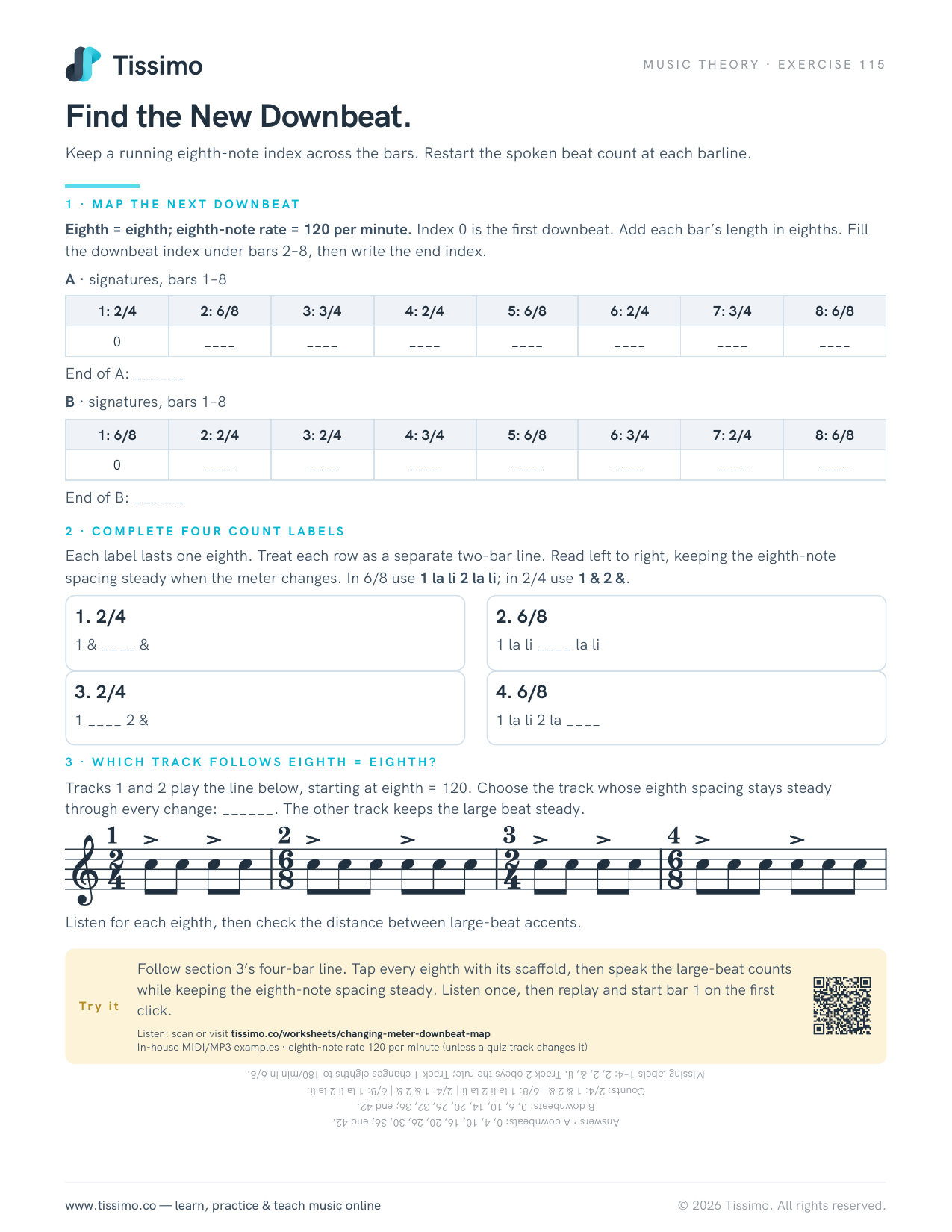
For an exercise with an unchanged quarter-note pulse, count 3/4, 2/4 and 4/4 as "ONE two three | ONE two | ONE two three four". That sequence contains nine quarter notes, not three equal-length bars. Prepare the next downbeat without adding a pause or filling the shorter bar with a missing beat.
What stays constant?
A time signature does not by itself specify an exact tempo. At a change between simple and compound meter, look carefully for an equation between note values or another tempo instruction.
Start in 3/4 at quarter note = 120, then move to 6/8:
- If old eighth note = new eighth note, the eighths remain at 240 per minute. Three now form each dotted-quarter beat, so the new mark is dotted quarter = 80.
- If old quarter note = new dotted quarter, the main beat stays at 120 per minute. The new eighths run at 360 per minute instead.
Both are valid instructions, but they produce different music. Keep the named duration constant rather than assuming every meter change preserves either the eighth note or the main beat.
Keep the concepts separate
An irregular meter can repeat the same uneven pattern without changing meter. Polymeter layers different meters at once. Metric modulation connects rhythmic durations across a transition and can accompany a meter change, but a change of time signature alone does not specify that connection.
Common questions
Does every change of time signature change the tempo?
No. A quarter-note pulse can stay steady while the bar changes from three beats to two, for example. Read the tempo marks and any note-value equation to find the intended relationship.
Is changing meter the same as irregular meter?
No. A repeating 7/8 grouped 2+2+3 can stay in one irregular meter. A sequence of 3/4 and 2/4 changes meter even though each individual bar uses a regular simple meter.