Instruments & Voices
Celesta
Pronounced suh-LESS-tuh
The celesta is a keyboard instrument whose felt hammers strike steel bars over wooden resonators, giving a soft, bell-like sound. Its music is written an octave lower than it sounds.
The celesta looks like a small upright piano, but inside it works like a glockenspiel played from a keyboard. Each key moves a felt-covered hammer that strikes a steel bar, and a wooden resonator box under each bar strengthens its note. A damper pedal works as on the piano, letting notes ring on. Because its sound comes from struck metal, the celesta is classed with the percussion, but it is played as a keyboard instrument, usually by a pianist.
A sound from the 1880s
The harmonium maker Auguste Mustel developed the celesta in Paris in 1886, and it quickly found a place in the orchestra. Tchaikovsky heard it in Paris and gave it a famous solo in the "Dance of the Sugar Plum Fairy" in his ballet The Nutcracker (1892). Since then, composers have used its sweet, glowing tone for magic, dreams, moonlight and anything that should sound not quite real.
Written an octave lower than it sounds
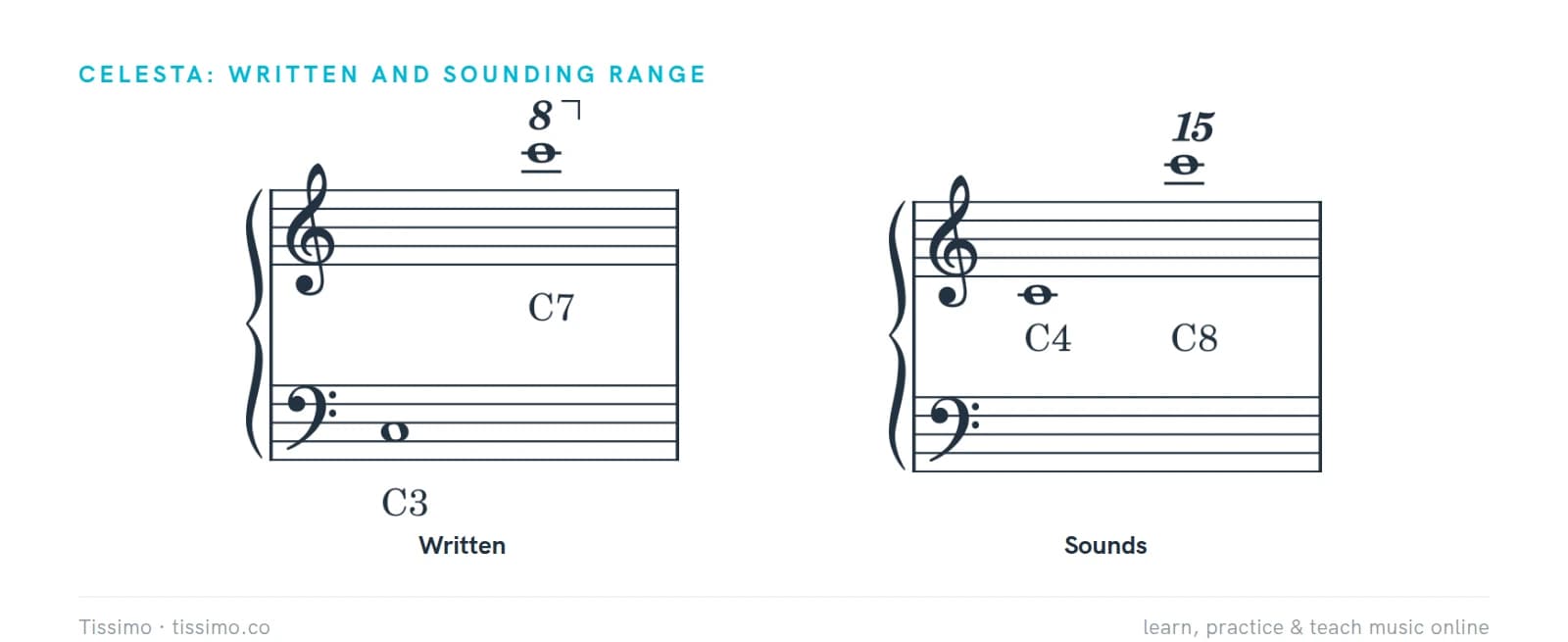
Celesta music uses the grand staff, like piano music, but every note sounds an octave higher than written: written C4 sounds C5. That makes the celesta a transposing instrument, and it saves the part from strings of ledger lines.
Celestas come in several sizes. A four-octave instrument sounds from C4 to C8, written C3 to C7. Five-octave instruments reach down to sounding C3, and the largest modern models span five and a half octaves, up to F8. Check which size the orchestra has before writing low notes.
Playing it
Celesta technique is piano technique: scales, arpeggios, chords, trills and tremolos all work, and the pedal holds notes. The instrument is gentle, though. Its dynamic range runs only from about piano to forte, and its notes fade a little sooner than a piano's, so it sounds best in a light texture and is easily covered by a full orchestra.
A common confusion
The celesta is not a glockenspiel with keys, though the two are related. A glockenspiel's bars are struck with hard mallets for a bright, piercing sound, and its music sounds two octaves above the page. The celesta's felt hammers and resonators give a softer, warmer tone, especially in its lower notes.
Common questions
Is the celesta a piano?
No, though it has a piano keyboard and is usually played by a pianist. Its hammers strike steel bars rather than strings, so it sounds like a soft glockenspiel, and its music sounds an octave higher than written.
What piece made the celesta famous?
Tchaikovsky's "Dance of the Sugar Plum Fairy" from The Nutcracker (1892), written a few years after the instrument was developed in Paris.
Comments