Chords & Harmony
Applied Leading-Tone Chord
An applied leading-tone chord is a diminished triad or leading-tone seventh chord that points toward a temporary tonic other than the home tonic. Its root lies a half step below the target chord's root.
An applied leading-tone chord, also called a secondary leading-tone chord, gives another major or minor chord a temporary sense of arrival. Like a secondary dominant, it supports tonicization without necessarily establishing a new key.
Build one for a target
In C major, suppose the target is G major, the V chord. Its leading tone is F♯, a half step below G. Build the diminished triad F♯–A–C and resolve it toward G–B–D. The label is vii°/V, read "seven diminished of five." The symbol after the slash names the target, not a bass note.
Adding E♭ gives F♯–A–C–E♭, the fully diminished seventh chord vii°7/V. Adding E natural instead produces a half-diminished seventh, a less common applied form before a major target. Fully diminished sevenths can lead to major or minor targets.
For a D-minor target in C major, C♯–E–G–B♭ is vii°7/ii. C♯ normally rises to D, while the chordal seventh B♭ falls to A. Spell B♭, not A♯, so the stacked thirds and the voice leading remain visible.
Context still matters
Not every diminished chord is applied: check its destination and the movement of its voices. An ordinary leading-tone chord resolving to the home tonic is not secondary.
Try it
Write the roots G, D and A on paper. Put a leading tone a half step below each, then build a diminished triad using alternate letter names. Identify the targets in C major before adding sevenths or choosing inversions.
Common questions
Does every diminished seventh chord have an applied function?
No. The spelling, resolution and surrounding key determine its function. Applied leading-tone chords point toward a temporary major or minor tonic other than the home tonic.
Practice it: free worksheets
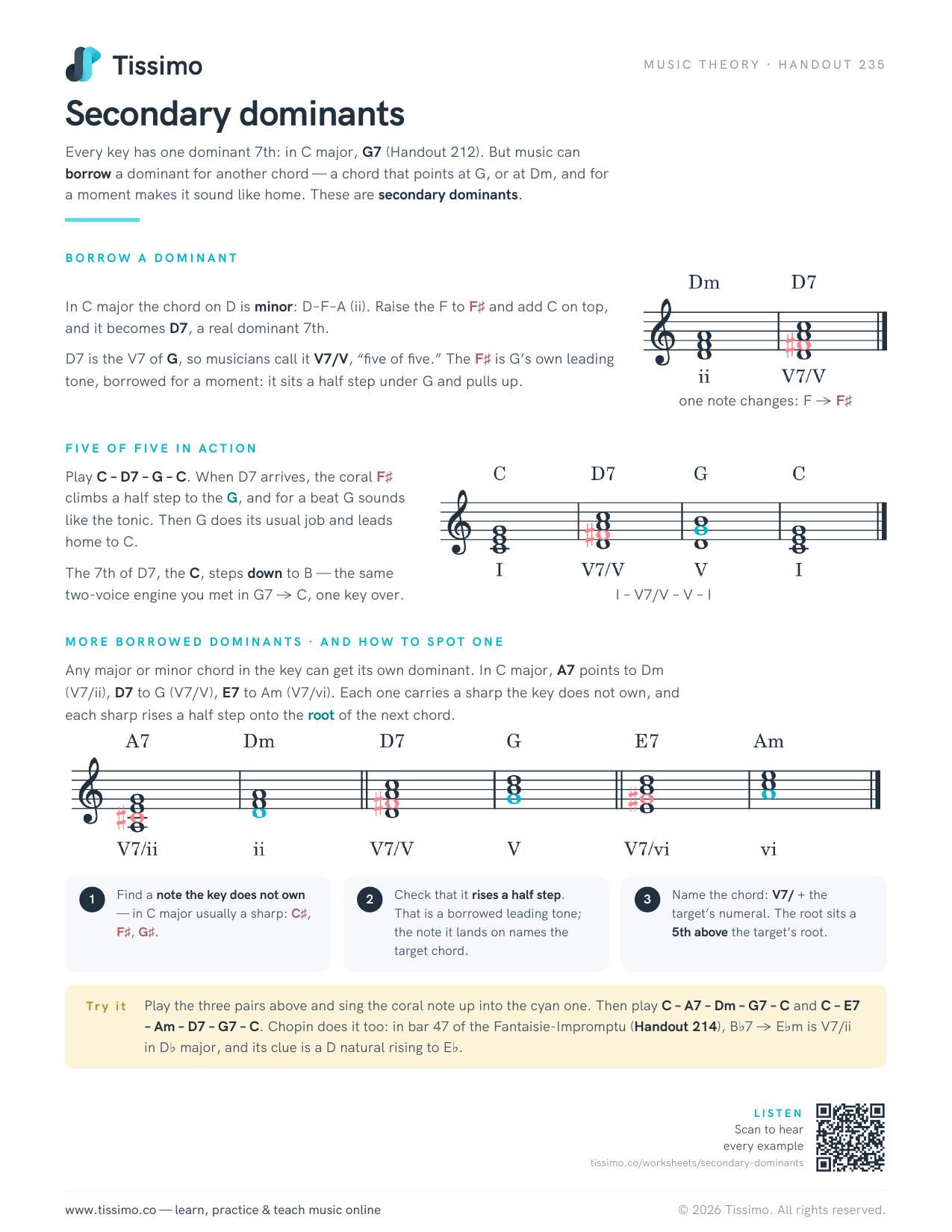 Secondary dominantsEvery key has one dominant 7th: in C major, G7 (Handout 212). But music can borrow a dominant for another chord — a chord that points at G, or at Dm, and for a moment makes it sound like home. These are secondary dominants. (Borrowing a chord from the parallel minor is different: Handout 384.)
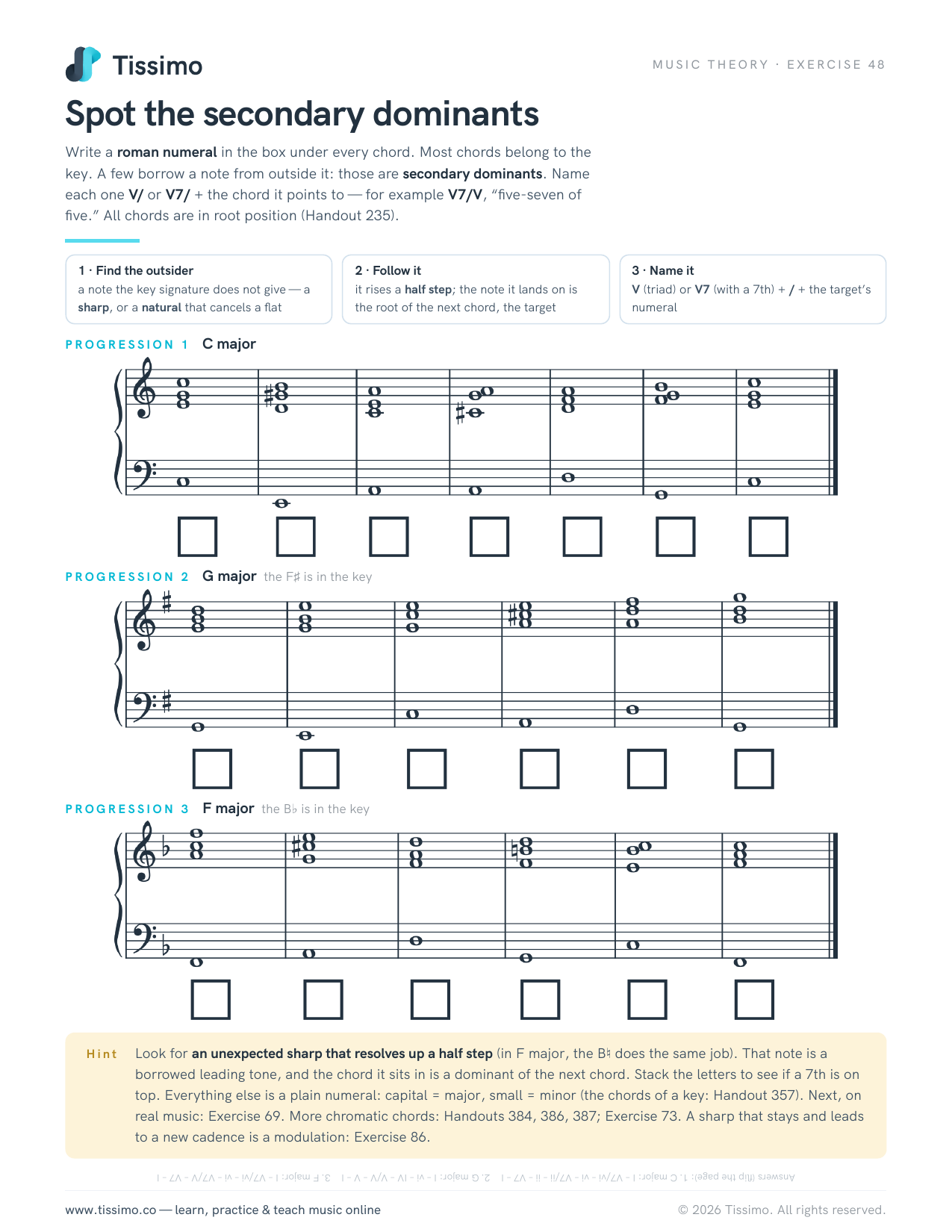 Spot the secondary dominantsWrite a roman numeral in the box under every chord. Most chords belong to the key. A few borrow a note from outside it: those are secondary dominants. Name each one V/ or V7/ + the chord it points to — for example V7/V, “five-seven of five.” All chords are in root position (Handout 235).
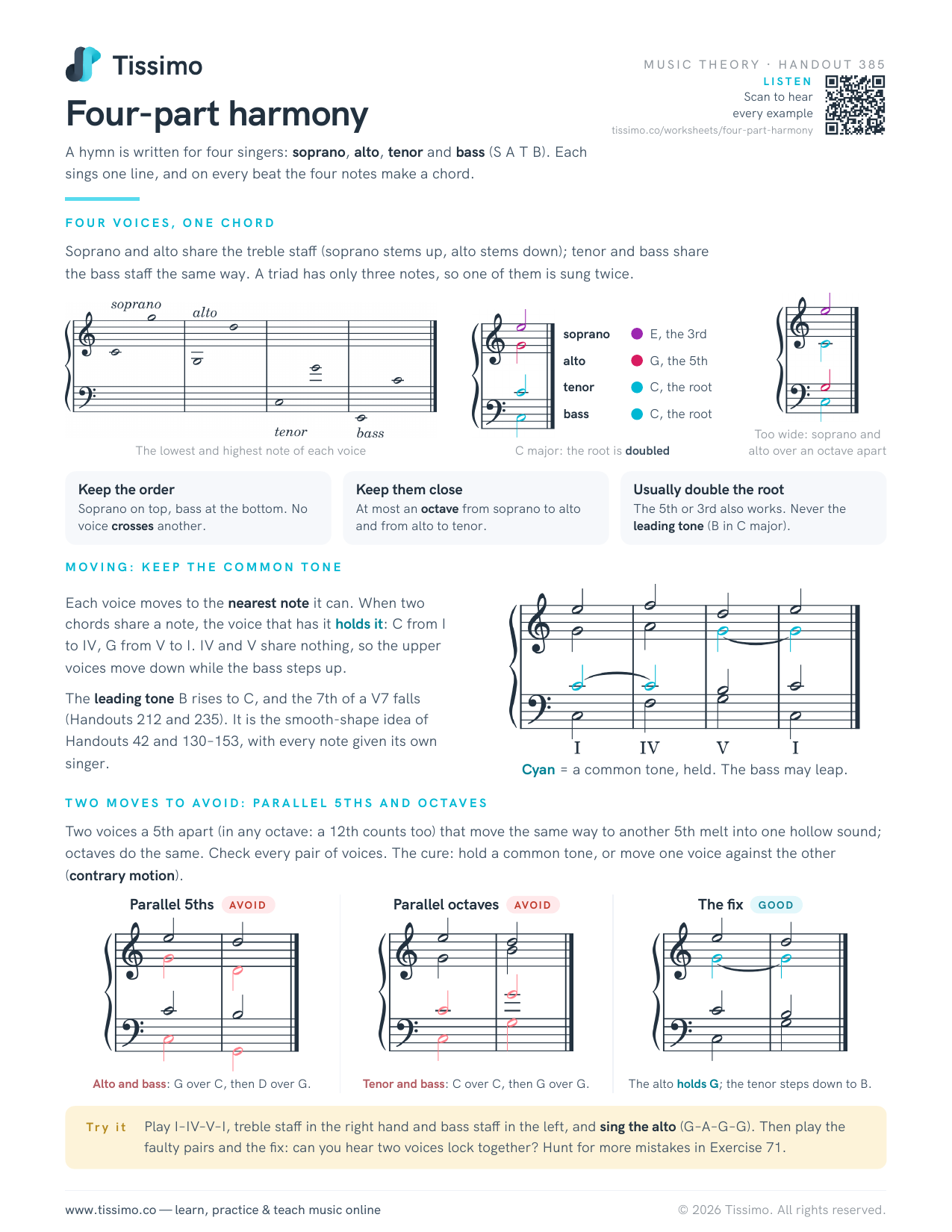 Four-part harmonyA hymn is written for four singers: soprano, alto, tenor and bass (S A T B). Each sings one line, and on every beat the four notes make a chord.