Tempo Markings
Tempo Giusto
Pronounced TEM-poh JOO-stoh
Tempo giusto means 'the right tempo' or 'in strict time': keep a steady, exact beat, often after a free passage, at the speed the style of the music calls for.
Tempo giusto means "exact time" or "the right time". Giusto is Italian for exact, proper or just, and the phrase has two related senses:
- In strict time. Keep a steady, exact beat. This is the opposite of rubato, and it often follows a free passage, a cadenza or a section marked rubato.
- At the right tempo. Play at the speed the style and character of the piece call for, neither pushed nor dragged. Some references connect this sense with music of the Baroque period.
Both senses come from the same idea: the beat is set by the music, not by your mood, and it holds.
How it looks on the page
Tempo giusto is printed above the staff, at the start of a piece or where a free passage ends. Giusto also joins tempo words: Allegro giusto is quick with precision, at an appropriate speed.
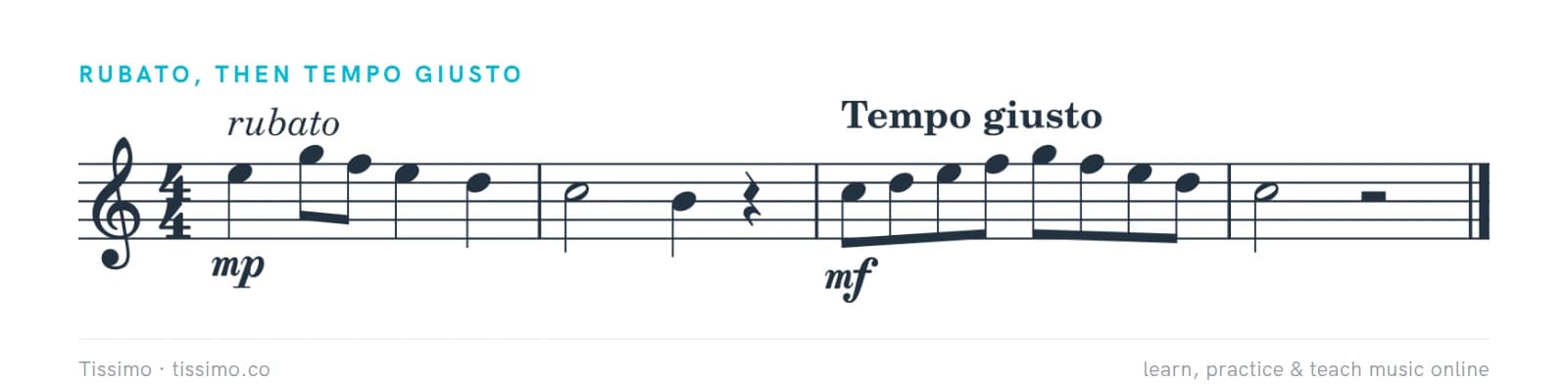
Playing tempo giusto
Set the beat with a metronome while you practice, then keep it without one. After a rubato passage, decide in advance what the giusto tempo is, so you can step straight into it, as you would at an a tempo. Even notes are the test: a scale passage in tempo giusto should sound as regular as a clock.
A common confusion
Tempo giusto is not a number. Some dictionaries add "moderate" to the meanings of giusto, and a tempo giusto is often a moderate one, but the phrase gives no metronome mark: it asks for steadiness and a fitting speed, which can be quick or moderate, depending on the music.
Common questions
What does tempo giusto mean?
Strict time, or the right tempo for the music: keep a steady beat at a fitting speed. It is the opposite of rubato. Giusto means "exact" or "proper".
Comments