Rhythm & Meter
Sixteenth Rest
A sixteenth rest is a slanted stroke with two small hooks. It is a quarter of a beat of silence in 2/4, 3/4 and 4/4, the same length as a sixteenth note.
A sixteenth rest is a measured silence as long as a sixteenth note. In 2/4, 3/4 and 4/4 that is a quarter of a beat: two sixteenth rests last as long as an eighth rest, and four as long as a quarter rest. In British English it is called a semiquaver rest.
What it looks like
The sixteenth rest is a slanted stroke with two small hooks on its left, one above the other. It is an eighth rest with a second hook added, just as a sixteenth note is an eighth note with a second flag. One hook means an eighth rest, two a sixteenth rest, three a thirty-second rest: count the hooks before you count the beat.
Counting sixteenth rests
Count sixteenths as "1 e & a, 2 e & a". A sixteenth rest takes the place of one of those syllables. Keep saying the syllable quietly and simply do not play on it. Write the Counts 2 puts a rest's count in parentheses so you can still see where it falls.
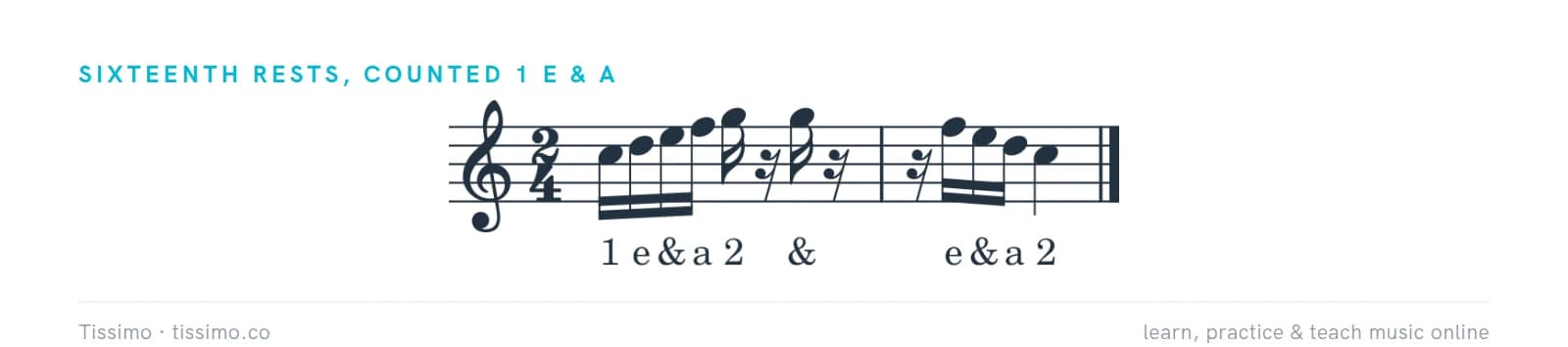
In bar 2 of the example, a sixteenth rest on the beat makes the next three notes start just after it, on e, & and a. Feeling that tiny gap on the beat is the skill: the notes after the rest must not slide back onto the beat.
Eighth rest or sixteenth rest?
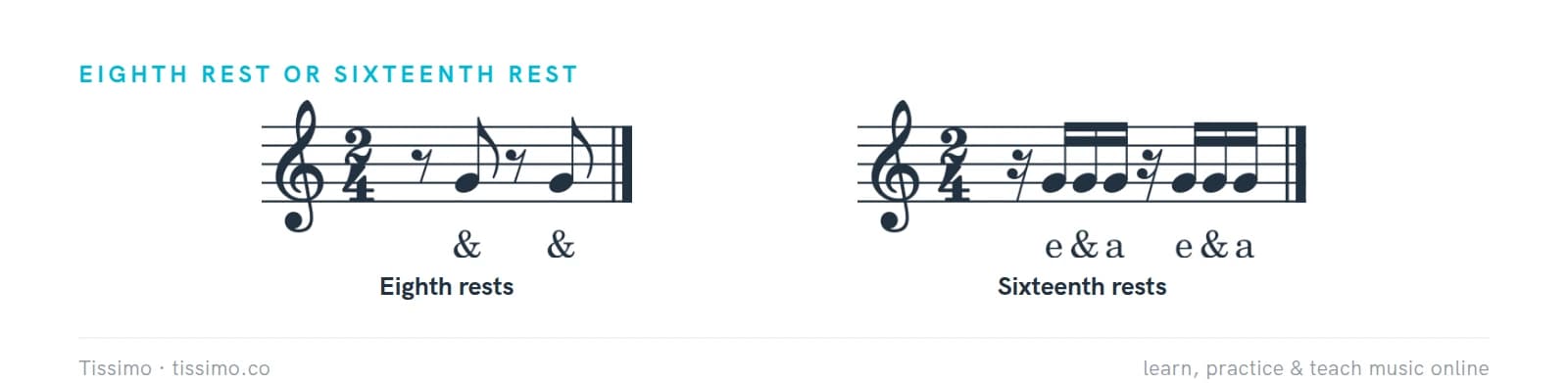
The difference is easy to see and to hear. After an eighth rest on the beat, the next note comes on the "&", halfway through the beat. After a sixteenth rest, it comes on the "e", only a quarter of the way through.
Writing them neatly
Rhythms are easiest to read when the start of every beat can be seen, so rests are grouped by beats. Two sixteenth rests that fill the first half of a beat are normally written as one eighth rest, and four that fill a whole beat as one quarter rest. Like any rest, a sixteenth rest can be dotted, which makes it half again as long.
See the sixteenth rest beside the other four in The Rest Family; The Rests introduces the first three. Practice the notes themselves with The Sixteenth Note.
Common questions
How long is a sixteenth rest?
A quarter of a beat in 2/4, 3/4 and 4/4, the same as a sixteenth note. In 6/8, where the dotted quarter is the beat, it is one sixth of a beat.
How many sixteenth rests equal a quarter rest?
Four, when the quarter note gets the beat. Two sixteenth rests equal one eighth rest.
Practice it: free worksheets
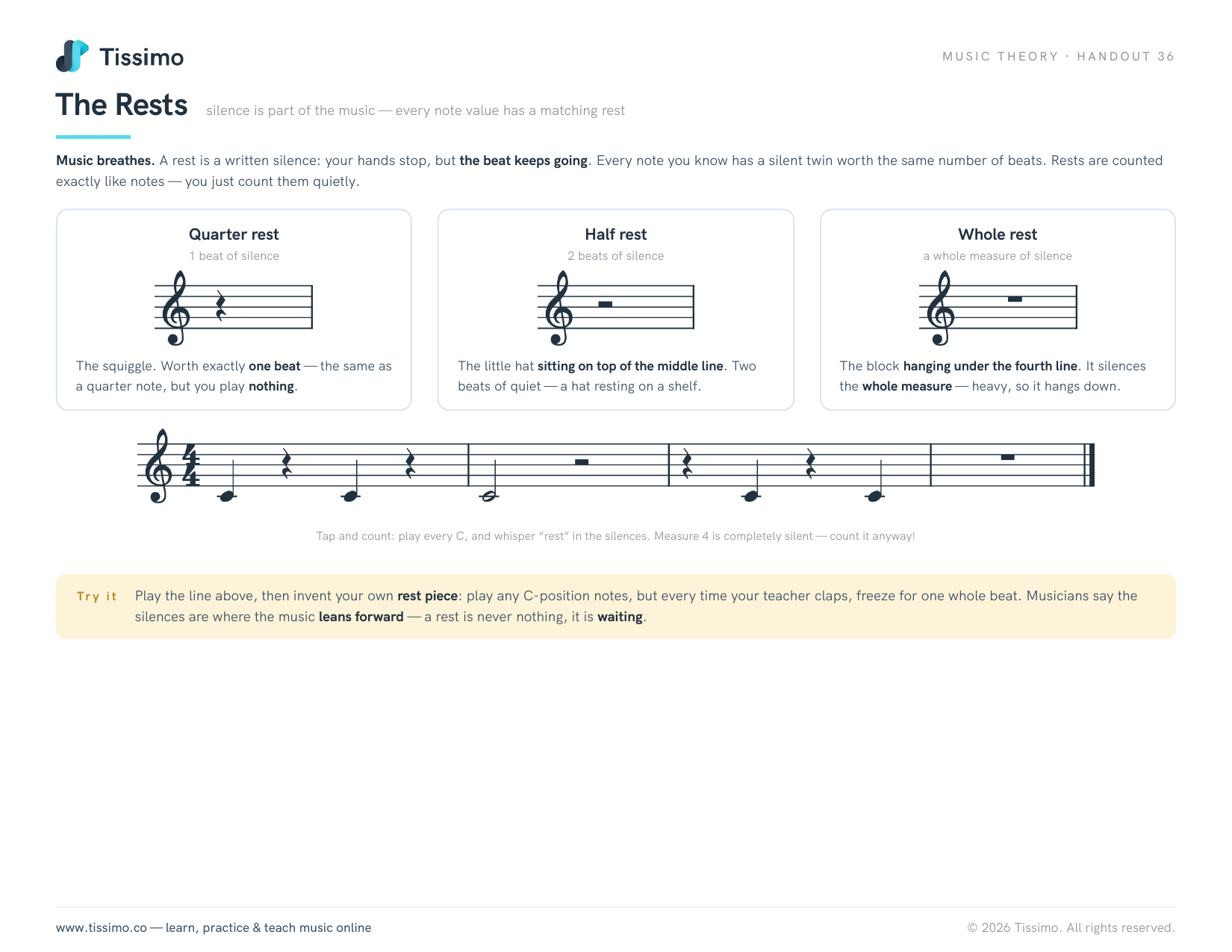 The Restssilence is part of the music — every note value has a matching rest
 The Rest Familyevery note has a silent twin — all five rests, whole to sixteenth
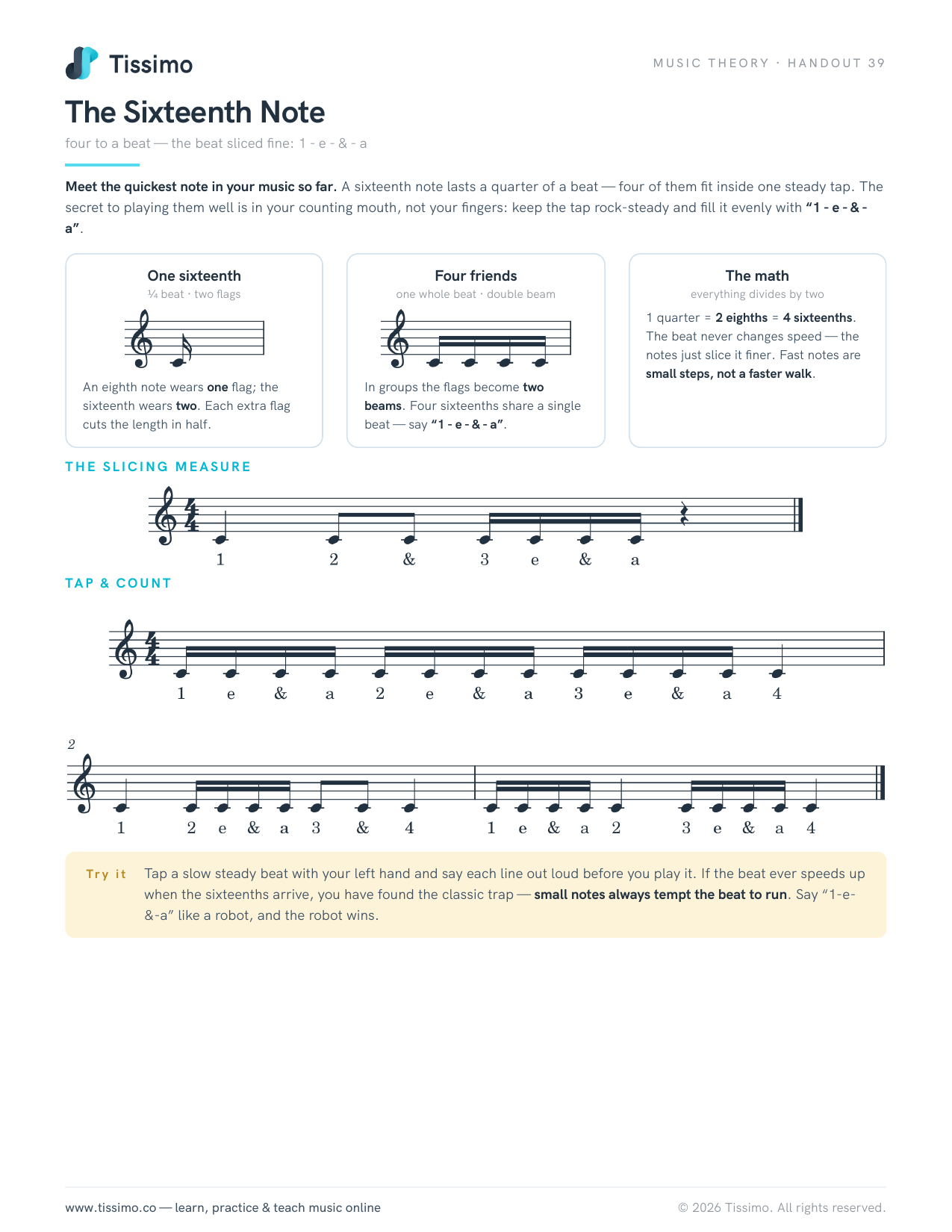 The Sixteenth Notefour to a beat — the beat sliced fine: 1 - e - & - a
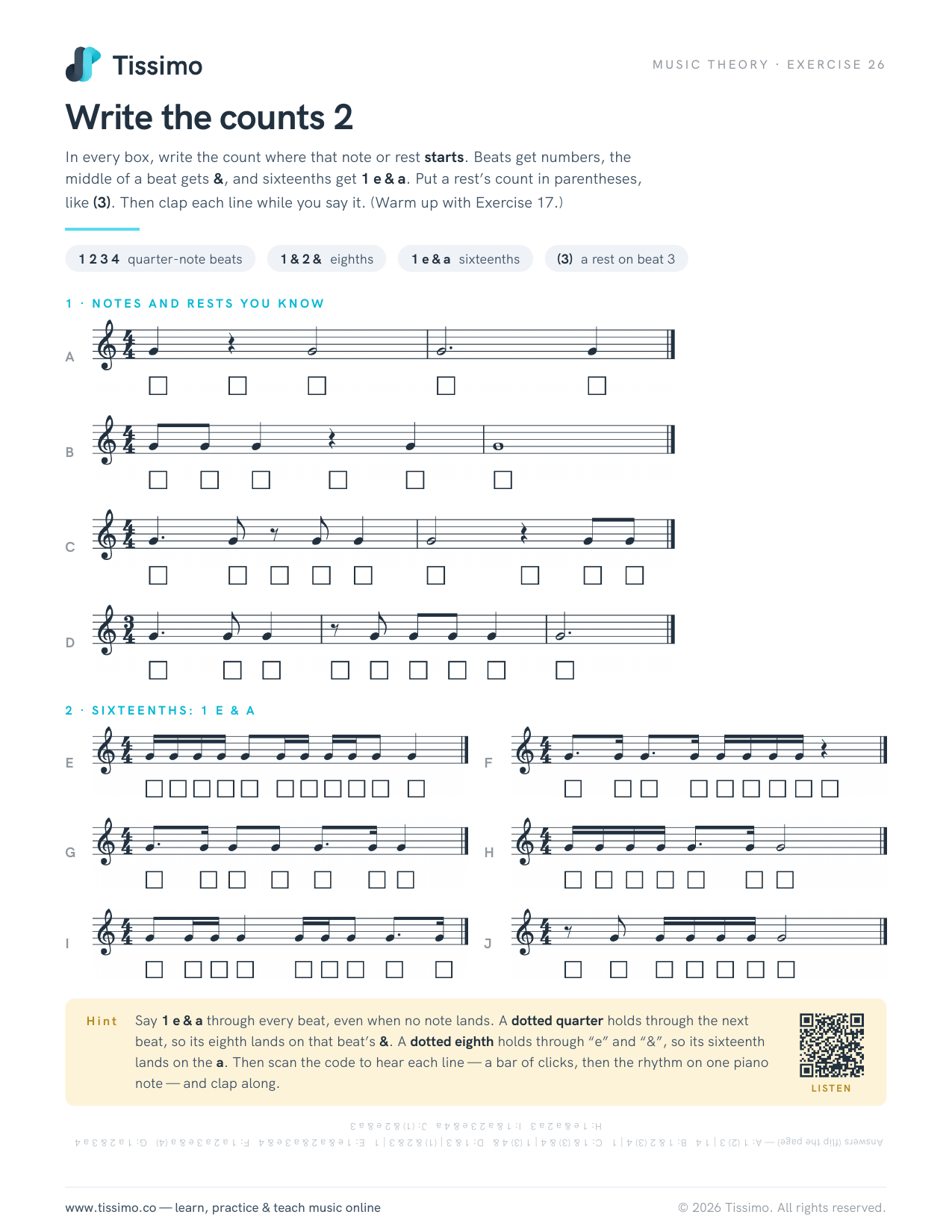 Write the counts 2In every box, write the count where that note or rest starts. Beats get numbers, the middle of a beat gets &, and sixteenths get 1 e & a. Put a rest’s count in parentheses, like (3). Then clap each line while you say it. (Warm up with Exercise 17.)
Comments