Chords & Harmony
Escape Tone
An escape tone is a non-chord tone approached by step and left by leap in the opposite direction. It usually decorates a weaker part of the beat between chord tones.
An escape tone takes a small step away from a chord tone, then leaps in the opposite direction to another chord tone. Its French name is échappée. The note is identified by both its melodic motion and the harmony beneath it.
An example over C major
Hold a C–E–G chord and play the melody E5–F5–C5. E5 and C5 belong to the chord, while F5 does not. The melody approaches F5 by an upward step and leaves it with a downward leap of a fourth. F5 is the escape tone.
Give the F a short duration on a weak subdivision, then let the C settle. If you remove the F, the underlying motion is simply E to C. The extra note decorates that motion without needing a new chord of its own.
Compare similar shapes
- A neighbor tone steps away and then steps back to the same pitch.
- A passing tone moves by step in the same direction between chord tones.
- An appoggiatura is commonly taught with leap-in, step-out motion, the reverse order of the escape tone's approach and departure.
Try it
Over the same C chord, compare E5–F5–E5 with E5–F5–C5. Label the F in each version. Then try G4–F4–C5: this time the approach steps down and the departure leaps up. Say the directions aloud before playing, and check that the middle note is outside the chord.
Common questions
Does an escape tone always step upward first?
No. It may step up and leap down, or step down and leap up. The step and leap go in opposite directions, and the decorated note is outside the current chord.
Practice it: free worksheets
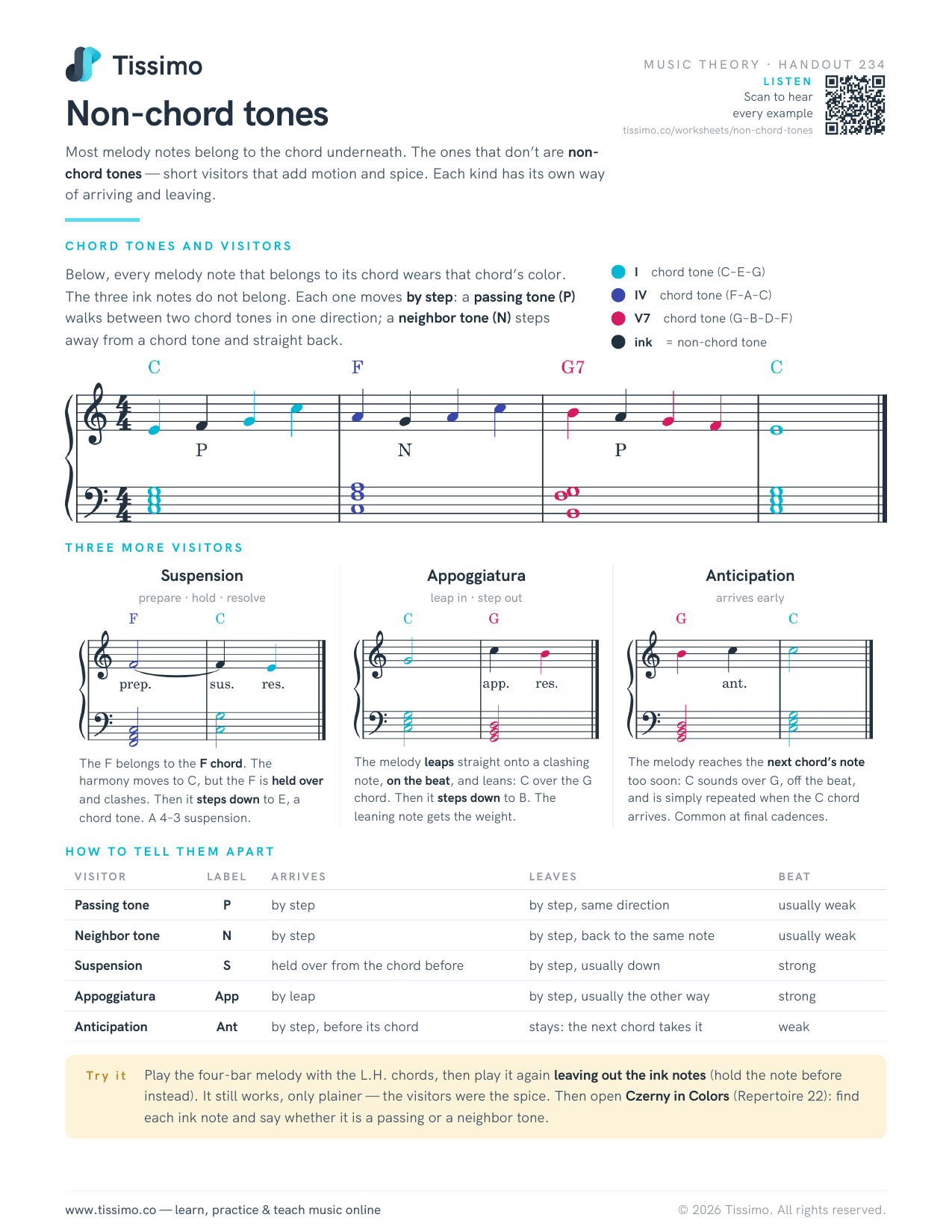 Non-chord tonesMost melody notes belong to the chord underneath. The ones that don’t are non-chord tones — short visitors that add motion and spice. Each kind has its own way of arriving and leaving.
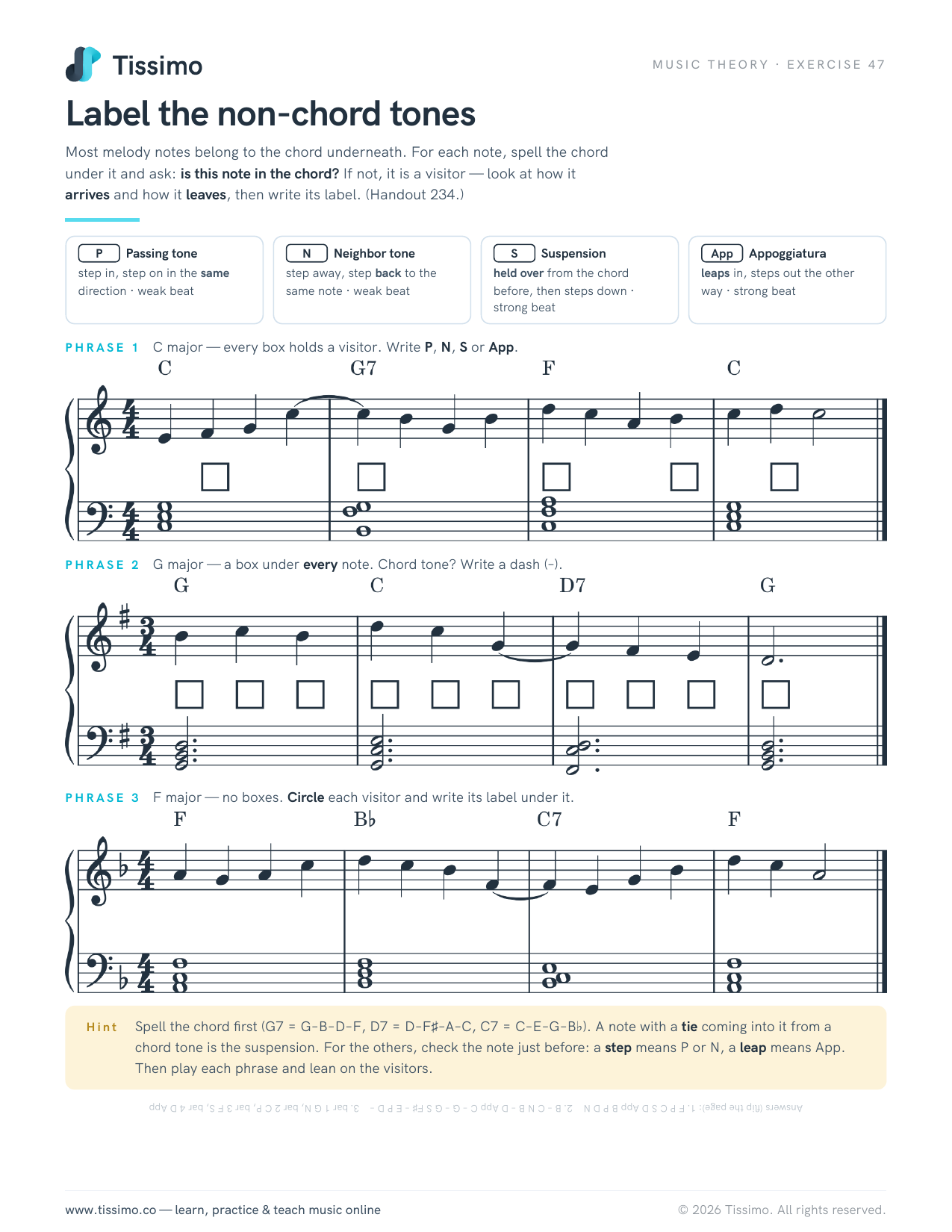 Label the non-chord tonesMost melody notes belong to the chord underneath. For each note, spell the chord under it and ask: is this note in the chord? If not, it is a visitor — look at how it arrives and how it leaves, then write its label. (Handout 234.)