Form & Structure
Tarantella
Pronounced tar-un-TEL-uh
A tarantella is a fast, whirling dance from southern Italy in 6/8 time, with running notes in groups of three. Its name probably comes from the city of Taranto, or from the tarantula spider.
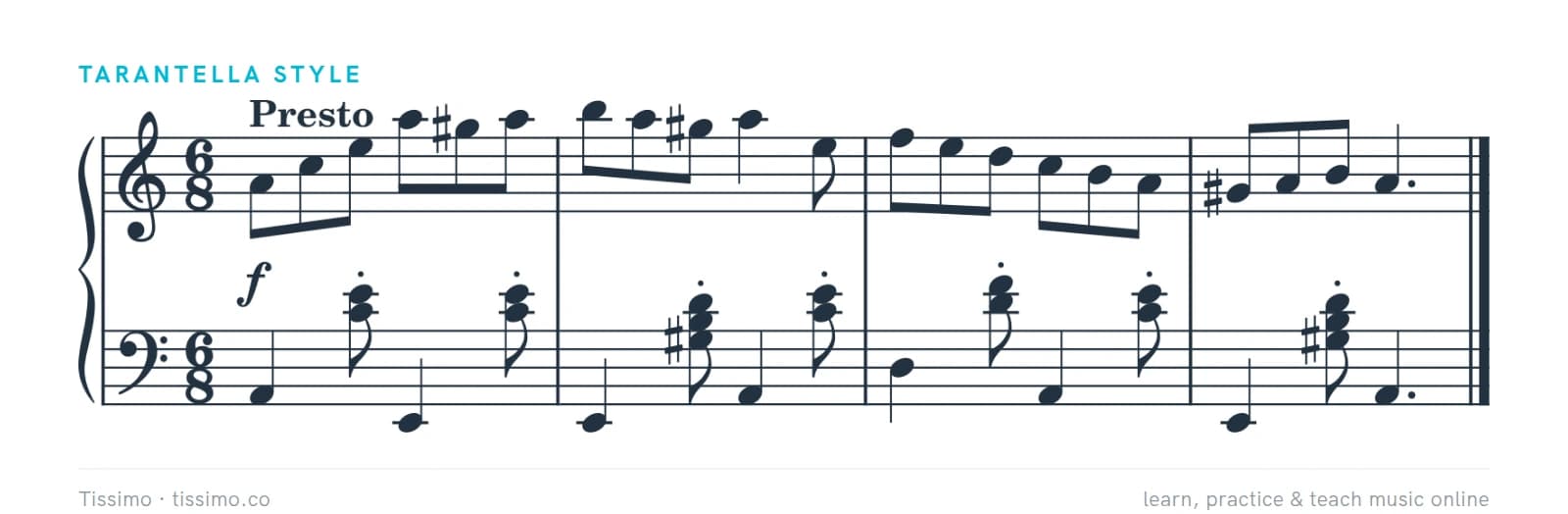
A tarantella is a fast folk dance from southern Italy, associated especially with Naples. It is in 6/8, a compound meter: two beats in each bar, and each beat divided into three quick eighth notes. Played at full speed, the music hardly stops for breath, and it can come close to a perpetual motion. As a folk dance it often gets faster and faster as it goes, and it may switch between major and minor.
The spider legend
The name probably comes from Taranto, a port city in the "heel" of Italy, or from the tarantula, a spider common there. An old popular belief held that the spider's bite could only be cured by dancing wildly to music, and the dance became linked with that cure. Treat the story as legend: what has come down to us is a dance, and a lot of exciting music.
The tarantella in concert music
Composers have also written tarantellas as concert pieces. Chopin's Tarantelle in A-flat major, Op. 43, was composed and published in 1841, and Rossini, Liszt and Mendelssohn used the dance as well. The saltarello, another fast Italian dance, is similar. You will also find the title in many collections of pieces for students, because it is an exciting way to practice evenness at speed.
How to play a tarantella
- Count two, not six. Feel each bar as two dotted-quarter beats, "1 & a 2 & a." The Simple vs compound and Time Signatures II worksheets practice exactly this.
- Lean slightly on each beat. Give the first of each group of three a little weight, and keep the other two light, so the music spins instead of plodding.
- Keep the left hand short. In piano tarantellas the left hand often plays a bass note and a short chord on each beat, as in the example. Short, bouncy chords keep the texture clear.
- Build speed gradually. Start slowly with a metronome clicking dotted quarters, and raise the tempo only when every group of three is even.
Tarantella or waltz?
Both are dances with groups of three, but a waltz is in 3/4: three beats in a bar, each a quarter note. A tarantella has two beats in a bar, each divided into three, and moves much faster.
Common questions
What time signature is a tarantella in?
Usually 6/8: two beats in each bar, each divided into three fast eighth notes. Some are written in 3/8, which groups the notes in threes in the same way.
Why is it called a tarantella?
The name probably comes from Taranto in southern Italy, or from the tarantula spider. An old popular belief held that wild dancing could cure the spider's bite.
Practice it: free worksheets
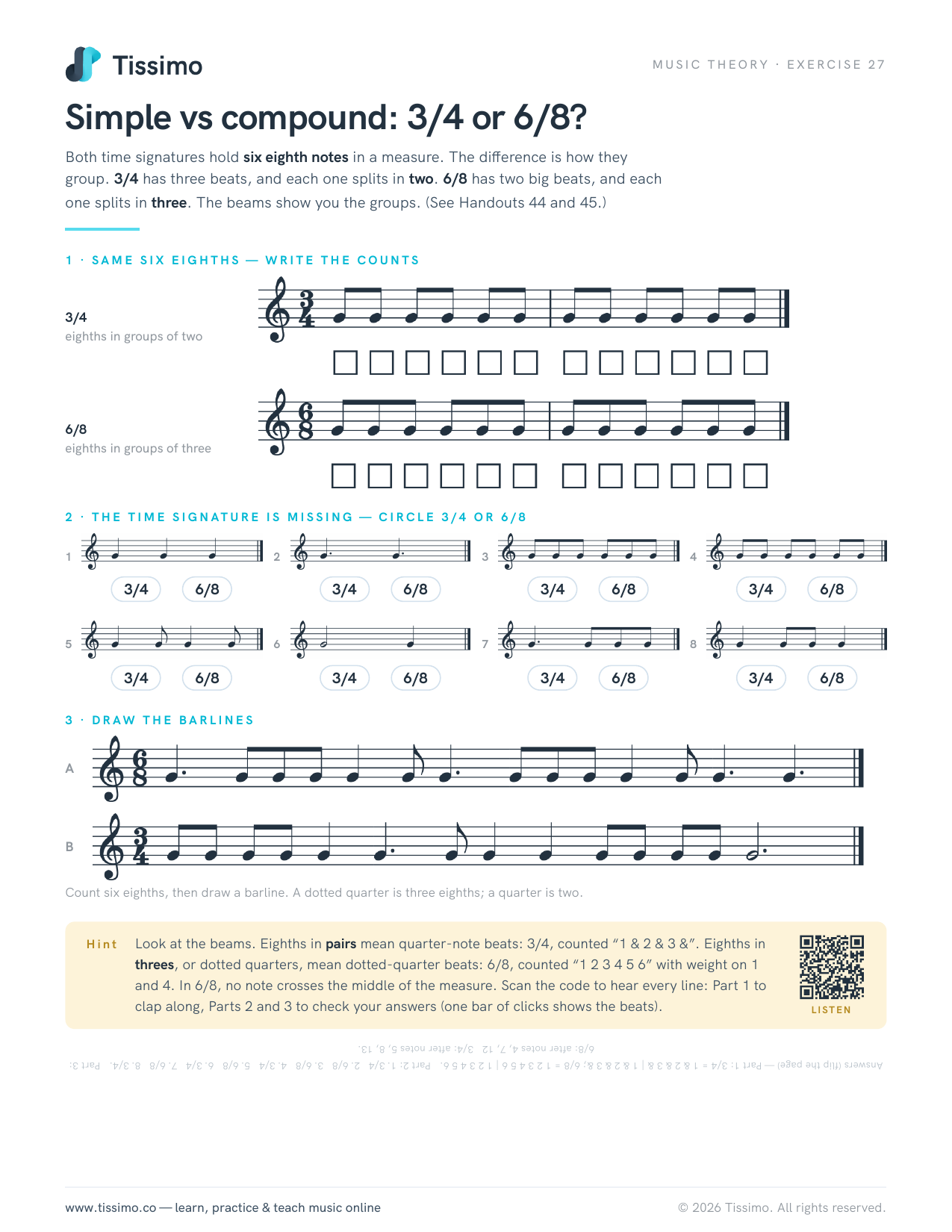 Simple vs compound: 3/4 or 6/8?Both time signatures hold six eighth notes in a measure. The difference is how they group. 3/4 has three beats, and each one splits in two. 6/8 has two big beats, and each one splits in three. The beams show you the groups. (See Handouts 44 and 45.)
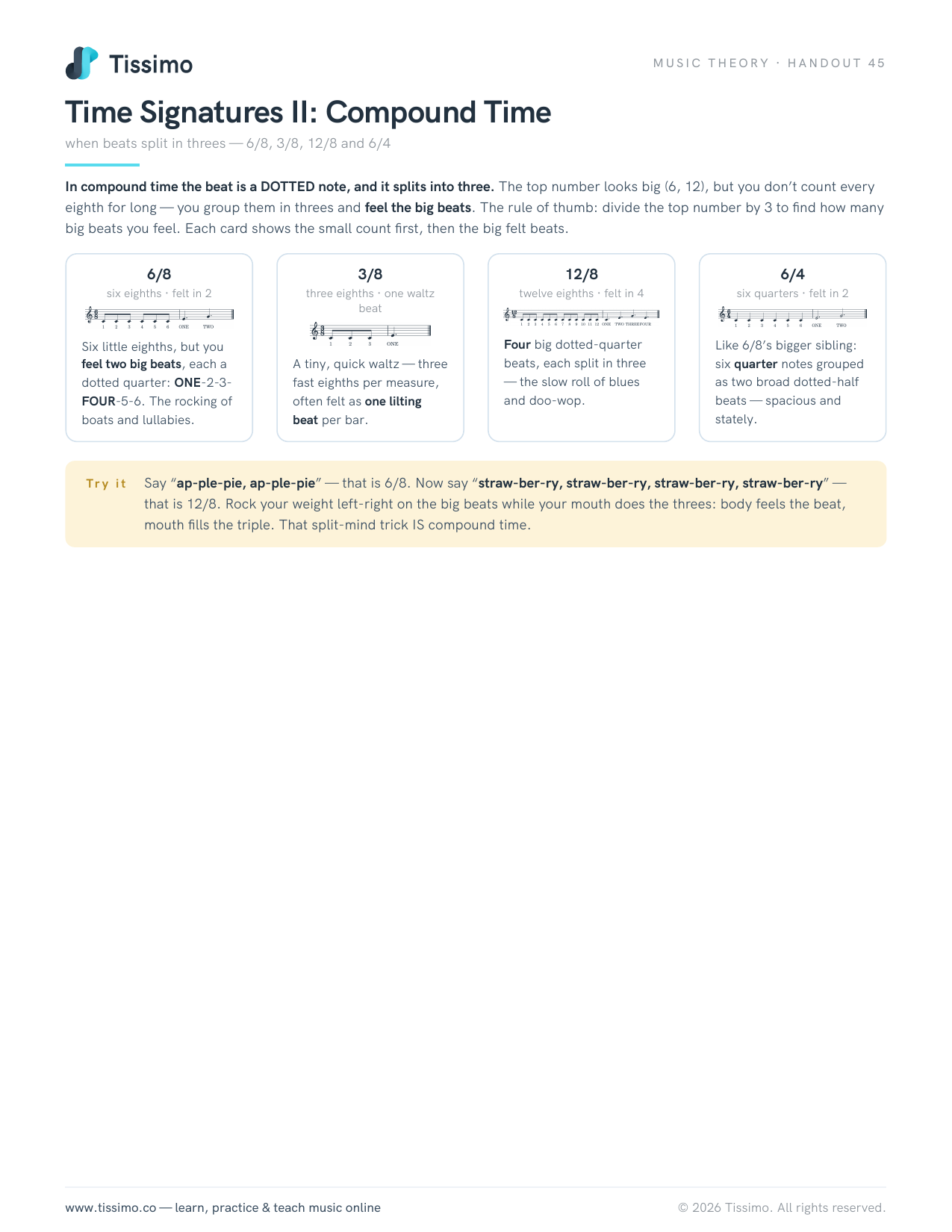 Time Signatures II: Compound Timewhen beats split in threes — 6/8, 9/8, 12/8 and 6/4
Comments