Technique & Performance
Sul Tasto
Sul tasto tells a string player to bow over the fingerboard, usually producing a more veiled tone with weaker upper harmonics. It specifies bow contact rather than a left-hand position or a soft dynamic alone.
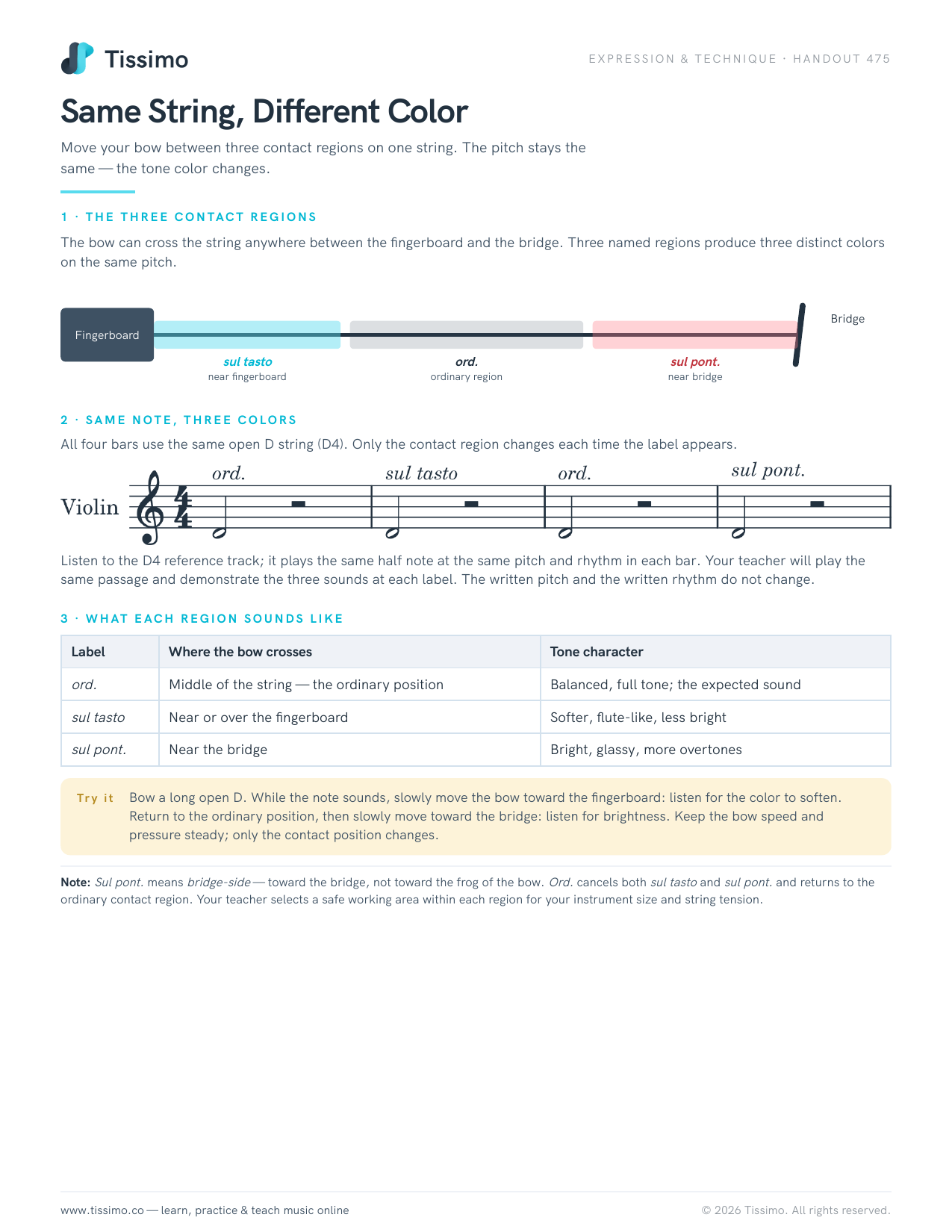
Sul tasto asks a bowed-string player to move the bow's contact along the strings toward or over the fingerboard. Compared with ordinary contact nearer the bridge, the sound usually has less prominent upper harmonics and a more veiled, airy quality. The instruction is about tone color, not just volume.
Contact point, not fingering
The bow hair still touches the strings. It is not an instruction to scrape the fingerboard, to move the left hand into a higher position or to choose a particular string. The written pitches remain the player's target.
For example, a violinist can compare the same open A with ordinary bow contact and with sul tasto contact. The note name stays A while the sound's color changes. Bow speed, weight and the instrument's response also affect the result, so no fixed distance from the bridge guarantees an identical tone everywhere.
Read the surrounding marks
Sul tasto is often used for quiet, delicate textures, but it is not interchangeable with piano. A passage still needs its own dynamic level and articulation. Molto sul tasto asks for a more pronounced contact-point effect, within the instrument's practical limits and the score's instructions.
An ord. or ordinario marking can restore ordinary contact after the passage. It does not automatically remove unrelated instructions such as a mute.
A contrasting color
Sul ponticello uses contact near the bridge and tends to emphasize upper partials. Moving between the two can change the color of a held note without composing a new melody. Both normally use bow hair; col legno instead involves the bow stick.
Common questions
Is sul tasto just another word for soft?
No. It asks for a bow-contact change that affects tone color. Soft playing is common with sul tasto, but the dynamic marking still specifies the intended loudness.
Does sul tasto tell the left hand where to play?
No. It concerns where the bow contacts the strings near or over the fingerboard, not a required left-hand position or a change of written pitch.