Tempo Markings
Quasi
Pronounced KWAH-zee
Quasi is an Italian word meaning 'almost' or 'as if'. It asks you to play in the manner of the word after it: quasi recitativo is like a recitative, quasi niente is almost nothing.
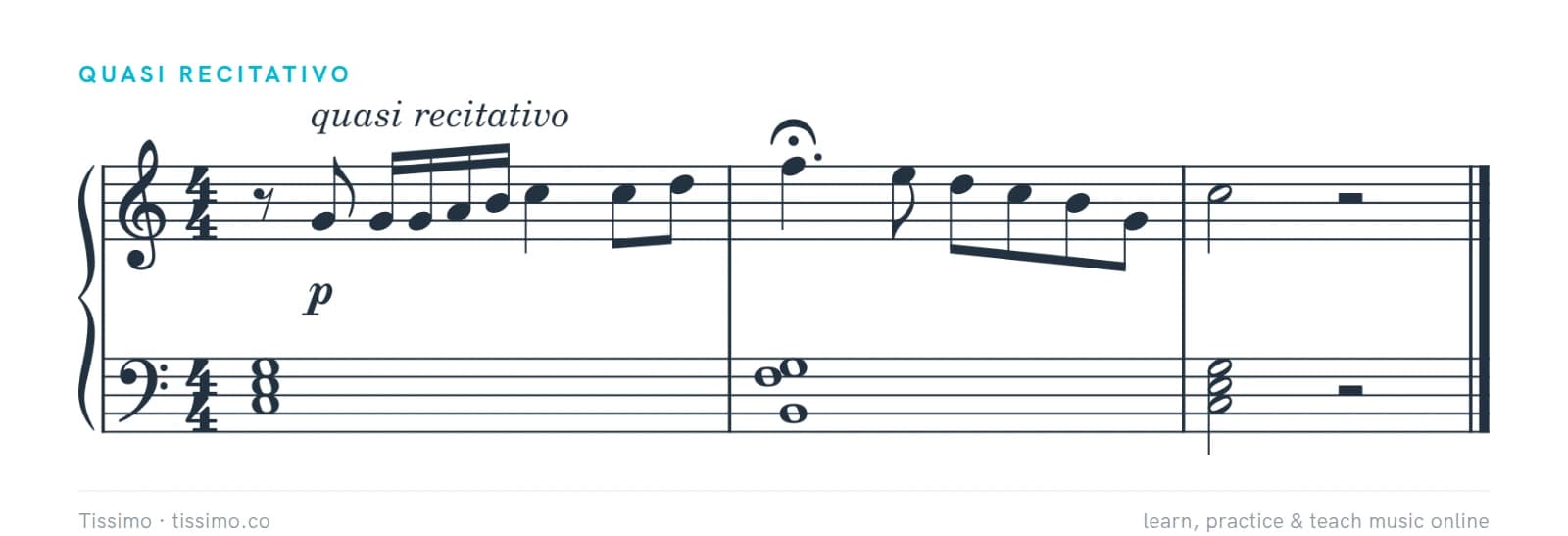
Quasi means "almost", "as if" or "like". It never stands alone: it points at the word after it and asks you to play in that manner without the music actually becoming that thing. A piano piece marked quasi recitativo has no singer, but you play the line as if someone were speaking it.
Quasi markings you will meet
- Quasi recitativo: like a recitative, free and speech-like, following the rhythm of imagined words more than a strict beat.
- Quasi cadenza: like a cadenza, with the freedom of a solo flourish.
- Quasi niente: almost nothing, barely audible, usually at the end of a fade.
- Quasi allegretto: like an allegretto, close to that speed and character.
- Quasi una fantasia: "like a fantasy". Beethoven used it in the title of his Sonata in C-sharp minor, Op. 27 No. 2, the "Moonlight", printed in Vienna in 1802 as a Sonata quasi una fantasia. Our Moonlight Sonata study explains what the title tells you about the piece.
Playing quasi recitativo
Shape the line like speech. Let repeated notes move forward the way unstressed syllables do, lean a little on the important note, and take time on held notes and fermatas. Keep the written rhythm recognizable, though: the marking asks for the freedom of rubato, not for new rhythms.
A common confusion
Quasi does not mean "exactly". Quasi allegretto is not a strict allegretto with a number, and quasi recitativo in an instrumental piece is still music in a meter. Read quasi as "in the style of", and let the word after it set the character. It is one of the small modifier words, like poco and sempre, that only make sense with their partner.
Common questions
What does quasi mean in music?
"Almost" or "as if". It changes the word after it: quasi recitativo means play like a recitative, and quasi niente means almost nothing, barely audible.
Comments