Tempo Markings
Colla Voce (Colla Parte)
Pronounced KOHL-lah VOH-cheh
Colla voce means 'with the voice': the accompaniment follows the singer's timing instead of a strict beat. Colla parte, 'with the part', asks the same for any soloist.
Colla voce means "with the voice". It is an instruction to the accompanist, or to the orchestra, to follow the singer's timing: wait where the singer holds a note, slow down when the singer slows, move on when the singer moves on. Colla parte, "with the part", says the same for any solo part, sung or played, and col canto, "with the song", is another name for it.
How it looks on the page
The words are usually printed in the accompaniment part, not in the solo line, at the point where the accompanist should stop leading. You will meet them in vocal music such as songs and arias, typically at a fermata, a free cadence or a phrase the singer shapes with rubato. The strict beat returns at a tempo or a new tempo marking.
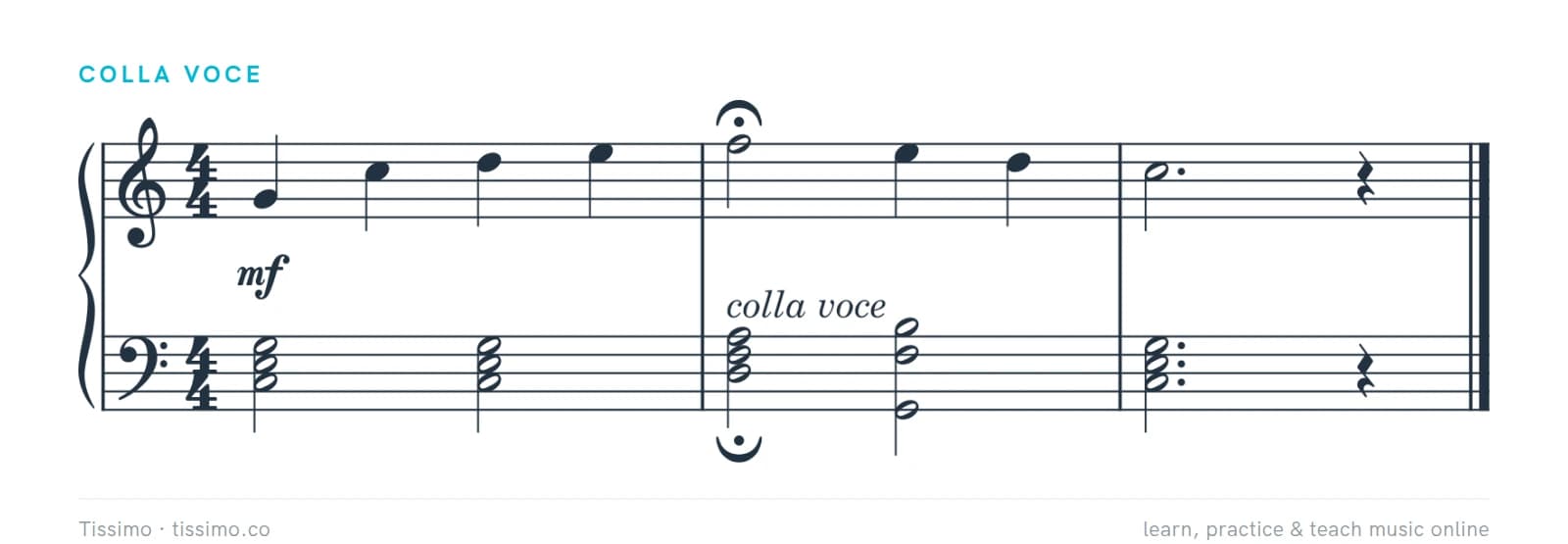
Playing colla voce
- Watch and listen. Follow the singer's breathing and words; the accompaniment moves when the voice moves.
- Lead into the held notes, then wait. Place your chord with the singer's note and hold it as long as the singer does.
- Agree in rehearsal, but stay flexible: colla voce means the singer may do it a little differently each time.
A common confusion
Colla voce does not mean that the accompaniment plays the voice's melody. It is about timing, not notes. (Doubling a line is a different instruction, such as coll'ottava, "with the octave".) The same habit of following the voice belongs to recitative. For the word colla itself, see con.
Common questions
What does colla parte mean?
"With the part": the accompaniment follows the timing of the solo part, sung or played, instead of keeping a strict beat. For a singer the same instruction is colla voce.
Comments