Form & Structure
Arabesque
Pronounced ar-uh-BESK
An arabesque is a florid, curling melodic figure, named after the flowing ornament of Arabic art. As a title, it names a light, decorative piece, usually for piano, such as Schumann's Arabeske or Debussy's two Arabesques.
The arabesque was first an idea from the visual arts: a flowing, interlaced ornament of curling lines, found in Arabic decoration and architecture. Musicians borrowed the word for something that looks and sounds similar.
Two musical meanings
- A florid figure: a decorated, curling melodic passage, full of quick turns and runs, inside any kind of piece. Compare ornaments, which decorate a single note; an arabesque decorates a whole line.
- A title: a piece of instrumental music, usually a character piece for piano, that promises a light, decorative character. Composers have used the title freely, so it tells you about mood and texture, not about form.
Arabesques by Schumann and Debussy
Robert Schumann's Arabeske, Op. 18, and Claude Debussy's Deux Arabesques (Two Arabesques) are the best-known pieces with this title, both for piano. Debussy's pair was published in 1891; leaving aside works published after his death, it can be counted as his first piece for solo piano. In both, the title promises grace and flowing lines rather than drama.
Burgmüller's Arabesque
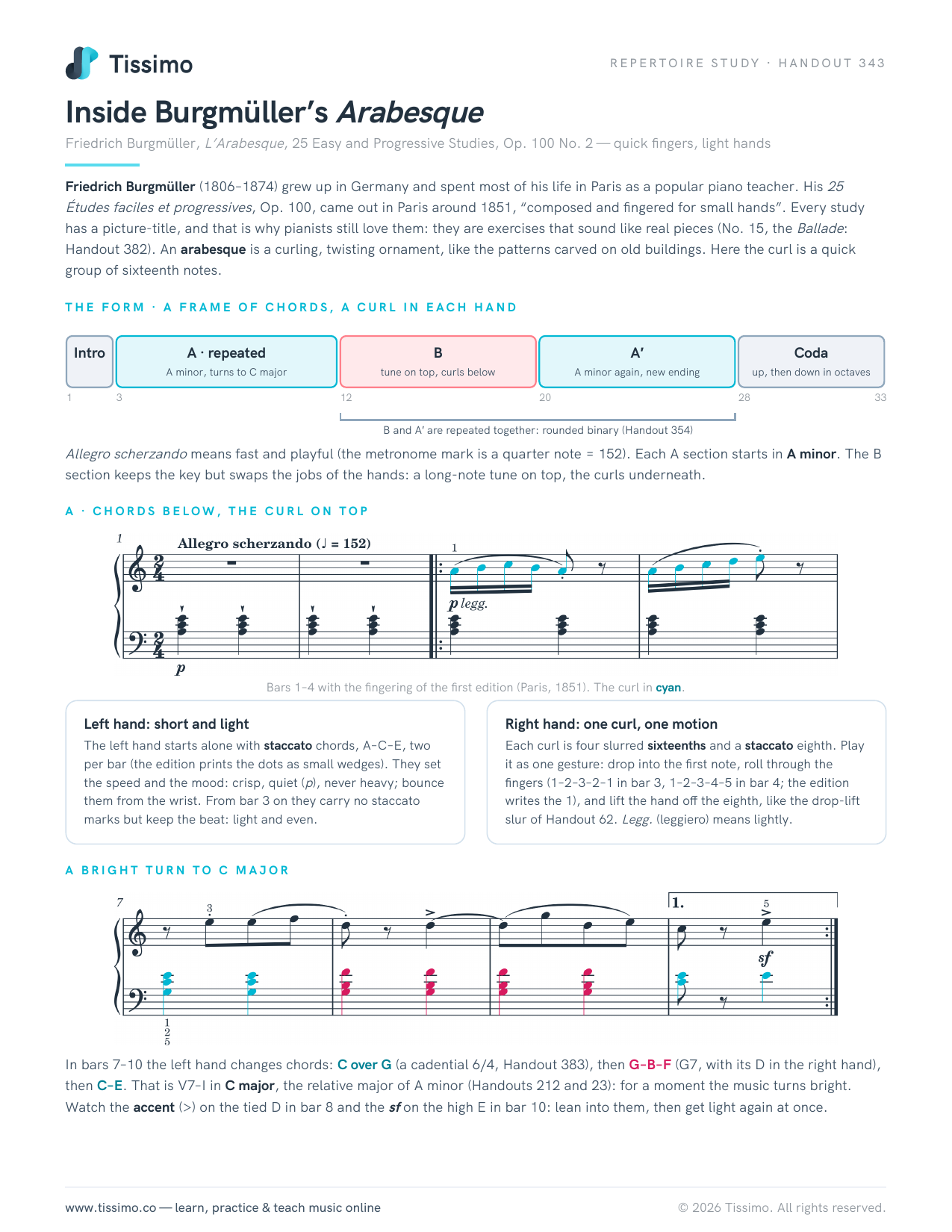
For many pianists the first arabesque they play is Friedrich Burgmüller's, No. 2 of his 25 Easy and Progressive Studies, Op. 100 (Paris, around 1851). It is in A minor and marked Allegro scherzando, fast and playful. Its "curl" is a quick figure of four slurred sixteenth notes followed by a staccato eighth note. It starts in the right hand over light staccato chords; in the middle section it moves to the left hand, under a singing tune. The Arabesque study walks through the piece bar by bar.
Playing an arabesque
- Think in gestures, not notes. Play each curl as one movement of the hand: drop into its first note, roll through the fingers and lift off at the end.
- Keep it light. Most arabesques want a leggiero touch; heavy fingers flatten the curves.
- Shape the line. A curl usually leads somewhere: let it grow slightly toward its goal.
Not the ballet arabesque
In ballet, an arabesque is a pose: the dancer stands on one leg with the other extended behind. It has the same origin in the visual arts but nothing to do with a musical figure, apart from the elegant curve it draws.
Common questions
What is an arabesque in music?
Either a florid, curling melodic passage, or the title of a light, decorative instrumental piece, usually for piano, such as Debussy's two Arabesques or Burgmüller's Arabesque, Op. 100 No. 2.
Comments