 Back

Bossa Nova Explained: The Rhythm, the Chords and Where It Came From
Play a Cmaj7 chord on the off-beats, keep a quiet bass note on beats 1 and 3, and sing the tune as if you were telling it to one person across a small room. That gets you a long way toward the sound of bossa nova. The rest is history, harmony and a lot of restraint. This guide walks through where the style came from, what the guitar (or the pianist's two hands) actually does, which chords carry the sound, and how to practice it so it feels relaxed instead of mechanical.
Where bossa nova came from
Bossa nova is usually described as a relaxed style of samba that developed in the late 1950s and early 1960s in the South Zone of Rio de Janeiro, with jazz, choro and classical music among its influences. Three names sit at the center of the story. João Gilberto (born in Juazeiro, Bahia, in 1931; died in Rio in 2019) was the guitarist and singer. Antônio Carlos "Tom" Jobim (1927–1994) was the composer and arranger. Vinícius de Moraes (1913–1980) was a poet and diplomat who wrote lyrics for Jobim.
The song that is most often called the starting point is "Chega de Saudade," by Jobim and Moraes. It was introduced in 1958, and its first appearance on record was on Canção do Amor Demais, an album by the singer Elizeth Cardoso, with Gilberto accompanying her on guitar. Gilberto's own LP, also titled Chega de Saudade, came out on Odeon in March 1959, with arrangements and musical direction by Jobim, and is often credited as the first bossa nova album. Not everyone agrees on a single "first": some historians point to "Desafinado" instead, which is also on that 1959 LP. Treat "first bossa nova song" as a convenient label, not a settled fact. What is clear is that the sound belonged to a small group of friends and collaborators in Rio before the world heard it, and that Jobim's harmony, Moraes's words and Gilberto's guitar and voice were three parts of one idea.
Even the name has a hazy origin. One account says the term "bossa nova" may first have been used in public for a 1957 concert by a Brazilian university group, but the same source says the exact origin of the term stayed unclear for decades. What is solid is the timeline below: a handful of dated steps from a Rio record to a worldwide hit.

Dated steps from the sources at the end. On November 21, 1962, a Bossa Nova concert was presented at Carnegie Hall in New York. Getz/Gilberto was released in March 1964; at the 1965 Grammys it won Album of the Year, and "The Girl from Ipanema" won Record of the Year.
"The Girl from Ipanema" ("Garota de Ipanema") was written in 1962 with music by Jobim and Portuguese lyrics by Moraes; English lyrics by Norman Gimbel came later. The Getz/Gilberto version, made in New York in March 1963 with Stan Getz, João Gilberto and Jobim, featured the vocal debut of Astrud Gilberto and became an international hit. If you only know one bossa nova record, it is probably that one, and it is worth knowing it is a later, polished export of something that began as an intimate Rio sound.
How it relates to samba
Samba is a broad family of rhythms that originated in Afro-Brazilian communities in Bahia in the late 19th and early 20th centuries; the modern urban samba that took shape in Rio at the start of the 20th century is predominantly in 2/4. A samba band is loud and percussive: surdo (a big bass drum), pandeiro, tamborim, cuíca, ganzá. Bossa nova keeps that pulse but shrinks the band to a nylon-string guitar played with the fingers. One description puts it neatly: the thumb stylizes the surdo, while the fingers phrase their chords like a tamborim.

Facts from the samba and bossa nova sources listed at the end. Bossa nova is often notated in 2/4 and typically played without swing.
Two consequences matter at your instrument. First, the eighth notes are straight, not swung, which is the opposite of the lilting jazz feel. Keep the two eighths of a beat even. Second, the music is often notated in 2/4 (two quarter-note beats per bar). A 2/4 chart writes the same groove in note values half as long: one 4/4 bar of the pattern below becomes one bar of 2/4, with the bass on both beats and the chords on sixteenth-note off-beats. If you have not met 2/4 before, the Two Beats in a Bar: 2/4 & Cut Time sheet covers it.
The guitar pattern (the batida)
Gilberto's guitar technique is called the batida. In one common description (in 2/4), the thumb plays the bass notes on both beats, while the fingers play the chord in unison on the two eighth notes of beat 1 and on the second sixteenth note of beat 2; across a two-bar pattern the syncopation usually shows up in the second bar. Players, teachers and transcribers all write it a little differently, and even Gilberto varied it from song to song.
So here is a simplified practice pattern, counted in 4/4. It is not the textbook batida above and it is not a transcription of Gilberto: it keeps two bass notes per bar and puts the chords only on the off-beats, so you can hear the syncopation clearly. Think of it as training wheels, not as Gilberto's exact playing.
- Thumb (bass): beats 1 and 3, the root first, then the chord's fifth, usually played below it (a fourth lower); when the root is already your lowest note, as on G7♭9 here, the fifth goes above.
- Fingers (chord): on the "&" of 1, the "&" of 2 and the "&" of 4.

The simplified pattern at a glance. Count 1-&-2-&-3-&-4-&.
Compare it with the "square" version most beginners play first, chords on 2 and 4. The bass stays the same; only the chord rhythm changes.

Same chord, same bass. Bar 1 is square; bar 2 is the bossa pattern. The right hand plays E–G–B; the left hand plays C on beat 1 and the chord's fifth, G, a fourth lower on beat 3.
The off-beat chords are a form of syncopation: the Tissimo sheet defines it as the emphasis slipping off the main beats onto the "&"s between them, while your foot keeps tapping. If you want more rhythm theory behind this, the article Syncopation Explained: Playing Off the Beat goes deeper. Tap your foot on 1-2-3-4 the whole time. The groove is the polite disagreement between foot and hands.
The harmony: jazz chords, softly
The harmony is where bossa nova sounds closest to jazz. Jazz did influence it, but samba guitarists were already using similar rich chords in the 1920s, so the two styles grew toward each other as much as one borrowed from the other. Writers on the style describe the chords as unconventional, with complex progressions and ambiguous harmonies; a sixth and a ninth added to a C major chord is a classic example, shown below. You do not need extended chords to start, though. Four seventh-chord types cover a great deal of ground, and you can read about the family in the sheets on the major 7th, minor 7th, dominant 7th and half-diminished 7th.
- Cmaj7 (C–E–G–B): the major 7th is 11 half steps above the root. Soft and unhurried; it can ring forever.
- Dm7 (D–F–A–C): a minor triad with a minor 7th, 10 half steps above the root. Mellow, and happy to keep moving.
- G7♭9 (G–B–D–F–A♭): a dominant 7th plus a flattened ninth. Tense, and it pulls toward C.
- Dm7♭5 (D–F–A♭–C): half-diminished, a minor 7th chord with the fifth lowered. Jazz charts usually write it m7♭5; classical scores write ø7.

The four chords as stacked thirds from the root (the half-diminished chord is the one to know for minor-key ii–Vs). The G7♭9 includes its root; in a band the bass often supplies it.
If a chord symbol like this looks unfamiliar, the Chord Symbols chart shows the standard ways to write maj7, m7, 7 and m7♭5.
Guitarists can reach the same four chords with the grips below. Three of the grips leave the low E string free (the Cmaj7 and Dm7 grips skip the D string too; G7♭9 has its root on the low E and its beat-3 bass on the A string), so the thumb can play the root and, on beat 3, the fifth shown as a hollow dot, while the fingers pluck the three highest strings of the grip.

Fret numbers read from the low E string on the left to the high e string on the right; x means the string is not played. A hollow dot is the thumb's beat-3 bass note, played on a string the grip itself leaves out. Cmaj7 = C–B–E–G, Dm7 = D–C–F–A, G7♭9 = G–F–B–D–A♭, Dm7♭5 = D–A♭–C–F.
Once those feel comfortable, bossa nova players like to add color. A ninth on top of a seventh chord gives Cmaj9 or Dm9, and a sixth plus a ninth gives the soft, open C6/9, a favorite for a final chord that should just ring.

Cmaj9 and Dm9 add a ninth to the seventh chords above; C6/9 adds a sixth and a ninth to a plain C major triad. You can swap Cmaj9 or C6/9 for Cmaj7, or Dm9 for Dm7, once the plain version is steady.
The ii–V–I at the center
Many bossa nova tunes lean heavily on the ii–V–I, and the ii–V–I in Every Key sheet is a good place to practice it: it strips each chord to its 3rd and 7th, the guide tones, so you can see two voices barely moving. In C that is Dm7 – G7 – Cmaj7. Bossa nova often colors the middle chord with a flattened ninth. For a full explanation of how and why it works, see The ii–V–I Progression Explained.
Here is the pattern from above applied to a ii–V–I, with a smooth right-hand voicing: the F in Dm7 stays on F in G7♭9, then falls to E in Cmaj7; A falls to A♭ and then to G; C falls to B and then stays on B. Nothing moves more than a half step, which is a big reason it sounds so calm.

Right hand: F–A–C, then F–A♭–B, then E–G–B. Left hand: D then A (below), G then D, C then G (below). Bar 4 repeats Cmaj7 so the pattern settles.
In a minor key the same idea uses the half-diminished chord you met above: Dm7♭5 – G7♭9 – Cm6 is a ii–V–i in C minor. The voices still barely move: F stays on F, then falls to E♭; A♭ stays on A♭, then falls to G; C falls to B, then to A.
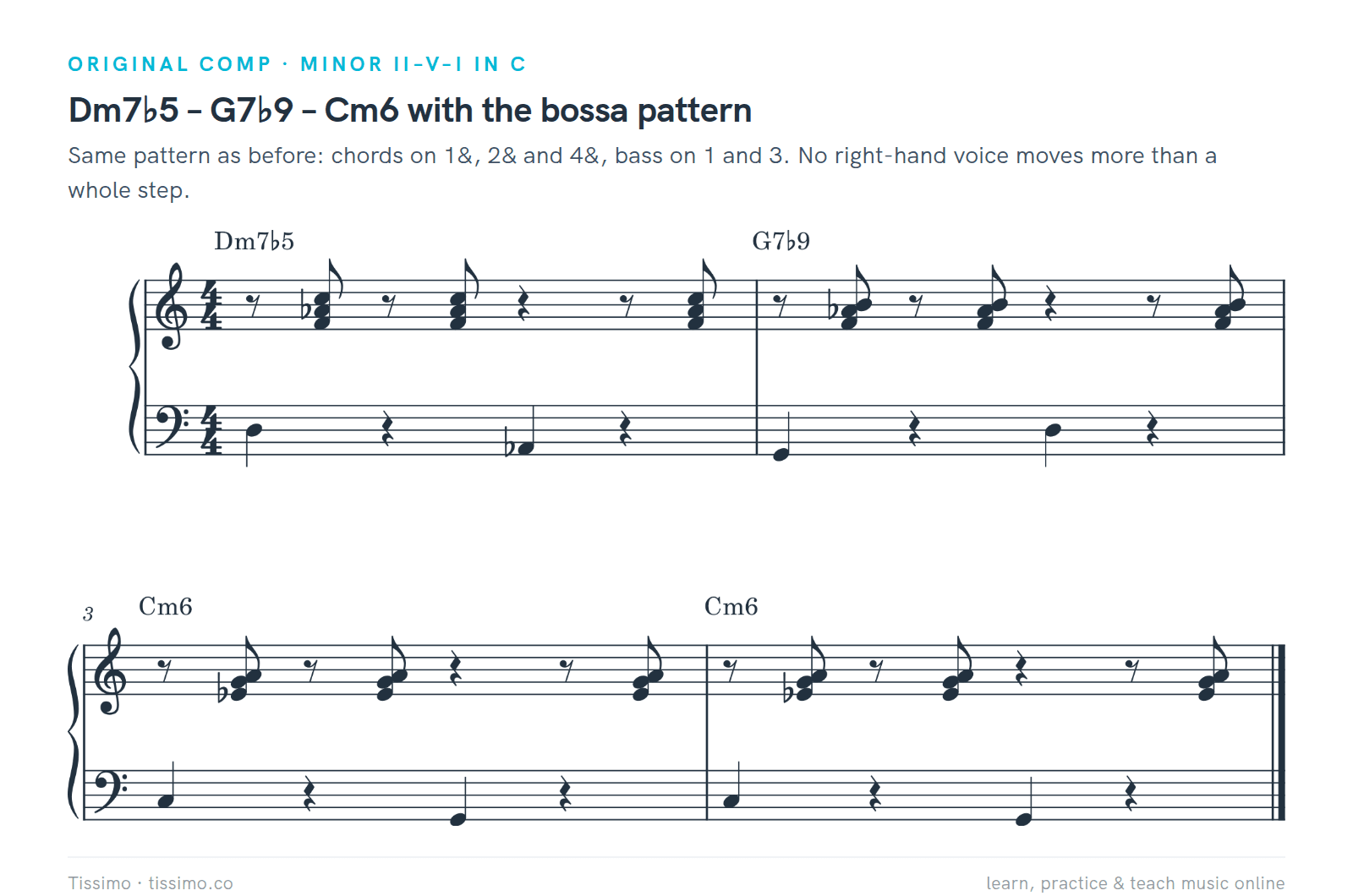
Right hand: F–A♭–C, then F–A♭–B, then E♭–G–A. Left hand: D then A♭ (below), G then D, C then G (below). Bar 4 repeats Cm6.
If you need a fuller, jazz-style left hand, voicings with just the root and one guide tone are a standard answer. The Shell Voicings sheet teaches the root plus the 3rd or the 7th as a two-note left hand.
A short original progression
Here is an original eight-bar progression in C that uses everything above. Bars 1–4 are a gentle turnaround, I–VI7–ii–V: Cmaj7, then A7♭9 (a secondary dominant that leads to Dm7), then Dm7–G7♭9. Instead of resolving, G7♭9 slips to Em7 in bar 5. In bars 5–7 each ii–V points to a target a half step lower than the last: the first leads toward D, the second toward D♭, the third toward C. Only the last pair actually resolves, to Cmaj7 in bar 8. That is what "chromatic ii–V" means here: the pairs themselves move down by half step.

Chord symbols only (the rests mean "play the pattern"). Bar 5: Em7–A7♭9; bar 6: E♭m7–A♭7; bar 7: Dm7–G7♭9, two beats each.
Try it with the practice pattern: one chord per bar in bars 1–4 and 8, two chords per bar (two beats each) in bars 5–7. When two chords share a bar, keep the bass on 1 and 3, so each chord gets one bass note: the first chord takes the "&" of 1 and the "&" of 2, and the second chord takes the "&" of 4.
The singing style
Bossa nova singing is quiet. Gilberto's vocal style has been described as laid-back and understated, and one account says his way of singing samba was inspired by Dorival Caymmi. A review of his 1959 LP in the newspaper O Estado de S. Paulo praised his sobriety in interpretation. For you, that means a few practical things:
- Sing at speaking volume. If you push, the style disappears.
- Keep the tune close to the written notes and let the rhythm of the words do the work.
- Keep the guitar or piano steady and let the voice float over it; don't let the voice pull the accompaniment along.
Listen for it in Gilberto's recordings: the voice and the guitar sound almost like one instrument, each leaving room for the other. When you sing along, try humming the melody once with only the thumb playing, then add the chords. If the tune feels rhythmically free against a steady guitar, you are on the right track.
How to practice it
Common mistakes
Most first attempts fall into the same few traps. Swinging the eighths turns the groove into a shuffle; keep them even. Hammering the bass makes the thumb louder than the chords, when it should be the quietest, steadiest voice in the texture. Playing every beat with the chord removes the syncopation entirely. And rushing the off-beats, pulling them early because they feel risky, makes the pattern sound nervous. Record yourself once a week at the same slow tempo; the difference between "square" and "relaxed" is easy to hear on playback and hard to feel in the moment.
A five-step plan
Another common mistake is trying to play and sing everything at once. Split it up, as in this plan.

A practice ladder. Use a slow tempo, and stay at each step until it feels boring.
- Thumb alone. Root on 1, fifth on 3. Count out loud, 1-&-2-&-3-&-4-&. Keep the pulse steady; the Tempo & the Metronome handout is a good guide to setting a metronome and stepping the tempo up slowly.
- Chords alone. Mute the bass and play only the three off-beat chords. Say the "&" out loud.
- Both, on one chord. Cmaj7 at about 60 beats per minute, with the foot tapping every beat.
- Change chords. Dm7, G7♭9, Cmaj7, keeping the pattern identical. Only the shapes change.
- Add the voice. Hum a slow melody first, then words.
On guitar, play it fingerstyle: thumb on the bass strings, fingers on the upper strings. On piano, use the left hand for the bass notes and the right hand for the off-beat chords, as in the figures above. For the jazz side of the story, What Is Jazz? is a good wider read.
A short listening list
Titles only; look them up on whatever service you use. Listen first for the guitar, then for the voice, then for the chords:
- "Chega de Saudade" (Elizeth Cardoso, with João Gilberto on guitar, 1958)
- "Chega de Saudade" (João Gilberto, 1959)
- "Desafinado" (João Gilberto, 1959)
- "Brigas, Nunca Mais" (João Gilberto, 1959)
- "Hô-Bá-Lá-Lá" (João Gilberto, 1959)
- "The Girl from Ipanema" / "Garota de Ipanema" (Getz/Gilberto, 1964)
- "Corcovado" (Getz/Gilberto, 1964)
Free worksheets for this lesson
- Syncopation — straight versus off-beat lines, counted "1-&-2-&"
- Two Beats in a Bar: 2/4 & Cut Time — reading and counting 2/4
- The major 7th — Cmaj7 built from a major triad, and how it differs from C7
- The minor 7th — Dm7 and the ii7–V7–I walk
- The dominant 7th — G7 and why it wants to resolve
- The half-diminished 7th — Bø7 / Bm7♭5 and how it sets up a minor ii–V–i
- The ii–V–I in Every Key — guide tones and two-hand loops in any key
- Shell Voicings — root plus a 3rd or 7th in the left hand
- Chord symbols — a reference for reading chart symbols
- Tempo & the Metronome — setting and raising a practice tempo
Next steps
Bossa nova rewards patience: the notes are simple, and the feel is everything. A Tissimo guitar or piano teacher can listen to your thumb and your off-beats in a live lesson and tell you whether the groove is settling. You can book a lesson when you want that kind of feedback.
Sources
- Bossa nova — Wikipedia
- Chega de Saudade (album) — Wikipedia
- Alguns discos clássicos já nascem grandes — Acervo Estadão
- João Gilberto — Wikipedia
- Antônio Carlos Jobim — Wikipedia
- Vinícius de Moraes — Wikipedia
- Getz/Gilberto — Wikipedia
- The Girl from Ipanema — Wikipedia
- Samba — Wikipedia
- The Birth of Bossa Nova — WFAE / WBGO (NPR)
- How João Gilberto's Music Sparked An Aesthetic Revolution — NPR (Texas Public Radio copy)
- Album of the Year, 1965 winners and nominees — Grammy.com
- Record of the Year, 1965 winners and nominees — Grammy.com
Read this article online: https://tissimo.co/articles/bossa-nova-explained-rhythm-chords-and-history




Comments