 Back

The ii–V–I Progression Explained: The Heart of Jazz Harmony
Pick up any jazz lead sheet — "Autumn Leaves," "Fly Me to the Moon," "There Will Never Be Another You" — and within a few bars you will find the same three-chord pattern: a minor seventh chord, a dominant seventh, and a major seventh on the tonic. That pattern is the ii–V–I progression, the single most important harmonic structure in jazz. Understanding it means understanding how jazz harmony thinks: where it wants to go, why it sounds inevitable when it resolves, and how to use it in every key.
What the ii–V–I is
The progression takes three consecutive scale steps and builds a seventh chord on each one. In C major, those steps are D, G and C — scale degrees two, five and one — giving:
- ii: Dm7 (D–F–A–C)
- V: G7 (G–B–D–F)
- I: Cmaj7 (C–E–G–B)
The roots descend by fifths: D → G → C. That circle-of-fifths motion is one of the strongest root movements in tonal music. Add the internal tension of the dominant seventh and the smooth voice-leading between the three chords, and you have a progression that pulls toward its resolution more forcefully than almost anything else.
Each chord has a function. The ii chord (Dm7) acts as a predominant — it prepares the dominant without being the tonic itself. The V chord (G7) is the dominant, the point of maximum tension. The I chord (Cmaj7) is the tonic, the point of rest. What makes the ii–V–I more effective than a plain V–I is that the ii chord eases the ear into the dominant: the motion from Dm7 to G7 is itself a small circle-of-fifths step (D to G), so the listener has two descending-fifth arrivals in a row before reaching home.

The ii–V–I progression in C major. All three chords are seventh chords: Dm7, G7 and Cmaj7. Notice the root motion by descending fifths: D → G → C.
Why it works: the tritone in G7
The dominant seventh chord is the engine of the progression. G7 contains a tritone — an augmented fourth or diminished fifth — between its third and seventh: B and F. Those two notes are six half steps apart, the most dissonant interval in Western tonal harmony.
At the resolution to Cmaj7, the tritone resolves by contrary motion: B, the leading tone, rises a half step to C (the root of Cmaj7). F, the chordal seventh, falls a half step to E (the third of Cmaj7). This contrary inward resolution — both notes pulling toward each other — produces the feeling of harmonic arrival that jazz musicians and listeners find irresistible.
For the ii–V–I, the key point is that the tritone is built into V7, which is why the dominant seventh always creates tension that resolves to I.

The tritone B–F in G7 resolves to C–E in Cmaj7. B rises by half step (the leading-tone resolution); F falls by half step (the chordal seventh resolves down). Both voices move by half step in contrary motion.
Guide-tone voice leading
Jazz musicians talk about "guide tones" — the third and seventh of each chord, the two notes that define a chord's quality and carry most of its harmonic information. Watch what happens to the guide tones as the ii–V–I unfolds in C major:
| Chord | 3rd | 7th | |-------|-----|-----| | Dm7 | F | C | | G7 | B | F | | Cmaj7 | E | B |
Two smooth voice-leading lines run through the progression:
Upper guide-tone line: F (7th of Dm7) → F (7th of G7, common tone) → E (3rd of Cmaj7, stepwise down). The F is held or repeated across the first barline, then falls a half step.
Lower guide-tone line: C (7th of Dm7) → B (3rd of G7, semitone down) → B (7th of Cmaj7, common tone). The C falls a half step to B at the first barline, then holds.
So the two guide-tone lines move in staggered half steps: one line shifts at the ii–V barline (C→B), the other at the V–I barline (F→E). This is why the progression feels so smooth even at fast tempos — the inner voices barely need to move.

The guide-tone voice-leading across ii–V–I in C major. Upper line: F – F – E (hold, then fall). Lower line: C – B – B (fall, then hold). Each line moves by half step exactly once.
Shell voicings: 3rds and 7ths at the piano
Jazz pianists rarely play every note of every chord. The most useful voicing for ii–V–I practice is the shell voicing: just the root (in the left hand or implied by the bass) plus the third and seventh in the right hand. Because the third and seventh are the guide tones, shell voicings capture the full harmonic meaning of each chord in two notes.
For the ii–V–I in C major:
- Dm7 shell: root D, with F (3rd) and C (7th) in the right hand
- G7 shell: root G, with B (3rd) and F (7th) in the right hand
- Cmaj7 shell: root C, with E (3rd) and B (7th) in the right hand
Notice how the right-hand pairs move: D shell has F and C; G shell has B and F — the C has dropped a half step to B, and the F has stayed. At the resolution, Cmaj7 shell has E and B — the F has dropped to E, and the B has stayed. The shell voicing makes the guide-tone voice leading audible.
The Shell Voicings worksheet drills this two-note voicing in all twelve keys.

Shell voicings for ii–V–I in C major. Right-hand notes are only the 3rd and 7th; the root sits in the bass. The guide-tone voice leading (C→B, then F→E) is easy to see and hear.
The ii–V–I in minor
In a minor key, the progression changes quality on the ii and I chords. In C minor:
- ii: Dm7♭5 (D–F–A♭–C) — also called the half-diminished seventh (written Dm7♭5 or D∅7)
- V: G7 (G–B–D–F) — the same dominant seventh, often with an added ♭9 (A♭) for extra tension
- i: Cm7 (C–E♭–G–B♭) — or CmMaj7 (C–E♭–G–B) in a more colorful resolution
The ii chord uses the note A♭, borrowed from the natural minor scale — the flattened sixth degree of C minor. This gives the half-diminished chord its characteristic darker sound. The ♭9 on the V7 (A♭ added to G7) intensifies the tension: A♭ is a half step above the root G and a tritone away from D, pulling the chord even more urgently toward resolution.
The guide-tone structure in minor still works the same way: the 3rd and 7th of each chord move by half steps through the progression, though the destination chord is minor rather than major. If you compare the two versions side by side — major Dm7–G7–Cmaj7 and minor Dm7♭5–G7–Cm7 — you can hear that the dominant G7 is identical in both. Only the ii and i chords differ in quality. This makes the minor ii–V–I feel distinctly darker and more unsettled than the major version, even before the V chord arrives.
The half-diminished 7th worksheet covers the Dm7♭5 chord in detail, including its construction and how to identify it by ear. The minor 7th worksheet does the same for the resolution chord Cm7.

The ii–V–I in C minor. The ii chord is now the half-diminished Dm7♭5 (D–F–A♭–C), and the i chord is Cm7. The V7 is unchanged.
Same pattern, any key: the ii–V–I in G major
One of the first things jazz students discover is that the ii–V–I pattern works in every key. In G major, the diatonic seventh chords on scale degrees two, five and one are:
- ii: Am7 (A–C–E–G)
- V: D7 (D–F♯–A–C)
- I: Gmaj7 (G–B–D–F♯)
The root motion is again by descending fifths: A → D → G. The tritone in D7 is F♯ and C: F♯ rises to G (the root of Gmaj7) and C falls to B (the third of Gmaj7). The guide tones tell exactly the same story as in C major, just transposed up a perfect fifth.
Learning to hear and play ii–V–I across all twelve keys is fundamental to jazz. The ii–V–I in Every Key worksheet drills all twelve major-key versions with audio. Once you can hear the sound in one key, you will start to recognize it everywhere. The table below gives the chord spellings for quick reference in C major and C minor.
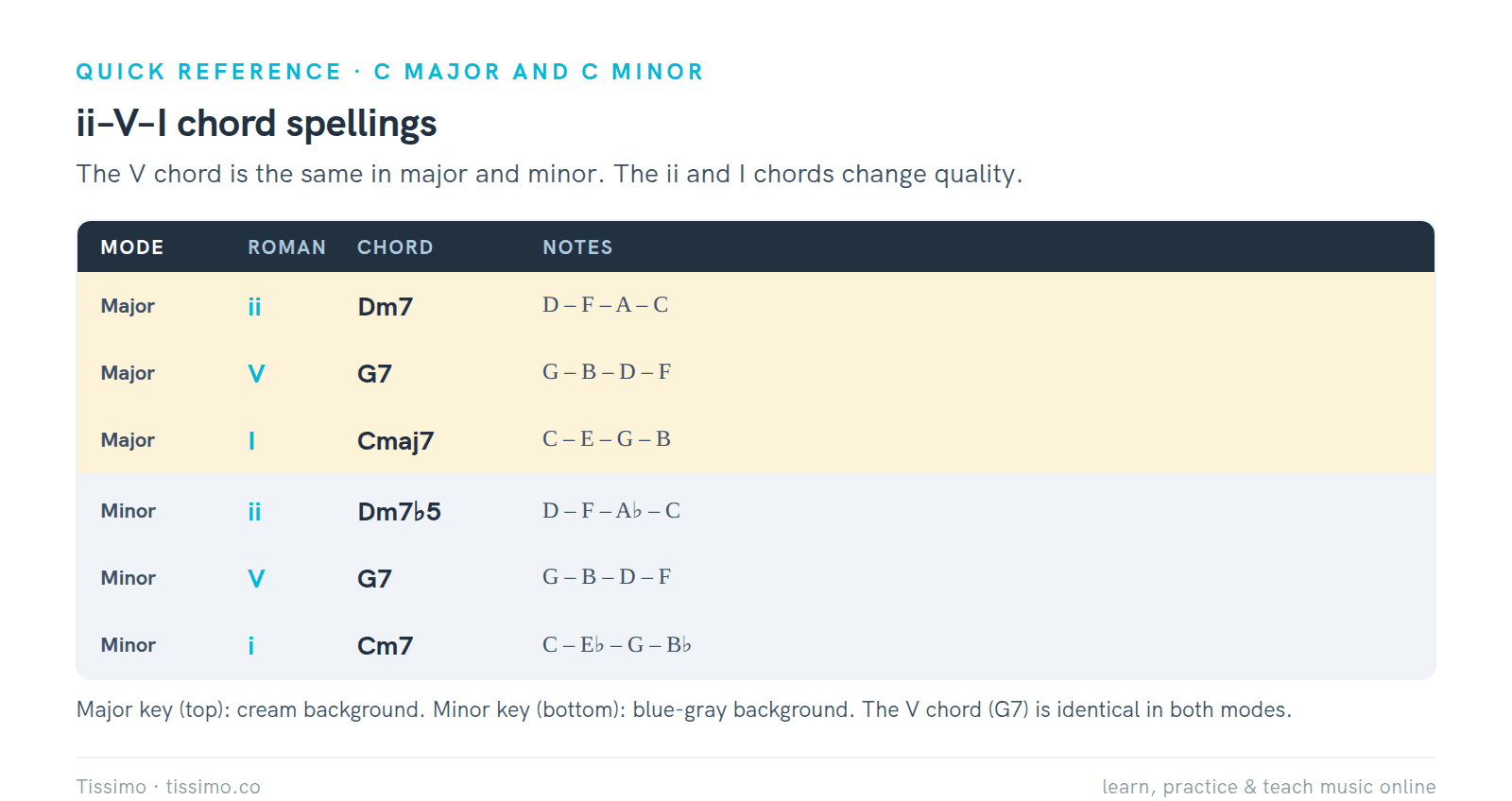
Quick-reference chord spellings for ii–V–I in C major and C minor. The V chord is the same in both modes; the ii and I chords change quality.

The ii–V–I in G major. Am7 → D7 → Gmaj7. Root motion by descending fifths: A → D → G. The tritone in D7 (F♯ and C) resolves to G and B at the Gmaj7 — the same resolution type as in C major.
ii–V–I in a full lead-sheet context: "Autumn Leaves"
The jazz standard "Autumn Leaves" (Joseph Kosma, 1945) is almost entirely built from ii–V–I progressions in two related keys. In the G minor version, the first eight bars cycle through:
- ii–V–I in B♭ major: Cm7 → F7 → B♭maj7
- ii–V–i in G minor: Am7♭5 → D7 → Gm7
This two-key structure — the relative major and minor sharing the same key signature — is one of the clearest demonstrations of how much harmonic work the ii–V–I does in real jazz repertoire. Every resolution uses the same guide-tone logic: the 3rd and 7th trading half steps at each change.

The opening harmonic plan of "Autumn Leaves" showing the two interlocked ii–V–I progressions. The progression through Cm7–F7–B♭maj7 is a ii–V–I in B♭ major; Am7♭5–D7–Gm7 is ii–V–i in G minor.
Chains of ii–V's
Jazz tunes often move through several keys by stringing ii–V pairs together — the ii–V–I of one key becomes the launching point for the next. This is called a "chain of ii–V's" or a "cycle of dominants."
A common example: start on ii–V in C (Dm7–G7), then before it resolves, insert ii–V in F (Gm7–C7), which leads into ii–V in B♭ (Cm7–F7), and so on. The ear follows the circle of fifths downward, and each dominant seventh creates momentum toward the next.
In a chain, the dominant seventh of one ii–V pair is enharmonically related to the ii chord of the next pair a fifth below — G7 and Gm7 both point toward C, but Gm7–C7 is now the ii–V of F. This overlap is the engine of the circle-of-fifths sequence.

A chain of three ii–V pairs descending by fifth. Each dominant seventh leads into the next ii chord a fifth below. The progression resolves to B♭maj7 after three pairs.
The tritone substitution: ♭II7 for V7
One of the most characteristic sounds of bebop and later jazz is the tritone substitution: replacing G7 with D♭7 (the dominant seventh a tritone away from G). The substituted chord shares the same tritone as G7 — now spelled F and C♭ (C♭ = B enharmonically) in D♭7, identical to G7's B and F — and resolves to Cmaj7 by half-step root motion (D♭ → C) rather than the usual fifth.
The ii–V–I with a tritone substitution becomes ii–♭II7–I: Dm7 – D♭7 – Cmaj7. The bass line now moves by chromatic half steps (D → D♭ → C), giving a smoother, more modern sound. Because the tritone {F, B} is shared by both G7 and D♭7, the guide-tone voice leading is preserved: the note F resolves to E (the third of Cmaj7) just as before, and the note B/C♭ resolves to C (the root of Cmaj7).
The figure below compares the two versions side by side.

The tritone substitution replaces G7 with D♭7. Both chords share the same tritone {F, B}: in D♭7, B is respelled as C♭ (the minor 7th). The bass now moves D♭→C by half step instead of G→C by fifth.
For more on tritone subs, see the secondary dominants worksheet.
Why Roman numerals matter here
The ii–V–I is always written and taught with Roman numerals — ii, V and I — rather than fixed letter names, because the pattern is key-independent. The same relationships hold in all twelve keys: the ii is always a minor seventh chord, the V is always a dominant seventh, and the I is always a major seventh (or the i is a minor seventh in minor). Once you understand ii–V–I in C major, you have understood it everywhere.
This is why jazz musicians read lead sheets using chord symbols (Dm7–G7–Cmaj7) while analysts use Roman numerals (ii–V–I). Both describe the same thing: chord symbols give the fixed pitch spelling for a specific key, while Roman numerals give the function that can be transposed. When a jazz teacher says "play the two-five-one," they mean the pattern, not any particular key. When an arranger writes ii–V–I, any reader can instantly play it in whatever key the chart is in.
The cadences worksheet explains how V–I functions as the strongest cadential formula in tonal music. The chords of a key worksheet puts the ii, V and I in context alongside the full diatonic set.
How to practice the ii–V–I
Step 1 — Learn the spelling in all twelve keys. Use the ii–V–I in Every Key worksheet. For each key, write out the three seventh chords from memory, then check against the worksheet.
Step 2 — Learn the shell voicings. Play Dm7 (F, C), G7 (B, F), Cmaj7 (E, B) with the right hand and roots in the left. Move through all twelve keys clockwise around the circle of fifths. The Shell Voicings worksheet gives all twelve layouts.
Step 3 — Listen for the guide tones. At slow tempo, play each progression and listen to the two half-step resolutions: the C→B at the ii–V bar line and the F→E at the V–I bar line. When you can hear those two moves, you can follow the progression even in complex arrangements.
Step 4 — Apply it to tunes. Start with "Autumn Leaves" or "Fly Me to the Moon" — both use clear, unambiguous ii–V–I progressions. Play through the chord changes using shell voicings before adding melody or improvisation.
Step 5 — Explore extensions. Once the basic three chords are secure, add color tones: 9ths, 11ths and 13ths. On Dm7, add an E above the C. On G7, try the ♭9 (A♭) and ♭13 (E♭). On Cmaj7, add a D (the 9th) or an A (the 6th/13th). The dominant 7th worksheet covers the G7 structure in detail.

A five-step practice plan for the ii–V–I. Steps 1 and 2 are theoretical; steps 3–5 are increasingly musical. All five work together — spelling feeds voicing, voicing feeds listening.
The ii–V–I in context: jazz as a conversation
Understanding the ii–V–I is not just harmonic bookkeeping. The progression is so deeply embedded in jazz that musicians use it as a shared language. When a bassist walks a ii–V bass line, every player hears it. When a pianist drops a G7♭9 at the V, the soloist knows Cmaj7 is a beat away. The ii–V–I is the common ground that lets jazz musicians listen, respond in real time, and build a performance together.
The progression also rewards continuous exploration. Bebop musicians like Charlie Parker built improvisations by outlining guide tones and adding chromatic neighbor tones. Modal players blurred barlines by landing resolutions slightly early or late. Contemporary players layer extensions, substitutions and outside notes over the ii–V–I skeleton. The pattern is simple enough to learn in an afternoon and deep enough for a lifetime.
If you are studying jazz from scratch, learning the ii–V–I well before anything else is not an oversimplification — it is the most direct route to understanding why jazz harmony sounds the way it does. Almost every other concept you encounter later (secondary dominants, tritone subs, modal interchange, chord-scale theory) will refer back to this single three-chord unit. Start here, in C major, with shell voicings, at a slow tempo, and let the guide tones guide you.
Free worksheets for this lesson
- The ii–V–I in Every Key — all twelve major and minor versions with audio and chord spellings
- Shell Voicings — the 3rd-and-7th voicing for every common seventh chord type, in all keys
- The dominant 7th — G7 structure, tritone and resolution with audio
- The minor 7th — Dm7 structure and quality with audio
- The half-diminished 7th — Dm7♭5 for the minor ii chord with audio
- The major 7th — Cmaj7 structure for the I chord with audio
- Secondary dominants — tritone substitutions and V/V chords with audio
- Cadences in Every Key — hear the V–I cadence in all twelve keys
- The chords of a key — all seven diatonic chords in major with audio
Sources
- Levine, M. — The Jazz Theory Book (Sher Music, 1995)
- Rawlins, R. and Bahha, N. E. — Jazzology: The Encyclopedia of Jazz Theory (Hal Leonard, 2005)
- Nettles, B. and Graf, R. — The Chord Scale Theory & Jazz Harmony (Advance Music, 1997)
- Piston, W. — Harmony, 5th ed., revised by Mark DeVoto (Norton, 1987)
- Martin, H. — Enjoying Jazz, 2nd ed. (Schirmer, 1996)
- Berklee Online — "The ii–V–I Chord Progression" (Berklee Online, 2022)
Read this article online: https://tissimo.co/articles/the-two-five-one-progression-explained-jazz-harmony




Comments