 Back

Write a Two-Voice Canon: Make One Melody Follow Itself
Write a short melody, then let a second voice follow it two bars later. This tutorial shows you how to build and check that two-voice canon in six bars.
The One Melody, Two Entrances sheet gives you the worked example to study alongside this article; Build a Canon: Copy, Overlap, Check is the follow-up exercise.
What “canon” means exactly
A canon uses a rule to derive a follower from a leader, with the follower entering later while the leader continues. Here you will write a strict canon at the unison: the follower copies every pitch and duration exactly, eight quarter-note beats later. Other canons can imitate at a different pitch interval or use systematic transformations such as inversion or augmentation. Those are beyond this first exercise.
Berklee’s canon lesson uses an octave follower; Columbia’s imitative-polyphony module explains the wider family of transformations.
The two voices in a two-voice canon have standard names. The voice that enters first is the leader (sometimes called the dux). The voice that imitates it is the follower (or comes). The time gap between entries — measured in beats — is the entry delay. The entry interval compares the follower’s first pitch with the leader’s first pitch; in our example they are the same.
A round is a type of canon designed to repeat. Its melody joins back to its beginning, and its repeated overlaps must work at the chosen delay. Performers can agree how to stop a round; arrangements may also supply a written ending. Our finite score instead gives each voice one statement: the leader stops after four bars, and the follower finishes alone.
Choose your entry delay and interval
Choose the entry delay: how many beats the follower waits. The entry interval is the pitch interval from the leader’s first note to the follower’s first note.
This tutorial uses an eight-beat delay (two bars of 4/4) at the unison: the follower begins on the same pitch as the leader. Those are the simplest choices, and they have a practical advantage — when the follower enters at the unison, the vertical intervals in the overlap zone come entirely from your melody. You can hear and adjust them without worrying about a separate transposition.
Eight beats is long enough to establish the melody before the follower enters, but short enough to keep the piece to six bars total.
Before you start composing, sketch the timeline on a piece of paper: six bar slots across the page, then two rows below them labeled Leader and Follower. Fill the Leader row in bars 1–4 and leave bars 5–6 empty. Fill the Follower row from bar 3 to bar 6 and leave bars 1–2 empty. The overlap zone — where both voices are active — is bars 3 and 4.

The six-bar timeline. The leader plays through bar 4 then rests for two bars. The follower waits two bars, then plays the same melody — creating an overlap in bars 3 and 4 where both voices are active at once.
If you are still building short melodic ideas before this step, start with Motif and sequence: it shows how a two- or three-note motif can fill a bar and generate a second bar by repetition or transposition, which is exactly the material you need for the leader.
Compose the leader melody
The leader is a four-bar melody in 4/4: four quarter-note beats per bar, as in Open Music Theory’s meter guide. For this tutorial, use all quarter notes — that removes rhythmic variety as a variable and lets you focus on pitches and the overlap.

These starting choices keep the melody readable. The interval check comes next.
Write the first two bars first: C4 E4 G4 E4, then D4 F4 A4 F4. Put that same material into the follower’s score bars 3–4. Now compose the leader’s bars 3–4 above those fixed notes. Our choice E4 G4 E4 C4 makes thirds against the follower’s C4 E4 G4 E4; F4 A4 F4 D4 does the same against D4 F4 A4 F4. You are composing against notes already on the page, rather than hoping two completed lines will fit.

The fixed follower in score bars 3–4 copies leader bars 1–2. Replace each upper placeholder rest with four quarter notes, checking one vertical pair at a time; then copy your new leader bars into follower bars 5–6.
Use C-major white-key notes. C4 means middle C; D4 through A4 are the notes above it in the same octave. Open Music Theory’s octave guide explains this register system. Here is the completed leader:
- Bar 1: C4 E4 G4 E4
- Bar 2: D4 F4 A4 F4
- Bar 3: E4 G4 E4 C4
- Bar 4: F4 A4 F4 D4

The four-bar leader: sixteen quarter notes in C4–A4. Bars 1 and 3 use C-major tones; bars 2 and 4 use D-minor tones. The follower will copy every pitch and duration eight beats later.
Each bar uses a chord-tone shape that moves by step or skip. Bar 1 outlines C major (C–E–G–E), bar 2 moves to D–F–A–F, bar 3 returns via E–G–E–C, and bar 4 lands on F–A–F–D. The range stays between C4 and A4. There are no accidentals.
If you are composing your own melody rather than using this one: notate it in pencil first. Count each bar’s four beats aloud as you write. Avoid starting every bar on C — a varied starting note gives the follower more interesting material to work with in the overlap zone.
Sing the melody slowly while tapping four steady beats per bar. If you lose your place, slow down and mark the bar lines before changing any notes. Check that each bar contains four quarter notes.
Copy the leader exactly into the follower
The follower is the leader melody copied note-for-note, shifted eight beats to the right. Not paraphrased, not harmonized — identical.
When copying, resist the temptation to ‘improve’ the follower. An isolated pitch or duration change breaks this exercise’s exact-copy rule. Revise the leader and its delayed copy together when you want to change the composition.

The same melody, before its opening rests are added. Melody bars 1–4 become follower score bars 3–6 in the complete canon.
Because the delay is two bars, the follower’s score bars are offset by two from the leader’s: what the leader plays in bar 1 is what the follower plays in score bar 3; the leader’s bar 2 becomes the follower’s score bar 4; and so on. The follower’s last two bars (score bars 5–6) are the leader’s bars 3–4 played alone while the leader rests.
Write the two-voice score like this: copy the leader onto the upper staff for bars 1–6, replacing bars 5–6 with whole rests. Then copy the follower onto the lower staff, putting whole rests in bars 1–2 and writing the melody in bars 3–6.
Check the first entry before copying the remaining notes. Point to leader bar 1, beat 1: C4. Count eight quarter beats forward to follower bar 3, beat 1: C4 again. Repeat with leader bar 2, beat 4: F4 becomes follower bar 4, beat 4. The bar number changes by two; the beat number within the bar stays the same.
Place the follower into the score
With both voices on paper, place them on a two-staff score. Use two treble-clef staves if you are writing for two instruments of similar range — two recorders, two flutes, or a voice and a melody instrument. Label the upper staff “Leader” and the lower staff “Follower.” Then look at bars 1–2.

Score bars 1–2: the leader plays alone while the follower counts two whole-bar rests. The follower’s first attack belongs on beat 1 of bar 3.
The follower’s whole rests in bars 1 and 2 are intentional. A student seeing a completed score for the first time sometimes wants to “fill in” those rests — do not. The silence is the delay, and the delay is the canon.
Now look at bars 3–4, the overlap zone. This is where both voices sound simultaneously.
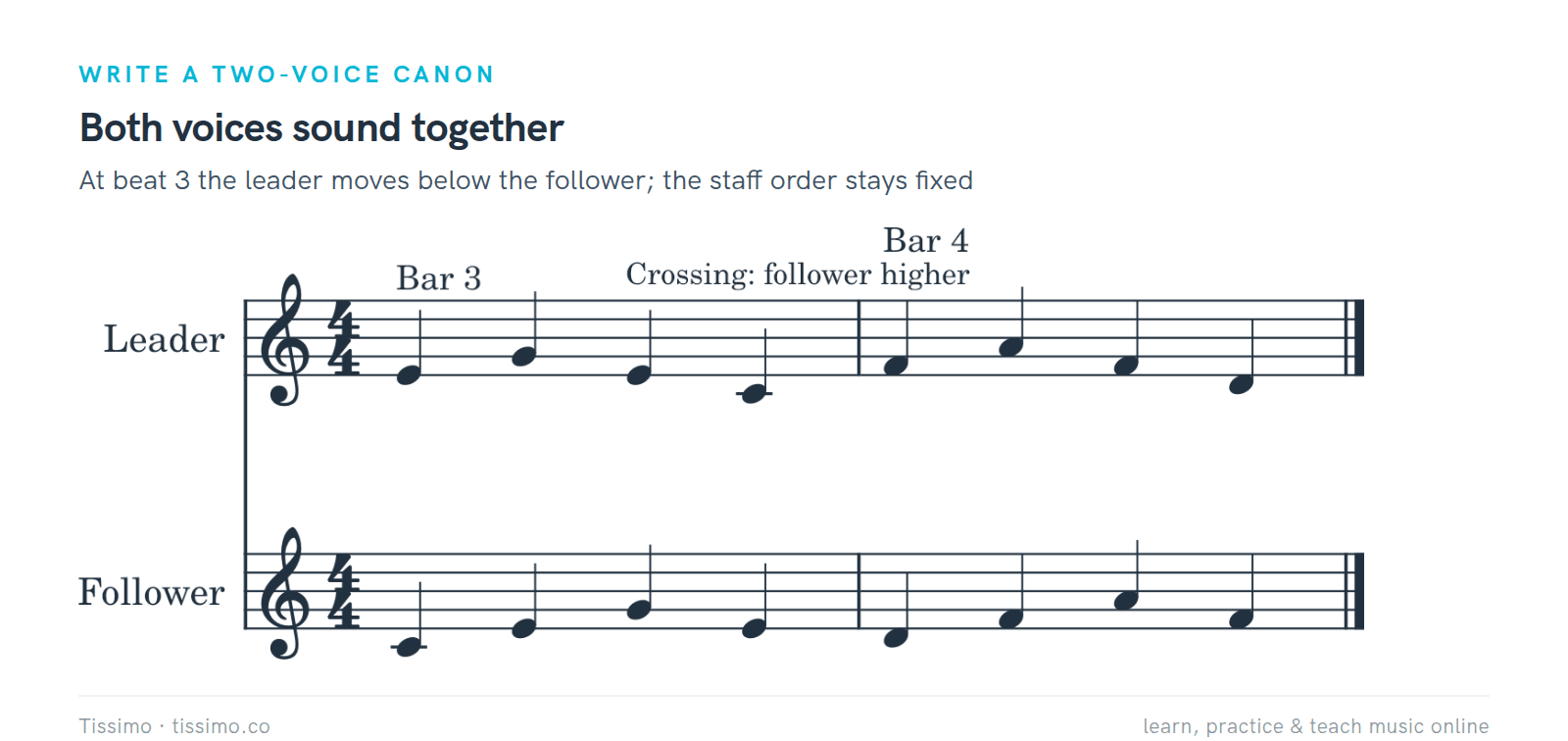
Score bars 3–4: both voices sound. The follower recalls the leader’s opening while the leader continues. On beat 3 the leader crosses below the follower; the upper staff still identifies the leader.
The Texture sheet calls the combination of melodic lines polyphonic. Here the lines share a quarter-note rhythm, but each carries the melody at a different point in its course: this is imitative writing. The sheet’s examples use contrasting rhythms to illustrate polyphony; in a canon, staggered entry achieves the same independence without rhythmic contrast.
The overlap is the canon’s heart: for these two bars, you hear what you wrote as a conversation with itself.
Hear the vertical intervals in the overlap
At every quarter-note beat in the overlap zone, two notes sound at the same time. The distance between them is a vertical interval. If a pair sounds tenser than you want, revise the leader and its delayed copy together; tension itself does not break the canon.
For the tutorial melody, every simultaneous pair in bars 3–4 forms a third. If you count letters: E above C is E–D–C, three letters, a 3rd. G above E is G–F–E, three letters, a 3rd. And so on for all eight beats of the overlap.
The leader is on the upper staff, but it is not always the higher voice. On beats 3–4 of each overlap bar, the follower sounds above it. This is voice crossing. For interval size, count from the lower sounding note to the higher one: the leader’s E4 below the follower’s G4 is still a third.

All eight pairs are thirds. M3 means major third (four semitones); m3 means minor third (three). Each aligned pair label names the lower sounding pitch first, regardless of which staff carries it.
If you are working with your own melody, list all eight vertical pairs. Count letters for the interval’s number, then check its quality. For this gentle exercise, try perfect unisons, fifths and octaves, or major/minor thirds and sixths. A fifth is not automatically perfect: B4–F5 spans six semitones and is diminished. Seconds, sevenths, fourths and augmented or diminished intervals can add tension; listen before deciding whether to keep them. Open Music Theory’s interval reference separates size from quality. The Intervals: steps & skips sheet practices letter counting.
Every leader edit must also appear two bars later in the follower: leader bar 1 maps to follower bar 3, bar 2 to bar 4, bar 3 to bar 5, and bar 4 to bar 6. If you keep the first two leader bars fixed and revise only bars 3–4, update the follower’s bars 5–6. Then check the overlap again.

Each corresponding event moves eight quarter-note beats later. Keep its beat within the bar and its duration: leader bar 1, beat 2 maps to follower bar 3, beat 2.
Try D4 instead of E4 on the first beat of the leader’s bar 3. Against the follower’s C4, it makes a major second. If you want a gentler sound, restore E4 to make a major third, and restore E4 in the follower’s bar 5 as well. All other notes and the eight-beat delay stay the same. Play both versions before choosing.

Demonstration variant (left) and printed original (right): changing leader bar 3’s first note from D4 to E4 turns C4–D4 into C4–E4. Make the same change in follower bar 5. Only these two pitches differ.
Read the complete six-bar score
With both voices written out, the full canon looks like this:

The complete once-through score: leader melody in bars 1–4, follower melody in bars 3–6. The opening and ending rests preserve the two-bar delay; only bars 3–4 overlap.
Set a steady quarter-note pulse around 60, or slower if needed. Play the leader for four bars while recording it, then count two silent bars before stopping the recording. Play that recording back and enter as the follower on beat 1 of score bar 3. Alternatively, ask another player to take one part or enter both parts in notation software. Listen through all six bars, especially the follower’s entry and the two-bar overlap.

The recording supplies the leader while you play the follower. Count eight opening beats before entering, then finish through score bar 6 while the recorded leader is silent.
The One Melody, Two Entrances sheet is the printable version of this exact score. It includes the entry/overlap timeline and a mini-task that asks you to identify which score bar the follower’s opening note falls on. The answer is bar 3: the follower begins on the same C4 that the leader used in bar 1, but two bars later in the score.
The follower finishes the melody alone in bars 5–6. Its final D4 leaves an open sound in this C-major exercise; you may hear it wanting to continue. The score is finite because both voices stop after one statement, not because D4 supplies a tonic cadence. A stronger tonal close is a separate compositional choice. Puget Sound’s cadence lesson explains harmonic arrival points; a stop alone does not demonstrate one.
Check and revise the imitation
Check for copying errors as well as unwanted clashes in the overlap. A pitch error can still sound acceptable, so check the notation as well as listening.
Start at follower bar 3 and compare it with leader bar 1. Match each pitch, including octave and any accidental, then match its duration and beat position. Check rests too. Every follower event must occur eight quarter-note beats after its model. For this all-quarter-note version, count four attacks per active bar; the follower must begin on beat 1 of bar 3. Do not rely on ear alone.
The Build a Canon: Copy, Overlap, Check exercise gives you a second original melody with a follower that contains two planted pitch errors. Compare leader bars 1–2 with the faulty follower’s bars 3–4 below; these snippets show different score times, not simultaneous parts:

Compare leader bars 1–2 with follower bars 3–4, eight beats later. Follower bar 3, beat 1 should be G4, not A4; bar 4, beat 2 should be B4, not C5. The other six pitches match.
The leader’s bar 1 opens on G4. The follower’s bar 3 must also open on G4. In the faulty version, it opens on A4 — one step too high. The leader’s bar 2, beat 2 is B4. The follower’s bar 4, beat 2 should also be B4 — but the faulty version has C5. Both errors change the pitch by one step, which is subtle enough to hear as “a little off” rather than obviously wrong.
Cover the lower comparison and write the expected first four pitches yourself. Then uncover it and check G4 A4 B4 A4 one event at a time. Repeat for C5 B4 A4 G4. This separates remembering the melody from locating its copy in the later score bars.
After correction:

Corrected follower bars 3–4 now match leader bars 1–2 in pitch and duration. These unjoined snippets show different score times, not a simultaneous duet.
The exercise also asks you to compose replacement leader bars 3–4, keeping the first two bars fixed and using quarter notes from C4 to A4. It prints an allowed interval set: unison, third, fifth, sixth, octave. Check those vertical pairs, then copy the new bars into follower bars 5–6; the interval constraint alone does not guarantee exact imitation.
Add a finite ending and understand the round
Our printed score is a once-through performance: the leader stops after score bar 4 and the follower after score bar 6. The same melody can also be tested as a two-part round.

These are two performance plans for this four-bar melody at a two-bar delay. A looping version needs both a workable melody seam and checked repeated overlaps. Six bars is the length of our once-through score, not a defining length for every finite canon.
For a round, test two things: how each melody ending joins its beginning, and how the voices fit together across every repeated overlap. With a four-bar melody and a two-bar delay, the leader begins its second pass in score bar 5; the follower begins its second pass in score bar 7.
You can also test this melody as a two-part round. Instead of resting in score bar 5, the leader returns to melody bar 1; the follower completes its first statement in score bar 6 before returning to bar 1. D4 returns by step to C4. In this example the new overlap pairs are thirds too, so no pitch change is needed. Our printed score chooses a finite, once-through performance instead.

Optional continuation: score bars 5–6 pair leader melody bars 1–2 with follower melody bars 3–4; score bars 7–8 restore the earlier combinations. Every pair remains a major or minor third. This verifies two parts at this delay only.
For our two-part version, check leader melody bars 1–2 against follower melody bars 3–4 after the leader restarts. Adding another voice or choosing another delay requires a new overlap check.
Before trying the loop, choose a stopping signal with your partner. For a first experiment, play through score bar 8 and stop together. That temporary stopping plan lets you hear the new overlap without needing to continue indefinitely. Keep the once-through score available so you can compare the two endings.
Free worksheets for this lesson
- One Melody, Two Entrances — the tutorial leader melody, a six-bar two-voice score, and an entry/overlap timeline that shows exactly which bars are active in each voice.
- Build a Canon: Copy, Overlap, Check — three sections: complete a missing follower, find two planted errors in a second melody’s canon, and compose a short overlap section under an explicit interval constraint.
- Motif and sequence — how a short melodic idea can fill two or more bars through repetition and sequence; useful before composing the leader.
- Texture — distinguishes monophonic, homophonic, and polyphonic writing; the overlap zone of a canon is a direct example of two-voice polyphony.
- Intervals: steps & skips — counting the letter-name distance between two notes; needed when checking vertical intervals in the overlap zone.
Writing a finite canon gives you a concrete experience of what polyphony feels like from the inside: the same melody arriving twice, slightly out of step, creating something neither voice could make alone. A Tissimo teacher can play through the overlap with you and give real-time feedback on any interval that sounds uncomfortable — book a lesson to work through the exercise section with a guide.
Sources
Read this article online: https://tissimo.co/articles/write-two-voice-canon-first-composition




Comments