 Back

How Long Does It Take to Learn an Instrument? Realistic Timelines by Goal
Ask how long it takes to learn piano and you can get three honest answers: a few months, about five years, or "it depends." All three can be right, because they answer different questions. One means playing a tune you recognize. Another means passing a grade exam. The third means playing well enough to be a musician for life. This guide separates those goals, gives you the few published figures that exist, labels every other number as an estimate, and ends with a worksheet-style grid for working out your own timeline.
"Learn" is four different goals
Before you ask how long, decide what finished looks like. Most beginners are really after one of four things, and each has its own clock.

The four common meanings of "learn," with what each one asks of you. The time estimates are Tissimo teaching rules of thumb for regular practice, not research findings.
Play simple songs. A familiar melody, slowly, start to finish without stopping. This is the quickest milestone, and our rough estimate is a few weeks to a few months of regular practice. It is also the one that keeps people going.
Accompany singing. Keep a steady beat and change chords on time while someone sings. You need a few chord shapes, a few changes you can make without looking, and the habit of not stopping when you slip. Our rough estimate is a few months.
Play in a group. Count your rests, watch a leader, and keep going after a mistake. The notes can be simple; the listening and counting are the work. Our rough estimate is several months to a year or more, and it depends heavily on the group.
Pass a grade exam. Here, unlike the other three, someone has published numbers, so this guide spends most of its time there. A grade exam tests pieces, scales, sight-reading and listening against a syllabus. ABRSM runs Grades 1 to 8, with an Initial Grade before them for some instruments. The Royal Conservatory (RCM) runs Preparatory A and B, then Levels 1 to 10, then the ARCT diploma.
If your goal is none of these, such as "play the guitar part from my favorite song," write it as a sentence a stranger could check. "Play the verse and chorus of one song at the original tempo" works. "Get good at guitar" does not.
What the research says about time
You may have heard that expertise takes 10,000 hours. That is a popular summary, not a rule for learners. The idea of deliberate practice, effortful practice aimed at specific improvements, comes from Ericsson, Krampe and Tesch-Römer's 1993 paper on expert performance, which is about people aiming at the top of their field, not hobbyists. A 2014 meta-analysis by Macnamara, Hambrick and Oswald found that deliberate practice explained 21% of the variance in music performance, and concluded that it is "important, but not as important as has been argued." Practice matters a great deal, and it is not the whole picture. Nothing in that work gives you a number of hours that will make you a competent hobbyist.
A study that is closer to ordinary learners comes from Sloboda, Davidson, Howe and Moore (1996). They interviewed 257 young people aged eight to 18 who had instrumental lessons, from pupils at a selective specialist music school to children who had quit within a year, and 94 of them kept practice diaries for 42 weeks. The result: musical achievement had a strong relationship with the amount of formal practice, and there was no evidence that high achievers reached a given exam level on less practice than lower achievers. High achievers also tended to practice more consistently from week to week.
Two honest cautions follow. First, that study describes one sample of young people, and it shows a relationship, not that more minutes cause better playing for every learner. Second, a small study of 17 graduate and advanced-undergraduate pianists (Duke, Simmons and Cash, 2009) found that for one hard three-measure passage, the quality of next-day playing was not significantly related to total practice time or the number of trials. It was related to the share of practice attempts that were played correctly, and to how few mistakes were made along the way. Their title says it: "It's Not How Much; It's How."

Each card describes only its own sample. None of the three tells you how many hours a particular beginner will need.
Put together, the studies say the same thing a teacher would: time counts, and a minute spent aiming at the right target is worth more than a minute of drifting. The full routine is in our guide to building an effective practice routine.
The one set of published hours: ABRSM
The best-documented figures for "how many hours" come from an exam board. ABRSM's qualification specifications for its Practical Music Grades publish, for each grade, Guided Learning Hours (time under a teacher's guidance) and Total Qualification Time (teacher time plus independent preparation). They call these "estimates of the average amount of time that it might take a candidate to prepare" and say they "should be used as guidance only," because individuals vary with experience and ability.
Here is the Total Qualification Time per grade. The piano specification (2025 and 2026) and the violin specification (from 2024) give the same table.

ABRSM estimates of the average preparation time for each grade, per grade rather than cumulative. Grades 1, 3 and 5 are shaded darker because the next chart uses them.
Three things are worth noticing. The hours climb steadily: Grade 8 is more than five times Grade 1. The figures are per grade, so reaching Grade 5 means adding the earlier grades. And the figures are about exam preparation, which includes pieces, scales and tests that a casual player might never touch.
Turning hours into weeks
Hours become a calendar only when you divide them by your week. The next chart does that arithmetic with the ABRSM figures, adding the grades together. This is our arithmetic, not a forecast: ABRSM publishes the per-grade numbers only, and a learner who skips a grade or arrives with experience will land somewhere else.

Grade 1 (60 hours) works out to about 17 weeks at 30 minutes a day and about 1.2 years at one hour a week. Grade 5 (600 hours added up) works out to about 3.3 years at 30 minutes a day. Weekly hours count lesson time and practice together. We start the count at Grade 1; ABRSM's optional Initial Grade adds another 40 hours below it, so a complete beginner may land nearer 100 hours for Grade 1.
The table makes one thing plain: the same goal looks very different at different paces. Sixty hours is about four months at 30 minutes a day, and more than a year at an hour a week. Neither is wrong. It just means the question "how long?" has no answer until you also say "how much each week?"
It also shows why a single long session is a poor way to spend limited time. Sloboda's high achievers kept their practice steady from week to week, and a small lab study (Simmons, 2012) found that musicians who spread sessions a day apart gained more accuracy than those who practiced in one sitting. Neither tested a beginner's week, but together they are why teachers suggest six short days over one long one.
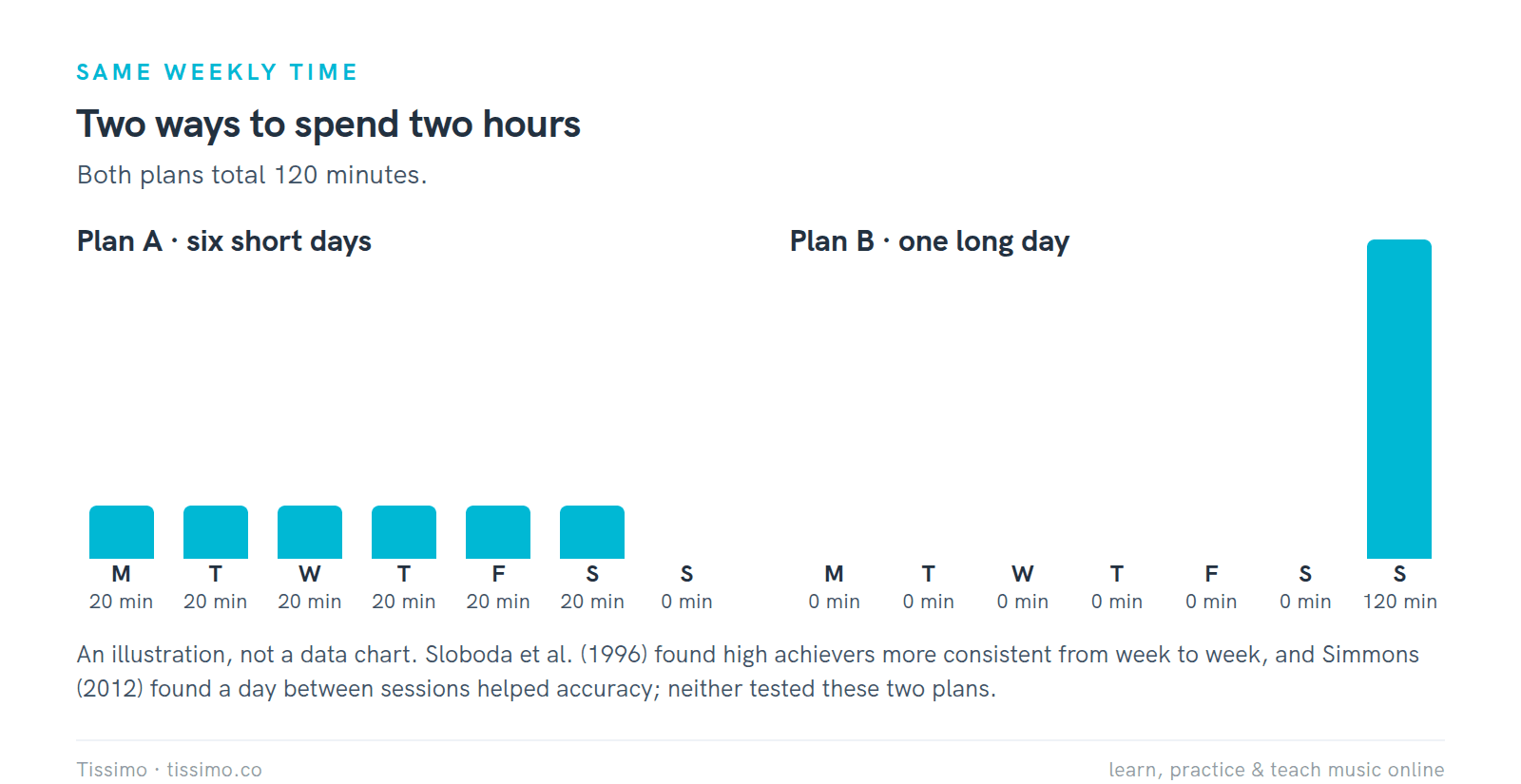
The same two hours, spent two ways. An illustration of consistency, not a data chart; the research above did not test these two plans.
Does the instrument change the answer?
Probably less than people expect, though nobody has measured it, and the differences show up mostly in the first months. We found no published study that ranks instruments by time to learn. ABRSM prints one qualification-size table for every instrument, but that is a regulatory size, not a comparison, so treat the cards below as teaching observations.

Typical early hurdles by instrument family, each with a Tissimo rough estimate for regular practice. These are teaching observations, not measured timelines.
On piano, the first sound is easy and the slow part is reading and coordinating two hands; our rough estimate for a simple two-hand tune is a few weeks to a couple of months. On guitar, chord changes are the wall; our guide to chord change practice on acoustic guitar covers how to push through it. Our rough estimate is weeks for a first simple song and a few months for a three-chord accompaniment. On violin, you make the pitch and tone yourself, so early sounds are rough before they settle; our rough estimate for an in-tune simple melody is several months. Winds and brass depend on breath and the mouth position (weeks to a first steady note, a few months to a simple tune, by our rough estimate), and voice relies on listening and guidance (weeks to a few months for a simple melody in tune, again our rough estimate).
If you are choosing an instrument for a child, a better question than "which is fastest?" is "which will they still want to play in a year?" Our parents' guide to the best first instrument for kids walks through that choice.
A worked example, with the arithmetic shown
Here is an invented learner, to show the method. Dana, an adult beginner, takes one 30-minute lesson a week and practices 20 minutes on five days. That is 30 + 100 = 130 minutes, a little over two hours a week. Dana wants Grade 1 piano, which ABRSM puts at 60 hours of Total Qualification Time.
60 hours divided by about 2.2 hours a week is roughly 28 weeks, about six and a half months. If Dana's goal is the earlier one, playing one song for friends, the exam hours do not apply. Dana picks a labeled guess of a couple of months, checks it with a recording at week four, and moves the date if the recording says so.
Two points follow. First, a lesson counts toward the hours, which is why the ABRSM table includes teacher time. Second, the calculator gives you a date to aim at, not a deadline. Illness, exams at school or a busy month will move it, and moving it is not failing.
What speeds progress
None of this is secret. Four levers matter, and you can set all of them in motion.

Four levers. The first two draw on the studies cited above; the last two are teaching practice.
Short sessions, most days. The high achievers in the Sloboda study practiced more consistently from week to week, and spacing sessions across days helped in the Simmons study. As a teaching rule of thumb, not a research figure, 15 to 20 minutes most days is a sensible starting point for a beginner. Your Daily Technique Routine is a piano plan of five stations in about 15 minutes, with one key per week and a log to fill in; the shape (warm-up, scale, one focus, a spot in your piece, cool-down) works on any instrument.
Aim each repeat. Pick the bar that breaks, play it slowly, and count only clean repeats. The How to Practice handout, written with piano in mind, gives a five-step session and a "fix-it loop" with the rule "3 clean in a row": a mistake on try two means you start counting again from zero. This is the practical version of the Duke finding. A metronome keeps the aim honest: the Tempo and the Metronome handout says to start slow, raise the speed 4 to 8 clicks at a time, and go back down when notes break. Our complete guide to practicing with a metronome goes further.
Get feedback. A teacher hears the wrong note you stopped noticing, picks the next task, and tells you whether your goal date is realistic. This is the one lever you cannot pull alone, and it is the main reason lessons shorten the road. For younger learners, see our guide to online music lessons for kids.
Keep evidence you can see. Progress is too small to feel day to day, so keep dated recordings or a log. The next section shows how.
Measuring progress so it does not feel invisible
The hardest part of learning an instrument is that daily progress is too small to feel. It is easy to lose heart in the flat-feeling weeks, when you are improving but cannot see it. The fix is evidence you can compare later.
My Music Progress: Three Pieces of Evidence is built for this. You choose a starting performance, a current performance and a written or creative piece from different dates, agree on one thing to notice with your teacher, and compare under the same conditions. Its fictional example counts missed attacks in the same eight-attack pattern at 60 beats per minute: the starting take misses two attacks, the current take misses one. The sheet calls it "one fewer attack was missed in this pair," and notes this is not an overall music grade. Small, honest, and checkable. Our article on a student music progress portfolio shows how to keep this up over a year.
If your goal is a performance, rehearse the whole event as well as the notes; My First Recital: Rehearse the Whole Trip walks through arrival, setup, the ready cue, playing and leaving.
When it feels slow
Progress on an instrument is uneven. A piece that would not come together for two weeks can suddenly work, and a skill you thought you had can slip when you add a new one. When that happens, check three things before you decide you are not improving.
First, check your conditions. If you are comparing a take at a slower tempo with a take at a faster one, you are not comparing like with like; the progress sheet above makes the same point. Second, check your goal: if it is vague, shrink it to one bar and one tempo. Third, check your schedule: a plan of five short days you actually keep beats an ambitious one you abandon. If all three look right and you are still stuck, it is a good moment to bring the problem to a teacher.
Work out your own timeline
Here is the method in four steps.

From a vague wish to a dated plan. If no published hours exist, use a labeled guess and revise it at the halfway check.
- Name the goal from the ladder, in a sentence a stranger could check.
- Find the hours. For a grade exam, use the ABRSM table. For anything else, make a labeled guess, and ask a teacher to reality-check it.
- Divide by your real week. Count only the hours you will truly give, not the hours you wish you had.
- Check at the halfway mark with a dated recording and move the date, not the goal.

A goal-setting grid you can copy by hand. The shaded row shows an example; the empty rows are for your own goals.
Many beginners expect too much from one month and too little from one year; that is a teaching observation, not a measured finding. If you are weeks in and it feels slow, that is common. Compare your recording today with one from week one, not with a performer who has played for decades.
Free worksheets for this lesson
- My Music Progress: Three Pieces of Evidence — compare dated samples against one agreed criterion and choose one next task
- Your Daily Technique Routine — a piano plan: five stations in about 15 minutes, one key a week, with a weekly log
- How to Practice — the five-step session, the fix-it loop and a weekly practice log
- Tempo and the Metronome — Italian tempo words and the 4–8 click ramp
- My First Recital: Rehearse the Whole Trip — a plan to rehearse arrival, setup, playing and leaving
Where a teacher fits in
A timeline is a guess until someone hears you play. A Tissimo teacher can listen to where you are, set a goal with a date you can believe, and adjust it as you go. You can book a lesson with a teacher for your instrument, find a piano teacher, or browse our free worksheet library to begin.
Sources
- Macnamara, B.N., Hambrick, D.Z. & Oswald, F.L. (2014). "Deliberate Practice and Performance in Music, Games, Sports, Education, and Professions: A Meta-Analysis" — Psychological Science
- Sloboda, J.A., Davidson, J.W., Howe, M.J.A. & Moore, D.G. (1996). "The role of practice in the development of performing musicians" — British Journal of Psychology
- Duke, R.A., Simmons, A.L. & Cash, C.D. (2009). "It's Not How Much; It's How: Characteristics of Practice Behavior and Retention of Performance Skills" — Journal of Research in Music Education
- Simmons, A.L. (2012). "Distributed Practice and Procedural Memory Consolidation in Musicians' Skill Learning" — Journal of Research in Music Education
- Ericsson, K.A., Krampe, R.T. & Tesch-Römer, C. (1993). "The Role of Deliberate Practice in the Acquisition of Expert Performance" — Psychological Review
- Piano Practical Grades Qualification Specification 2025 & 2026 (Qualification size table) — ABRSM
- Bowed Strings Practical Grades, Violin Syllabus from 2024 (Qualification size table) — ABRSM
- Piano Syllabus, 2022 Edition — The Royal Conservatory of Music
Read this article online: https://tissimo.co/articles/how-long-does-it-take-to-learn-an-instrument




Comments