Back
Back
Online Music Lessons for Kids
Are online music lessons the right choice for your child?
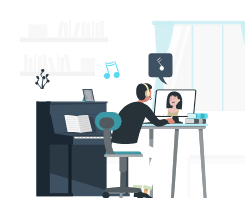
Your child loves music, but the nearest good teacher is forty minutes away and your evenings are already packed. Sound familiar? A growing number of parents are solving this with online music lessons — real, live teachers over video call, not an app or a YouTube tutorial.
Plenty of families have already tried the free options: video tutorials on YouTube and self-learning apps designed to feel like games. They're a fine way to get a taste of an instrument, but most fall apart once a child moves past the basics — few teach music theory and notation in a structured way, and none can listen to a phrase and tell a child exactly what to fix. Working with a real teacher over video call closes that gap. Done well, online lessons can be just as effective as sitting in the same room as the teacher, often more affordable, and they open up advantages in-person lessons cannot match: convenience, flexibility, a wider choice of instruments and styles, and access to teachers well outside your zip code.
Convenience and Flexibility
One of the biggest advantages of online lessons is how easily they fit into a busy family's routine:
- No driving. Parents don't need to shuttle kids to and from lessons or plan an evening around a commute.
- Lessons almost anywhere. As long as there's a stable internet connection, a lesson can happen at the kitchen table, at a grandparent's house, or wherever the week takes you.
- Easy rescheduling. If a child gets sick or an evening suddenly fills up, moving a lesson is a quick message away instead of a lost slot.
For families juggling school, sports, and everything else, that flexibility can be the difference between sticking with lessons and quietly letting them drop.

Access to a Broader Range of Resources
Online lessons also open up a far wider range of resources than most families can find locally. A student learning ukulele in a small town with no local teacher can now choose from specialists in fingerstyle, Hawaiian, or pop styles based anywhere in the world, instead of settling for whoever happens to teach nearby. If a child is homeschooled, or their school doesn't have a music program, online lessons are a straightforward way to bring music education into the home. Students also get access to the internet's full library of supplemental material — free printable sheet music, practice worksheets, recordings, and other tools that may never make it into a traditional studio lesson.
More Options & General Music Lessons
Taking lessons online opens up more options for both students and teachers. Kids can learn from teachers around the world, giving them access to different teaching styles and approaches, and can choose from a wide variety of instruments and subjects — piano, guitar, drums, ukulele, music production, songwriting, and more. Parents can find a teacher who specializes in the exact style their child gravitates toward, whether that's classical, jazz, pop, or something else entirely.

If you're not sure yet what your child wants to learn, general music classes are a good starting point for any age, including toddlers. These classes build a love of music through singing and elementary musical concepts, while laying down two foundational skills that make picking up an instrument later much easier: rhythmic training and reading music. For more on how to choose the right teacher for your child, see our article on finding the right music teacher.

Comfortable Learning Environment
Online lessons take place in a familiar, comfortable environment, which makes it easier for children to learn while feeling relaxed and focused. They learn in their own home, which eliminates the stress of going somewhere new and meeting a new teacher face to face for the first time. And for piano or drum lessons, since hauling the instrument along isn't practical anyway, a child gets the added advantage of practicing and taking lessons on the very instrument they already know.

Interactive and Engaging Lessons
Online lessons can be just as interactive and engaging as in-person ones. Many online music lesson platforms build in real-time video chat, high-quality audio, screen sharing, virtual whiteboards, and other tools that enhance the lesson itself. A good platform also offers free resources the student can use outside the classroom, and teachers can leave detailed notes and feedback after each lesson to guide practice in between sessions.

The format is also genuinely adaptable. Lessons can be tailored to an individual student's needs and learning style, and adjusted for students with physical or cognitive disabilities — opening up music education to kids who might otherwise have gone without it.
Easy to Get Started & Cost-Effective
Getting started with online lessons is simple: all you need is a stable internet connection and the instrument your child wants to learn. It's often more affordable too. Parents skip the cost of gas and parking, and teachers don't have to cover studio space or their own commute — savings that frequently get passed along in lower rates.

Cognitive Benefits
Music is not only art and entertainment — it also has a measurable impact on how children's brains develop. Research published in Frontiers in Neuroscience found that structured music lessons can enhance children's language-based reasoning, short-term memory, and planning skills, with gains that carry over into broader academic performance. Learning to read sheet music and play an instrument engages multiple areas of the brain, and the close attention to detail that playing requires can strengthen problem-solving abilities that transfer to subjects like math and science.

Music lessons can support social development too. Group lessons in particular encourage listening, cooperation, and communication, and research suggests that these social gains are largest for children who start out with weaker social skills — meaning the kids who might benefit most from a boost in confidence and cooperation are often the ones who gain the most.
Possible Drawbacks
Online lessons aren't the right fit for every family, and it's worth weighing a few real drawbacks:
- Connectivity. Lessons need a reliable internet connection and adequate technology, which isn't a given for every household.
- Focus at home. Some kids, similar to homeschooling, find it harder to stay engaged when their bedroom or living room is full of familiar distractions.
- Tuning help. With instruments like guitar and violin that need regular tuning, a teacher on a screen can't physically step in and adjust the instrument the way they could in person.
With a bit of guidance and support from parents and teachers, none of these are dealbreakers — just things to plan around.
Conclusion
Online music lessons are a convenient, cost-effective, and engaging way for kids of nearly any age to learn music. They offer flexible scheduling, a comfortable learning environment, access to teachers and styles you'd never find locally, and tools that help a child stay motivated between lessons. If you're considering it for your child, the best way to know if it's a fit is to try a trial lesson or two with a couple of different teachers.
Sources
- ScienceDaily - Music lessons improve children's cognitive skills and academic performance
- PLOS ONE - Group Music Training and Children's Prosocial Skills
If your child is ready to start, you can browse qualified teachers and book a trial lesson here. (P.S. — no piano at home yet? Check out our guide to finding a free piano.)