Back
Back
9 Tips for Successful Online Music Lessons
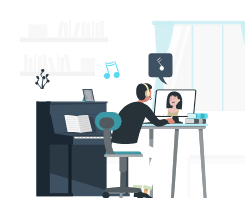
Bad audio, a distracted kid, a laggy connection — online music lessons can go sideways fast if you're not set up right. The good news: a handful of small habits make the difference between a frustrating video call and a lesson that feels almost as good as sitting next to your teacher in person. Live online music lessons have become just as accessible and popular as in-person ones, often with more flexibility and better pricing to boot — but they do come with their own challenges. Here are 9 tips to help you get the most out of every lesson.
1. Find a quiet space
Keep it quiet and distraction-free. A calm environment is one of the biggest factors in a successful lesson. Coordinate with family or housemates so noise and activity stay low during your lesson time. If the lesson is for your child, this matters even more — kids focus best when there isn't extra stimulation competing for their attention. Close any open windows or apps on your device that could interfere with audio or video quality, or pull your attention away mid-lesson.

2. Get your gear right
Start with the basics — nothing fancy required. Before your lesson, make sure your devices are up to date and working: computer, tablet, or phone, plus your internet connection and any lesson software. Test your audio and video ahead of time. Whatever you're learning — piano, guitar, drums, violin, cello, bass, flute, clarinet, trumpet, ukulele, or anything else — a setup you trust makes you more confident the moment the lesson starts.

Want to invest a little more? An electronic or MIDI version of your instrument is the upgrade that pays off most. If you play piano, guitar, drums, violin, or another instrument with an electronic option, connecting it directly to your computer gives your teacher a noticeably clearer signal than a microphone picking up the whole room. Depending on the instrument, you may also need a standalone audio interface if one isn't already built in.

None of this is required, though. If you're taking voice lessons, play an instrument without an electronic version — mandolin or oboe, for example — or would just rather not buy new gear right now, an acoustic instrument works completely fine. What matters most is that the platform you're learning on treats music as music, not background chatter. General-purpose apps aren't a lost cause here: Zoom has an opt-in "Original Sound for Musicians" mode, and Google Meet lets you manually turn off its noise cancellation so it stops filtering out your playing. Both require you to remember to flip the setting before class starts, and most people never do. A platform built for music from the ground up, like Tissimo's own classroom, keeps that fidelity on by default, so you don't have to think about it.
3. Use headphones
Wear a headset or headphones. They cut background noise and give both you and your teacher the best possible listening experience. Echo cancellation is standard in videoconferencing, but it doesn't always work perfectly — headphones keep you from getting caught in an echo loop with your teacher, and make sure they can always hear you clearly enough to give real feedback. (Tissimo's own classroom, for what it's worth, runs audio processing tuned specifically for music rather than generic call-app noise suppression — but good headphones still make a real difference no matter which platform you're using.)

4. Be punctual
Show up on time, just like you would in person. If you're running late, give your teacher a heads-up. Make sure you know their rescheduling and cancellation policies too, and give them enough notice to avoid paying for a missed lesson. If your schedule tends to shift around, look for a teacher you know is flexible.

5. Come prepared
Have your materials ready before the lesson starts. That means your instrument, music books, and any notes or assignments from last time — it's the fastest way to make the most of your lesson time. If you're not sure what you need, ask your instructor; a good teacher will let new students know what to have on hand for a first lesson, and will point you toward any new materials they assign along the way.

6. Communicate with your teacher
Speak up when something isn't working. Communication matters in any music lesson, but especially online — tell your teacher if you're having trouble hearing or seeing them, or if you need a concept repeated. And just like with in-person lessons, share your goals, ask questions between sessions, and stay in touch about what you're working on.

7. Take breaks
Give yourself permission to step away for a minute. Sitting in front of a screen for an extended stretch is tiring, and a good instructor understands that. If you need to stretch, move around, or grab some water partway through your lesson, just say so.

8. Practice, practice, practice
Consistency outside your lessons is what drives real progress. Even the best musicians follow a regular practice routine, and your teacher can guide you on what to work on and how. If you have kids studying music, keeping a light eye on their practice time — and celebrating the small wins — goes a long way.
9. Be patient
Give yourself room to improve gradually. Online lessons can feel a little different from in-person ones, and becoming a confident musician doesn't happen overnight. With patience and persistence, you'll notice real progress. Studying music should be enjoyable, so if your curriculum isn't clicking, tell your teacher and work together to change it up.
Quick recap
- Pick a quiet room and coordinate quiet time with anyone else at home.
- Test your setup — device, internet, audio, and video — before the lesson starts.
- Use headphones to cut background noise and avoid echo.
- Show up on time, and give your teacher a heads-up if your schedule changes.
- Have your materials ready: instrument, music, and notes from last time.
- Speak up if something isn't working, and take a break when you need one.
Conclusion
Taking one-on-one music lessons online offers flexibility and convenience, but it takes a little preparation to get the most out of it. Follow these tips and you'll spend less time fighting your setup and more time actually learning.
Ready to get started?
Once your setup is dialed in, the only thing left is finding the right teacher. Browse qualified, vetted instructors across every instrument and book your first lesson on Tissimo.