Back
Back
Piano Posture 101: The Setup That Fixes Half Your Technique Problems
If your wrists ache after twenty minutes of practice, or your teacher keeps saying "relax your shoulders," the problem probably isn't your fingers — it's how you're sitting. Piano posture is invisible until it isn't: it's the difference between a warm, controlled tone and a tense, brittle one, and between years of comfortable playing and a repetitive strain injury. Proper positioning at the piano doesn't just prevent physical strain — it directly shapes your ability to produce beautiful tone, execute complex passages, and express musical ideas effectively. This guide breaks proper positioning down piece by piece — bench, spine, arms, hands — so you can check, and fix, your own setup in a few minutes.
Quick posture checklist — run through this before you sit down to practice:
- Forearms parallel to the floor, elbows bent close to 90 degrees
- Feet flat on the floor, or on a footstool if they do not reach
- Shoulders relaxed and dropped away from your ears
- Elbows unlocked, floating slightly away from your sides
- Wrists level with your hands, not arched up or collapsed down
- Hands curved gently, as if holding a small ball
If any of these feel off, the sections below explain exactly why — and how to fix it.
Bench Height and Distance
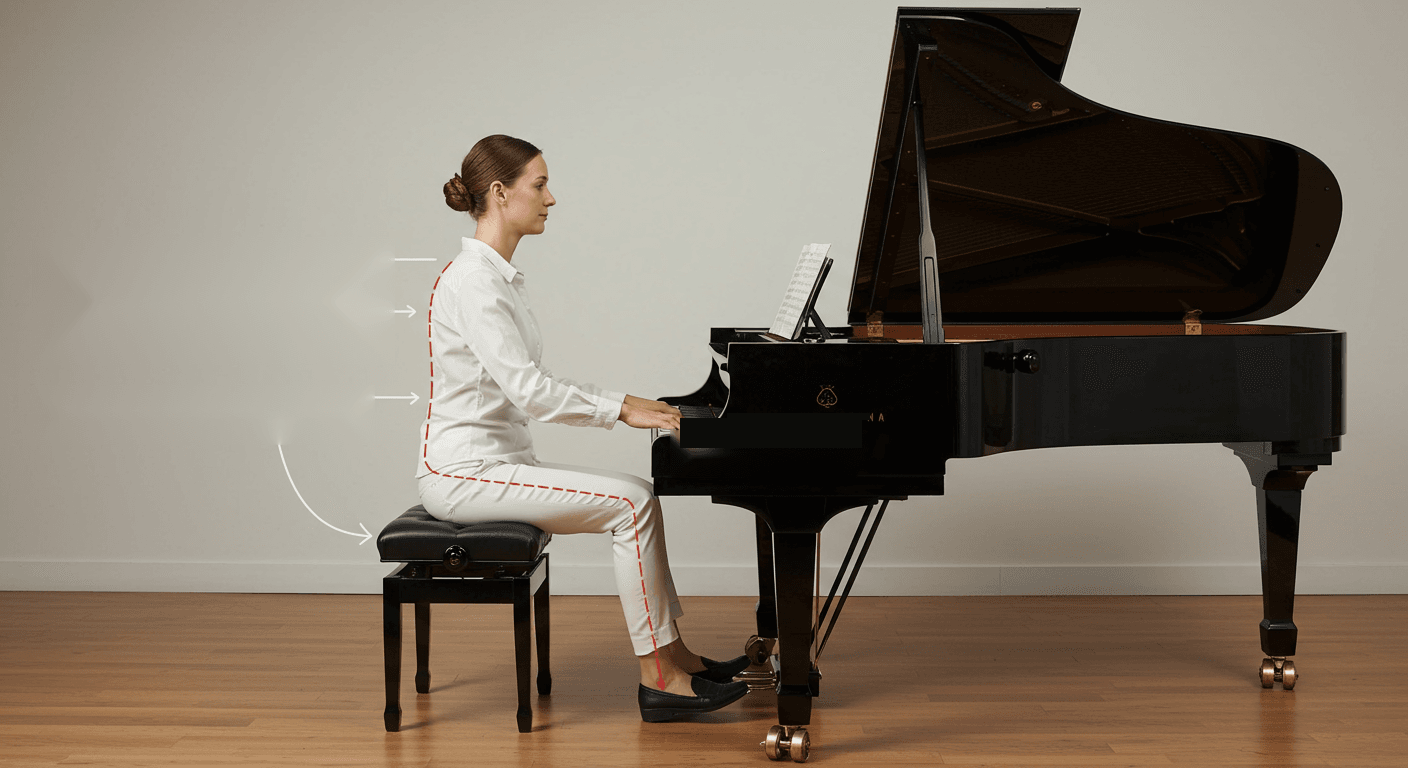
The foundation of good piano posture begins before you even touch the keys—it starts with your bench setup. The correct bench height allows your forearms to be parallel to the floor when your fingers rest on the keys, with your elbows bending naturally at roughly a 90-degree angle. Most pianists find that their bench should be adjusted so that their thighs are roughly parallel to the floor, with feet flat on the ground or on a footstool if needed.
Distance from the piano is equally crucial. Sit on the front half of the bench, allowing yourself to lean slightly forward from the hips when needed. You should be close enough to comfortably reach all areas of the keyboard without stretching, yet far enough that your arms can move freely without your elbows hitting your torso. A good test is to place your hands on the keys and check that you can extend your arms without locking your elbows or leaning forward excessively.
Many pianists make the mistake of sitting too low or too close to the piano, which restricts arm movement and creates tension. Take time to experiment with different heights and distances until you find what feels natural and allows for the freest movement. Remember that as you grow or if you share your piano with others, regular adjustments may be necessary.
Spine Alignment
Your spine is the central support system for your entire playing mechanism, making its alignment crucial for both comfort and technical facility. Sit tall with your spine in its natural S-curve, avoiding both slouching and rigid military-style posture. Imagine a string gently pulling upward from the crown of your head, lengthening your spine while keeping it relaxed and flexible.
Your shoulders should be relaxed and level, dropping naturally away from your ears. Many pianists unconsciously raise their shoulders when concentrating or attempting difficult passages, creating unnecessary tension that travels down through the arms to the hands. Regular shoulder rolls between practice segments can help maintain relaxation and awareness of shoulder position.
The pelvis should be in a neutral position, neither tilted too far forward nor tucked under. This neutral alignment allows your weight to be distributed evenly on your sitting bones, providing stable support while maintaining the flexibility to lean and move as musical expression demands. Your core muscles should be gently engaged to support your spine without creating rigidity.
Breathing plays a vital role in maintaining good spinal alignment. Deep, diaphragmatic breathing not only provides necessary oxygen but also helps release tension and maintain flexibility in your torso. Many pianists hold their breath during challenging passages, which creates tension throughout the body and restricts movement.

Arm and Elbow Positioning
Your arms serve as the connection between your body's core power and your fingers' precise movements, making their positioning critical for efficient technique. The upper arms should hang naturally from relaxed shoulders, with elbows positioned slightly away from your body—not clamped to your sides nor spread wide like wings. This neutral position allows for free movement in all directions while maintaining connection to your body's support.
Elbow flexibility is essential for navigating the keyboard smoothly. Your elbows should be free to move in and out as you play across different ranges of the piano, acting as shock absorbers and helping to maintain optimal hand position. When playing in the middle register, elbows typically hang naturally; when reaching to the extremes of the keyboard, they move accordingly to maintain comfortable hand positioning.
The forearms should maintain a relatively straight line from elbow to hand, avoiding excessive angles at the wrist. This alignment allows for efficient transfer of arm weight through to the keys while minimizing strain on the smaller muscles and tendons. Think of your arms as channels through which energy flows from your back and shoulders down to your fingertips.
Avoid the common mistake of playing with elevated elbows, sometimes called "chicken wings." This position creates tension and disconnects your arms from your body's natural support system. Similarly, clamping elbows tightly to your sides restricts movement and forces your wrists into awkward angles, especially when playing black keys or wide intervals.
Hand Shape and Wrist Position
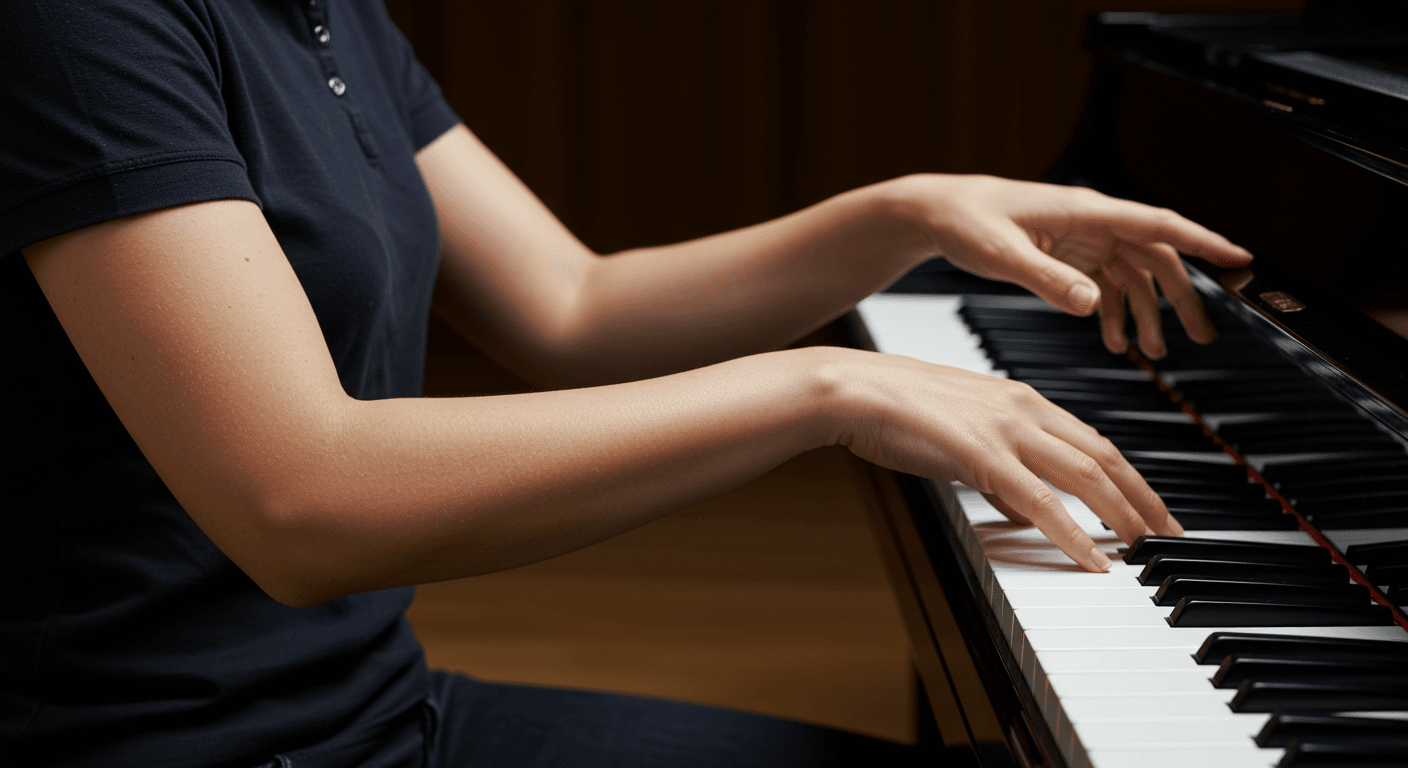
The shape of your hands at the keyboard should mirror their natural, relaxed position when hanging at your sides. Cup your hands gently as if holding a small ball, with fingers curved and fingertips contacting the keys at roughly a 45-degree angle to the key surface. This curved position provides the structural integrity needed for clear articulation while maintaining flexibility for various technical demands.
Your wrists should remain flexible and generally level with your hands, avoiding both excessive arching and dropping below key level. Think of your wrists as fluid joints that can adjust position based on the musical requirements—slightly higher for powerful forte passages, more level for singing melodies, and capable of lateral movement for smooth transitions across the keyboard. The key is maintaining flexibility rather than locking into any fixed position.
Finger positioning deserves special attention. Each finger should maintain its natural curve, with the fingertip—specifically the fleshy pad just before the nail—making contact with the key. The thumb, being structured differently, contacts the key on its side edge near the tip rather than the flat of the thumb. Avoid collapsed joints, particularly the first joint of each finger, as this weakens your touch and can lead to injury over time.
The often-overlooked aspect of hand position is the balance between firmness and relaxation. Your hand structure should be firm enough to transfer weight effectively to the keys while remaining supple enough to adjust to different intervals, chords, and technical patterns. Regular exercises away from the piano, such as gentle stretching and strengthening, can help develop this optimal balance.

Common Posture Mistakes and Corrections
These are the four mistakes that show up most often — and the quickest way to fix each one.
- Bench height is off. Too low, and your wrists drop below the keys, forcing your fingers to reach up and straining your arms. Too high, and your wrists arch excessively, limiting finger mobility and creating tension. Fix: recheck your bench height whenever you grow, switch pianos, or start using a footstool.
- Tension builds without you noticing. Necks, shoulders, and backs quietly tighten during concentrated practice or performance, often going unnoticed until discomfort sets in. Fix: run a quick body scan at the start and end of every practice session, and take short breaks to stretch.
- Slouching creeps in as you tire. Long practice sessions compress your breathing, reduce arm mobility, and strain your back. Fix: set a phone timer to buzz every 15 minutes during practice and do a 5-second shoulder-and-wrist check.
- Posture freezes into a rigid pose. In the effort to sit "correctly," many pianists become statue-like, forgetting that healthy playing involves constant micro-movements and adjustments. Fix: treat posture as a starting point you return to, not a pose you hold — let your body sway, lean, and shift weight naturally as the music demands.

Left: raised, hunched shoulders and a compressed spine. Right: the same pianist sitting tall, with shoulders level and the spine in its natural curve — notice how much more relaxed the hands and forearms look in the second photo.
Some pianists find it helpful to practice occasionally in front of a mirror, or to record themselves from the side, to catch these habits before a teacher has to point them out.
Conclusion
Mastering proper piano posture is a journey that requires patience, awareness, and consistent practice. While it may feel unnatural at first, especially if you're correcting long-standing habits, the benefits of good positioning—increased technical facility, reduced risk of injury, improved tone production, and greater expressive capability—make the effort worthwhile. Remember that every pianist's body is unique, and what works for one person may need slight modification for another.
As you continue your piano studies, make posture awareness an integral part of your practice routine. Regular check-ins with a qualified teacher, video recordings of your playing, and mindful attention to physical sensations will help you maintain and refine your positioning over time. With proper posture as your foundation, you'll find that technical challenges become more manageable, musical expression flows more naturally, and the joy of playing piano can be sustained throughout a lifetime of music-making.
Posture habits are hard to catch in a mirror — they are exactly the kind of thing a second pair of eyes spots in seconds. If you would like real-time feedback on your setup, a Tissimo piano teacher can watch you play over video and help you correct small habits before they turn into hard ones to break.