 Back

Violin Bow Retakes: A Silent Return for the Next Down-Bow
With your teacher, choose a comfortable short region of the bow. Play an open D on a down-bow through that region, count two beats of rest, then play another down-bow beginning at the same location on the hair. During the rest, your bow needs to come back without adding an up-bow note. That silent airborne return is a retake. The next sound begins only after the bow has returned and settled on the string.
This lesson is for you if separate down- and up-bows already feel comfortable and you can count through a rest. Stay on the open D string throughout. Your teacher chooses a manageable region of the bow and demonstrates the lift; you supply the counting and listen for the silence. The aim is a prepared second down-bow, with no extra on-string stroke between the two notes.
1. Read two down-bows with a rest between
Look above the two notes. Each has the same down-bow sign, shaped like a small squared arch. The sign identifies the sounding stroke's direction. It does not turn the rest into another note. Read the first bar aloud: “D for one, two; rest for three, four.” Start the next D on the following beat 1.

Two down-bows separated by silence. Each D lasts two beats and each rest lasts two beats; the second attack comes on the next bar’s beat 1. For full chosen-region strokes beginning at the same place, return through the air in the first rest. The second rest finishes this two-note example, so it does not require preparation for an unprinted third note. The direction signs belong to the sounding notes, while the rest remains a rest.
Both notes are half notes. In this 4/4 example, each lasts two quarter-note beats; each half rest also lasts two beats. If the hollow notehead is unfamiliar, The half note compares it with two quarter notes. Count through beat 2 without making a second attack. Then let the written silence begin on beat 3.

Read the whole bar before moving: begin D on 1, sustain through 2, and leave 3–4 silent. The hollow notehead and the half-rest symbol carry the same duration in this quarter-note-beat example, but only the note asks for sound. Keep counting at the same pace across the change. Use this bar first as a rhythm-reading task; add the airborne preparation only when the count and the teacher-led movement are each comfortable on their own.
Before touching the violin, tap just the two note beginnings while saying all eight counts. Your taps occur on the first “1” and the next “1.” The Rests gives the rest shapes and matching silent values. Saying “rest” must not stop the pulse; beats 3 and 4 take time even though no note begins there.
Read the pitch as well as the rhythm: D4 is the open D string used throughout this lesson. Repeating that one pitch lets you focus on the difference between sounding travel and silent preparation. You do not need to place a left-hand finger or solve a new string crossing between attacks. Return through the air, then place the hair back on the D string for the next note, and let your teacher check the string contact before you start.
Now imagine playing an audible up-bow during those two counts. You would have replaced the half rest with a half note. Moving your arm back is not enough to make a successful retake: the return must leave the written silence intact. Keep that listening task beside the direction signs whenever you read this lesson's examples.
2. Identify where the first stroke ends
Ask your teacher to choose two locations along the bow hair. Call the starting location A, nearer the frog, and the ending location B, nearer the tip. These are relative labels within a comfortable chosen region. You do not need to travel from the actual frog to the actual tip, or measure a fraction of the bow.

Use A and B as names for the two ends of a teacher-chosen region. Down-bow moves the string’s contact along the hair from A toward B; up-bow moves it from B toward A. The arrows describe relative locations on the bow and are not directions up or down in the room. The strip is a schematic, not a measured bow path, and its apparent length does not tell you how much bow or how high a lift to use.
For our full-region down-bow, the string's contact with the hair travels from A toward B. At the end of the note, B is at the string. The next full-region down-bow is supposed to begin with A at the string again. That difference between your current location and your next starting location creates the need for a return.

The first down-bow starts at A and finishes at B. During the rest, restore A for the next full-region down-bow. The pitch stays open D.
Play only the first note, then stop the exercise. Let your teacher point out which location is now at the string. Naming the endpoint is useful: “I finished at B; my next down-bow starts at A.” You are planning a location on the bow hair, not moving to another string or changing from bowing to plucking.
Two down-bow signs by themselves do not universally demand a retake. Shorter strokes may leave enough available bow for another stroke in the same direction. For a contrast, choose a third location C between A and B. A short down-bow can finish at C; a second down-bow can continue from C toward B after a silent on-string stop. That second note begins at C, not at A. Our retake exercise instead requires both notes to start at A. Here, the instruction to use the whole chosen region makes the decision explicit. Do not apply this exercise's answer automatically to a new piece; first check the intended starting locations with your teacher.
3. Watch your teacher separate the bow from the string
Watch one slow demonstration before copying it. Listen to the first note finish. See the bow stop, leave the string, return to the chosen start, and settle again. Heather Kaye's retake lesson recommends open-string practice and setting the bow before pulling the next stroke. Ask your teacher to make those two moments easy to distinguish.

Watch one demonstration with three specific questions in mind. Where does this stroke start and finish? When does its sound end? How does the bow leave, return and meet the string again? Ask your teacher to separate those events slowly enough to recognize them before copying. The panel order organizes observation; it does not prescribe a new technical grip, an exact lift height or a performance tempo. Keep the familiar open D as the sounding task throughout.
Use four words for the preparation: stop, lift, return, place. “Stop” ends the first sounding stroke. “Lift” separates the hair from the string. “Return” brings the chosen starting region back through the air. “Place” restores contact quietly, before you begin the next sounding stroke. The words describe an order, not four equal subdivisions of the rest.

Stop with the hair touching the string; lift to separate it; restore the starting region while off the string; place quietly before the next stroke. These panels show contact and location, not lift height or the timing of individual joints.
First try that sequence without a running beat, with your teacher checking the movement. Allow time to place comfortably. For this first exercise, have your teacher demonstrate a small, controlled return close to the string, using a comfortable short region. Aim to clear the string and restore the start without making the flight larger than necessary. This follows Heather Kaye’s beginner exercise on open strings. If the bow feels difficult to control, pause for an adjustment rather than making the return larger or faster on your own.
A retake is not a request to bounce the bow. In this exercise the flight belongs to the silence, and the next note begins from prepared contact. Stay with this one task. You do not need an accented attack, a new bow hold, or a different string to learn what makes the return silent.
4. Return silently while the count continues
Once the movement is comfortable without time pressure, restore the count. Play D through beats 1 and 2, then use the half rest to prepare the next D. Keep “three, four” in the same pulse as “one, two.” Your teacher can count aloud while you concentrate on hearing whether the rest remains quiet.

This comparison has four sounding beats: down-bow D on 1–2, up-bow D on 3–4. It shows what happens to the rhythm if an audible return stroke replaces the intended half rest. It is useful for hearing the difference, but it is not the exercise you are trying to reproduce. In the retake version, the second half of this bar must remain silent while the bow returns away from the string.
The comparison above deliberately sounds an up-bow on beats 3 and 4. It helps you recognize the extra note you are avoiding. In a retake, returning along the bow's length happens away from the string. It does not spend another sounding up-bow to put A back at the string. Listen especially to the middle of the rest, where an unnoticed return stroke might creep in.

Read the count row continuously, with D sounding over the first two cells of each bar and silence over the next two. The first rest prepares another note, while the second rest closes the example. Action labels suggest what to remember, not when a particular joint must move. In particular, “return” and “ready” are not compulsory one-beat phases. Your teacher can adjust how the movement fits inside a comfortable rest without changing which beats are sounded.
The diagram's action labels are reminders, not a timetable for your joints. Do not assign a mandatory beat to each part of the movement. Your teacher adjusts the preparation within the available silence. If it cannot fit comfortably yet, stop the timed version and return to the unhurried sequence. A rushed landing is not a reason to remove the rest's last count.
Try the four-bar route below. Each bar has the same half-note D and half rest. There are four sounded attacks and eight sounding beats in total, balanced by eight silent beats. Only the first three rests lead to another attack, so only those three require returns for this route. The final rest is a counted finish.

Four attacks, three required retakes. Four half notes total eight sounding quarter-note beats, and four half rests total eight silent beats. Return to the chosen start in the first three rests because another full-region down-bow follows each one. Count the last rest completely, then finish. These numbers describe this printed four-bar route; they do not imply that every group of four down-bow signs in other music must use exactly the same return plan.
A Silent Return for the Next Down-Bow puts this contact-state idea beside the four-bar route and an alternating-stroke comparison. Use it with your teacher: identify the three preparation rests before playing. Keep the last rest quiet too, without treating it as a command to begin another cycle.
5. Place first, then begin the next note
Reaching A is only part of being ready. The hair also needs comfortable contact with the D string before the next stroke starts. Practice ending the airborne movement, placing, and waiting briefly before playing. Your teacher can see whether those actions remain distinct. Your ears check whether placement adds a thump or scrape before the intended note.

Prepare the count and the movement separately before asking them to cooperate. Say the rhythm; rehearse the teacher-led silent return without time pressure; then join them at a comfortable pulse. If that last step is premature, use the explicitly longer written version or pause the beat for movement rehearsal. Neither approach makes a half rest worth more than two quarter-note beats in the original 4/4 example. Return to that rhythm only when the preparation is ready for it.
If two rest beats are too short for comfortable preparation, use an explicitly longer practice version. The next figure adds a whole silent bar between the two note-and-rest bars. Count that extra bar from 1 to 4. This changes the exercise on purpose; it gives you room to learn the sequence without pretending the original half rest has become longer.

A longer written rehearsal: the first note-and-rest bar is followed by a whole silent bar before the next note-and-rest bar. There are six silent quarter-note beats from the end of the first D to the beginning of the second: two in the half rest and four in the added silent bar. Count the added bar explicitly. This gives preparation more room by changing the practice version on the page, rather than silently stretching a two-beat rest in the original example.
With a teacher, you can also work without a steady beat and resume counting after preparation. Call that a movement rehearsal. When you return to the printed two-bar rhythm, keep its four beats per bar. Separating those practice modes prevents a common confusion: being ready eventually is useful progress, but it is a different result from being ready for the written onset.

During the first rest, restore A and place the hair quietly. Begin sounding only on the next beat 1. The contact lane shows event order, not fixed durations for the preparation.
Tempo & the Metronome explains the relationship between the click and the beat. If your teacher chooses quarter note = 60 for this 4/4 pattern, each count lasts one second, so the half rest lasts two seconds. That arithmetic describes the music; it is not a deadline your body has to meet today. Choose a slower comfortable tempo or the longer written preparation instead of racing the click.
When the next beat 1 arrives, start the down-bow from the prepared contact. Avoid using the note's first beat to finish landing. Then listen through its second beat as carefully as you did the first note. A clean return has succeeded only if it leaves you able to play the next note comfortably.
6. Compare a reversal with a retake
Now change the second direction sign to up-bow, the small V-shaped mark. Keep both half rests. Under our full-region model, the first down-bow ends at B and the next up-bow starts at B. You can stay at that endpoint during the rest and reverse direction for the next note. An airborne return is unnecessary for this boundary.

Down followed by up uses the current endpoint: the down-bow ends at B and the up-bow begins at B. Stop during the first half rest and preserve that location for the next stroke. The opposite direction does not authorize sound during the rest. Compared with down/down, the notes and durations remain the same; the preparation changes because the required start for the next stroke already matches the end of the previous one.
In the direction labels below, D means down-bow and U means up-bow; every sounded pitch is still open D. Play the D/D version and the D/U version with the same rhythm. The first needs a return to A; the second uses B for the next start. In both, the half rest stays silent. The difference is the preparation, not an added or missing note. Do not fill the rest just because an up-bow is coming next.
Up-bows follow the same location logic. A full-region up-bow travels from B toward A. Another full-region up-bow needs B back at the string, so the return goes toward B through the air. If a down-bow follows instead, it can begin at A, where the up-bow just finished. Read the endpoints before deciding what your arm should do.

Up/up needs the chosen start restored; up/down can reverse from the endpoint. After the first up-bow, A is at the string, so return through the air until B is ready for the second up-bow. That second up-bow ends at A, already the next down-bow’s start. There is one required return across these two boundaries under the full-region model. The final rest finishes the example and does not add another required return.
Say the four pairings before playing: down/down returns; down/up reverses; up/down reverses; up/up returns. Every answer assumes full chosen-region strokes and the stated starting locations. In other music, shorter repeated-direction strokes can have different plans. Violin Online's bow-stroke reference also cautions that articulation terminology and marks need musical context; a sign alone does not describe an entire physical action.
In a piece, a retake may be implied by the bow plan rather than marked separately. You may also see a comma-like lift indication, but do not treat every comma as an automatic retake command. Ask where the next stroke should begin and whether the available rest gives you time to prepare it. This lesson practices the case with a written rest; do not shorten notes in a new piece on your own to create a return window. Violin Lounge’s bowing-terms lesson explains the sometimes-unmarked retake.
Does the Next Stroke Need a Return? asks you to make that decision from supplied directions and locations. Trace the first stroke to its endpoint, then compare that endpoint with the next required start. Explain the mismatch, or the match, before checking the answer. This reasoning is more useful than circling “return” whenever you see two notes with a rest.
7. Check silence, readiness and comfortable contact
Use the four-note direction route D, D, U, U. Begin at A and use the full chosen region for each note. The first down-bow ends at B, so return to A for note 2. Note 2 ends at B, already the start for note 3's up-bow. Note 3 ends at A, so return to B for note 4's up-bow.
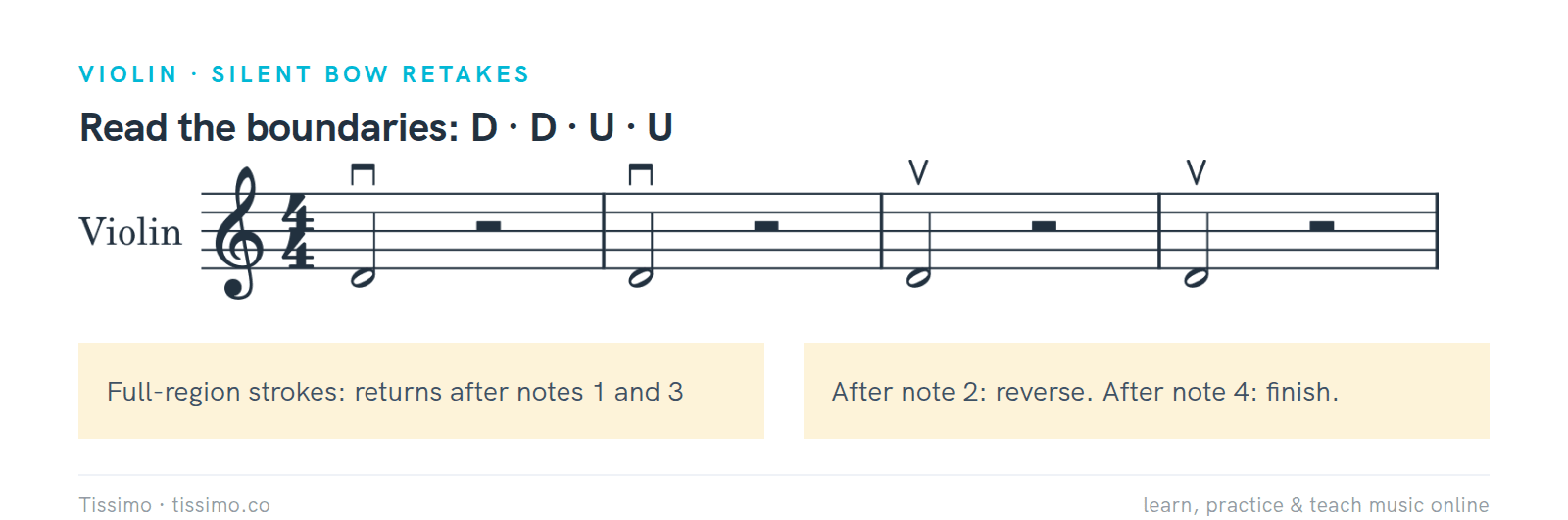
D/D/U/U contains two required returns in this model. After note 1, restore A for note 2; after note 2, use B for note 3 without returning; after note 3, restore B for note 4. The final half rest is still counted, although no next attack needs a reset. Explain the three boundaries separately before playing. The answer follows from the supplied full-region starts and ends, not from a general rule that all repeated-direction notes need lifting.
There are exactly two required returns: between notes 1 and 2, and between notes 3 and 4. There is a reversal between notes 2 and 3. After note 4, count the final rest and finish. A final rest still has its full duration even when no next attack requires preparation. Use The Rests again if you find yourself dropping that last silence.

Check silence, readiness and comfort independently after the short route. An extra bowed note in the rest is a listening result; arriving at the correct starting region is something the teacher can watch; comfortable contact needs the player’s feedback as well. Use those separate observations to choose the next rehearsal task. A correct direction sequence on paper does not establish comfortable physical execution, and a silent recording alone cannot show whether the hair left the string during the return.
Use the exercise’s state-order task before the playing route if the sequence still feels unclear. Its scrambled cards read place, stop, return, lift. Beginning when the first sound ends, the order is stop, lift, return, place: card numbers 2, 4, 3, 1. Explain what changes at each boundary. Lifting changes contact; returning changes location; placing restores contact. None of those silent preparation states adds a new sounding pitch.
The companion recordings are neutral piano references for pitch and time. Listen for the D attacks and the written gaps, then count the same pattern yourself. They cannot demonstrate a lift, a bow path or a comfortable landing. You need the teacher’s visible demonstration and observation for those checks. A pitch-correct recording could accompany several different physical actions, so do not use timbre or silence alone to decide which bow movement happened.
If you hear an extra sound during the rest, ask your teacher whether it came from the lift, an on-string return, or placement. Rehearse that part without the beat, then join the sequence again. If placement is late, use the longer preparation version or a slower teacher-selected pulse. If the next attack is rough, isolate quiet placement followed by a separate start. Change one part, then try a short route again. There is no required repetition quota or speed target; stop for help if the movement feels strained.
Before another attempt, name the one result you want to change: a quieter rest, earlier readiness, or a cleaner next attack. Use the return-or-reverse exercise to explain the bow plan, then have your teacher observe that one change.
Keep the retake attached to its musical purpose: a silent return makes the next intended stroke available. Music Mark includes bow retakes in its introductory strings curriculum. You can bring this particular rhythm to a Tissimo teacher and ask for feedback on silence, placement and the next attack in a live lesson.
Free worksheets for this lesson
- A Silent Return for the Next Down-Bow — contact states, four down-bows with counted rests, and an alternating-stroke comparison.
- Does the Next Stroke Need a Return? — decide from the supplied full-region model, order preparation states, and check D/D/U/U.
- The half note — recognize the two-beat note used throughout these examples.
- The Rests — recognize and count quarter, half and whole-measure silences.
- Tempo & the Metronome — connect a metronome setting with a steady counted beat.
Sources
- 28 Basic Violin Bowing Terms — Violin Lounge
- How to Retake the Violin Bow with Good Tone — Heather Kaye
- Strings, Area B, Programme of Study 1 — Music Mark
- Violin Bow Strokes — Violin Online
- Down-bow notation — W3C MusicXML 4.0
- Up-bow notation — W3C MusicXML 4.0
- Rest notation — W3C MusicXML 4.0
- Metronome notation — W3C MusicXML 4.0
Read this article online: https://tissimo.co/articles/violin-bow-retake-silent-return-rest




Comments