 Back

Time Signatures Explained: Simple, Compound, and Odd Meters
Pick up any piece of printed music and you will see two stacked numbers at the very start, right after the clef. Those numbers are the time signature, and once you know how to read them they tell you everything about how the music counts — how many beats fill each bar, which note gets one beat, and whether those beats split in two or in three. This guide takes you through simple meters (4/4, 3/4, 2/4 and cut time), compound meters (6/8, 9/8 and 12/8), and the odd asymmetric meters (5/4 and 7/8), with engraved examples you can play at the piano today. It also shows you how the bottom number works, what the C and cut-C symbols mean, and what happens when a piece changes meter mid-stream. Our companion guides How to Count Rhythm and Rhythm vs. Meter cover the broader counting system and the relationship between rhythm and the beat; this article focuses specifically on reading and using time signatures.
The two numbers: top and bottom
A time signature looks like a fraction but is not one. The two numbers answer two separate questions.
The top number tells you how many beats are in each measure. Count from one to that number, over and over, and you have the meter's pulse: 4 in 4/4, 3 in 3/4, 6 in 6/8.
The bottom number tells you which note value gets one beat. It is a code: 2 means a half note, 4 means a quarter note, 8 means an eighth note, and 16 means a sixteenth note. So 3/4 has three quarter-note beats, 6/8 has six eighth-note beats, and 2/2 has two half-note beats.

Read a time signature in two steps: check the top for the beat count, then check the bottom for the note that gets one beat. The worksheet Time Signatures I: Simple Time covers 4/4, 3/4 and cut time with clapping examples.
Simple meters: beats that split in two
In simple time each beat divides neatly into two equal parts. The top number is 2, 3 or 4, and the most common bottom number is 4 (quarter note). If you have never clapped a time signature before, try Time Signatures I: Simple Time first; it starts with one bar of 4/4 and builds from there.
4/4 — common time
Four quarter-note beats, the most common meter in Western music. Marches, pop songs, most classical pieces and almost all beginner piano music live in 4/4. The first beat is the strongest — count ONE-two-three-four — and beat 3 has a secondary weight: ONE-two-THREE-four. Music publishers sometimes write the abbreviation C (a large letter C, standing for "common time") instead of the two numbers.
3/4 — waltz time
Three quarter-note beats: ONE-two-three, ONE-two-three. The spinning feel of a waltz comes from that strong first beat followed by two lighter ones. A single dotted half note fills a whole 3/4 bar; The dotted half note shows how to count it. Bach's minuets, Chopin's waltzes and countless folk songs use 3/4.
2/4 — march time
Two quarter-note beats: ONE-two, ONE-two. Exactly half a bar of 4/4, with a strong beat on 1 and a light one on 2. Marches and many folk dances use 2/4 because two big feet-shaped beats are physically direct.

One bar of each simple meter. Play the notes and count aloud on every note; feel the difference in weight between beat 1 and the beats that follow.
How beaming shows the beat
Eighth notes and shorter values are joined by beams, and those beams group notes by beat. In Beaming & Grouping, the rule is stated clearly: beam each beat's notes together so anyone can count your bar at a glance. In 4/4 each beam group covers one beat (the eighth note plus its "&"), and beats 1–2 or 3–4 may share one longer beam — but never beats 2 and 3, which would hide the middle of the bar. In 3/4, each beat's two eighths share a beam.
Beams are not decoration — they show the beat structure. A correctly beamed bar reveals the meter even before you read the time signature.
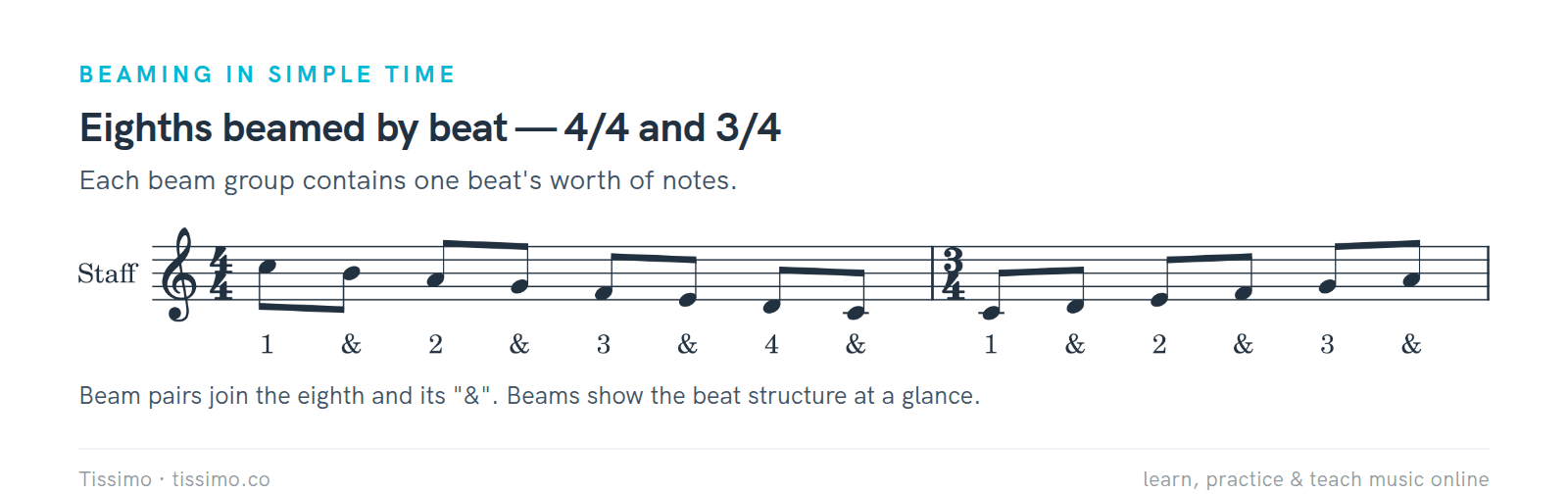
Eighth notes beamed by beat. In 4/4 each pair spans one quarter-note beat (the note and its "&"). In 3/4 the same pairing applies. The worksheet Beam the rhythm gives bars with wrong beaming to fix.
Practice adding barlines to unbarred rhythms with Add the Barlines, which gives you 4/4 and 3/4 lines with the barlines erased so you count and restore them. After that, Complete the measure gives you bars with one note missing that you must identify by counting the beats already there.
Cut time: 2/2 and the C with a slash
Cut time is 2/2 — two half-note beats per bar. Its symbol is a C with a vertical line through it. The notes on the page are identical to a bar of 4/4, but the half note now gets the beat, so there are only two beats. Quarter notes are counted 1 & 2 &, and eighth notes 1 e & a 2 e & a — the same syllables, but now under a half-note beat.
As Two Beats in a Bar: 2/4 & Cut Time explains, fast music is often written in cut time because two big beats are easier to feel than four quick ones. Clementi's Sonatina in C, Op. 36 No. 1, is printed in cut time in the standard Schirmer edition, with two broad half-note beats per bar. The Time Signatures I sheet calls cut time "striding" to distinguish it from the sturdiness of 4/4 and the spinning of 3/4.

The same five notes counted in 4/4 and in cut time. In 4/4 the quarter note is one beat; in cut time the half note is one beat and the quarter becomes its "&". The Count in two sheet prints the same rhythm in both meters side by side.
The bottom number: a table worth memorizing
You will mostly see 4/4, 3/4, 2/4 and 6/8, but the bottom number is a general code and any power of two can appear there.

All three bars have two beats. Only the note value that gets one beat changes: the half note in 2/2, the quarter in 2/4, the eighth in 2/8. The bottom number names that note.
The table is simple: 2 = half note, 4 = quarter note, 8 = eighth note, 16 = sixteenth note. You will almost never see bottom numbers other than these four. When you meet an unfamiliar time signature, decode the bottom number first, then the top.
Compound meters: beats that split in three
In compound time each beat divides into three equal parts, so the beat itself is a dotted note. The top number looks large — 6, 9 or 12 — but those are eighth-note counts, not beat counts. The rule: divide the top number by 3 to find the number of beats you feel. This works for 6, 9 and 12 (not for 3, which is simple time — three eighth-note beats, not one dotted-quarter beat). The worksheet Time Signatures II: Compound Time covers 6/8, 9/8, 12/8 and 6/4 with listening examples.
6/8 — compound duple
Six eighth notes, felt in two. Divide: 6 ÷ 3 = 2 big dotted-quarter beats. Count every eighth and lean on 1 and 4: ONE-2-3-FOUR-5-6. Lullabies, barcarolles and Irish jigs live here. The worksheet Time Signatures II: Compound Time calls it "the rocking of boats and lullabies."
In 6/8 the eighth notes are beamed in groups of three — that is the first visual difference from 3/4, which beams them in pairs. The Simple vs compound: 3/4 or 6/8? worksheet gives you eight bars with the time signature removed so you must decide from the beaming alone.

Six eighths in 6/8, beamed in groups of three. Bar 1 shows all six counts; bar 2 shows the two dotted-quarter beats. Feel the two big beats even when you count all six eighths.
3/4 versus 6/8: the same notes, different grouping
Both time signatures hold six eighth notes per bar. The difference is entirely in how those eighths are grouped. In 3/4 they are beamed in pairs — three quarter-note beats each splitting in two. In 6/8 they are beamed in threes — two dotted-quarter beats each splitting in three. Listening to Schumann's The Wild Rider (6/8) next to Petzold's Minuet in G (3/4) makes the difference audible: the Wild Rider rocks in two, the Minuet spins in three.

The same six eighth notes, two meters. In 3/4 (top) the pairs reveal three quarter-note beats. In 6/8 (bottom) the groups of three reveal two dotted-quarter beats.
9/8 — compound triple
Nine eighth notes, felt in three: ONE-2-3-FOUR-5-6-SEVEN-8-9. Three dotted-quarter beats, each rolling in three. The feel is "a waltz whose every beat rolls," as the Time Signatures II sheet puts it. Eighths are beamed 3+3+3. Practice counting 9/8 with Write the counts 4: compound time, which gives full-bar exercises for all three compound meters.

Nine eighths in 9/8, beamed in three groups of three. Strong pulses fall on eighths 1, 4, and 7 — the start of each dotted-quarter beat.
12/8 — compound quadruple
Twelve eighth notes, felt in four: beat 1 on eighth 1, beat 2 on eighth 4, beat 3 on eighth 7, beat 4 on eighth 10. Four dotted-quarter beats, beamed 3+3+3+3. The blues, gospel and doo-wop use 12/8 for its slow, rolling feel — say "straw-ber-ry, straw-ber-ry, straw-ber-ry, straw-ber-ry" and you are counting 12/8.

Twelve eighths in 12/8, beamed in four groups of three. Each group of three is one dotted-quarter beat. Count the small eighths and lean on the four big beats.
A quick reference: simple vs compound
The Simple vs compound: 3/4 or 6/8? sheet gives you eight one-bar lines to sort into one or the other, using the beaming as your only clue. The Ear Training: Rhythm Dictation II sheet takes the same idea to the ear: two beats, three pulses each, with a listening track.
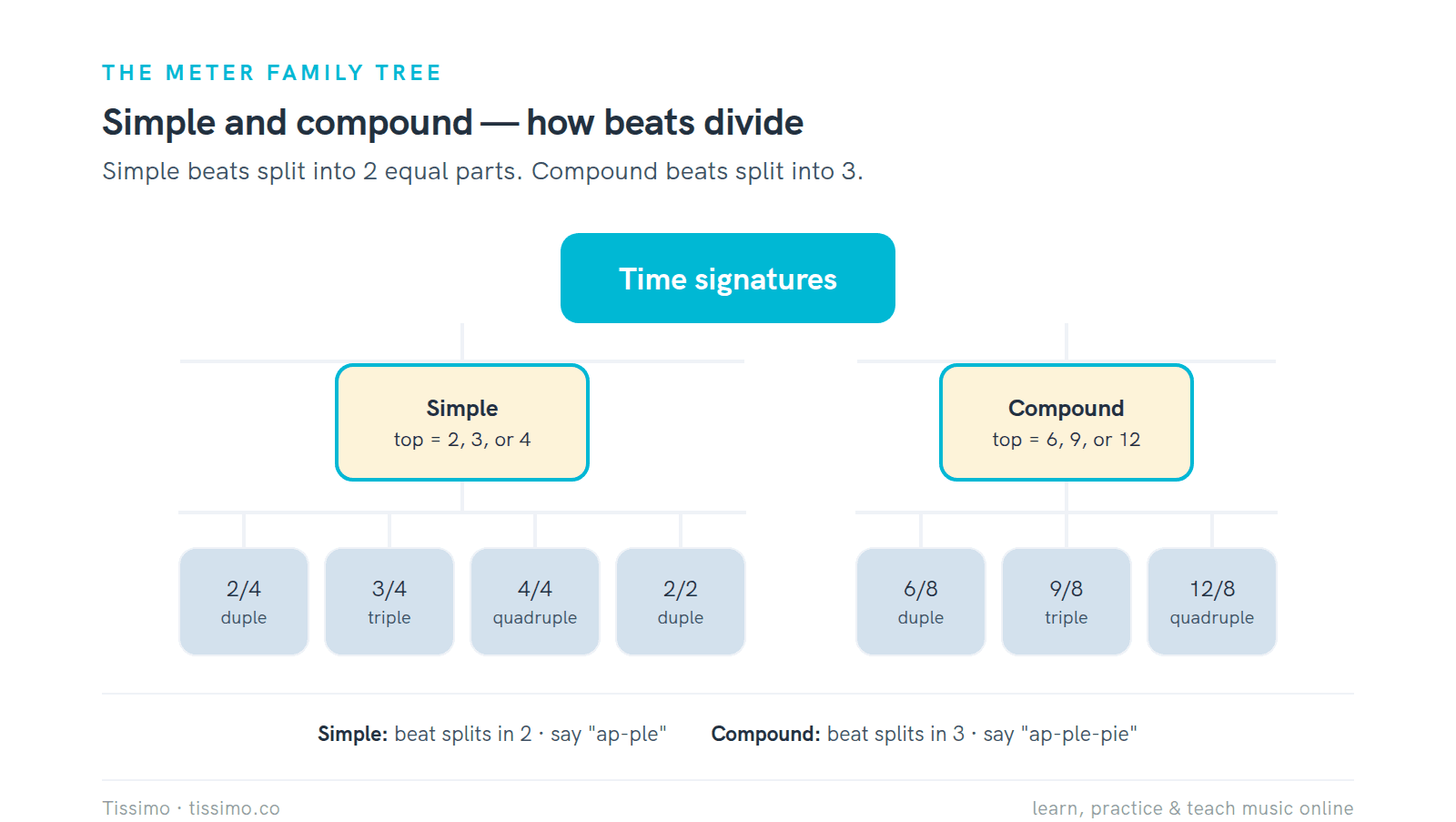
The meter family tree. Simple and compound are the two main branches. The top number is the fastest way to tell them apart: 2, 3 or 4 means simple; 6, 9 or 12 means compound.

Three families of meter at a glance. The mnemonic from Time Signatures II: say "ap-ple" for a simple beat (two syllables), "ap-ple-pie" for a compound beat (three syllables).
Counting compound time in four steps
Compound meters confuse beginners because the top number is not the beat count. These four steps work for every 6/8, 9/8 and 12/8 you will encounter.

Four steps to any compound time signature. The reminder at the bottom matters: 3/8 has three eighth-note beats and is simple time, not compound.
Work through every exercise in Write the counts 4: compound time. It moves from one-bar examples in 6/8 to two-bar lines in 9/8 and 12/8, and each exercise asks you to write the counts under the notes before you clap them — the same method How to Count Rhythm uses throughout.
Odd and asymmetric meters: 5/4 and 7/8
Simple and compound meters divide their beats into equal groups of two or three. Asymmetric (or additive) meters combine groups of two and three to make a bar with an uneven feel. As the Feeling 5/8 and 7/8 worksheet explains, the top number counts eighth-note pulses (or quarter-note pulses in 5/4), and the groups decide where the accents fall.
5/4 — five quarter-note beats
Five quarter notes per bar. The five beats split into 3 + 2 or 2 + 3 — the grouping comes from the music itself, and the beaming and phrase marks show it. In 3 + 2 the strong beats fall on 1 and 4; in 2 + 3 they fall on 1 and 3. The Feeling 5/8 and 7/8 worksheet says: "A group of 2 lasts a quarter note; a group of 3 lasts a dotted quarter." In 5/4 with quarter-note pulses, 3 + 2 means you have a dotted-half plus a half, and 2 + 3 means a half plus a dotted-half.

Five quarter notes in 5/4. Bar 1 groups as 3 + 2: feel ONE-two-three-FOUR-five. Bar 2 groups as 2 + 3: feel ONE-two-THREE-four-five. Accents mark the group starts.
The Dave Brubeck Quartet's "Take Five" (1959), written by Paul Desmond, is the best-known 5/4 piece in jazz: the left-hand piano vamp moves as 3 + 2, with a crisp accent on beat 4 each bar.
7/8 — seven eighth-note pulses
Seven eighths per bar, grouped 2 + 2 + 3, 3 + 2 + 2 or 2 + 3 + 2. The beaming tells you which grouping the composer chose, and the grouping tells you which eighth pulses carry the accent. Béla Bartók used 7/8 and irregular meters throughout his Mikrokosmos; Bulgarian folk music (the dance called Rachenitsa) commonly uses 7/8 grouped 2 + 2 + 3.

Seven eighths in 7/8, grouped two ways. Top: 2 + 2 + 3, accents on 1, 3 and 5. Bottom: 3 + 2 + 2, beamed in those three groups, accents on 1, 4 and 6. A group of 2 lasts as long as a quarter note; a group of 3 as long as a dotted quarter.

All five common groupings of 5/4 and 7/8 in one table. The worksheet Feeling 5/8 and 7/8 gives reading and completion exercises for both meters.
The easiest way to learn asymmetric meters is to feel the groups in your body before you read them on the page. Set a metronome to a slow eighth-note pulse, say the counts out loud (1-2 | 1-2 | 1-2-3 for 7/8 in 2 + 2 + 3), and clap on the accent at the start of each group. When that feels automatic, pick up the Feeling 5/8 and 7/8 worksheet and work through its reading and completion exercises.
Changing meter
A new time signature placed at a barline means the meter changes from that bar onward. The counts restart at 1, and the note values keep their meaning as long as the bottom number stays the same. If the bottom number changes, the note-value reference shifts.
The Find the New Downbeat exercise is built around this exact skill: it gives eight-bar sequences that alternate among 2/4, 3/4 and 6/8 (all sharing an eighth-note reference), and asks you to track where the downbeat falls in each bar using an eighth-note index. The key insight is that the eighth note is the common unit: a bar of 2/4 is four eighths, a bar of 3/4 is six, and a bar of 6/8 is also six — but they feel different because the beats group differently.

A meter change mid-line. The new time signature appears at the barline. Bar 2 has only three beats; bar 3 returns to four, with a rest on beat 4.
The Changing meter: new meter, same eighth worksheet drills the case where an eighth note means the same speed throughout — a common instruction composers write as a note-value equation at the change.
Putting it all together: a practice routine
Once you can name a time signature's beats and note value, the next step is to hear it. For each new meter:
- Identify the top and bottom numbers. What note gets the beat? How many?
- Say the counts out loud for one bar, slowly, before you play.
- Clap the rhythm while you keep counting, as the How to Count Rhythm guide teaches.
- Play on one key first, then on the written pitches.
- Check the beaming in anything you are learning — it shows you the beat structure even before you count a note.
For compound meters, add one step: divide the top number by 3, then say the grouped count (ONE-2-3-FOUR-5-6 for 6/8) before you play. For asymmetric meters, identify the groups from the beams and clap the accent pattern first.
Free worksheets for this lesson
- Time Signatures I: Simple Time — 4/4, 3/4 and 2/2 with clapping examples
- Time Signatures II: Compound Time — 6/8, 9/8, 12/8 and 6/4 with listening examples
- Two Beats in a Bar: 2/4 & Cut Time — 2/4 and cut time side by side
- Simple vs compound: 3/4 or 6/8? — eight bars to sort from the beaming alone
- Write the counts 4: compound time — write the counts under 6/8, 9/8 and 12/8 lines
- Beaming & Grouping: Show the Beat — the rules for correct beaming in simple and compound time
- Beam the rhythm — fix incorrectly beamed bars
- Add the Barlines — count beats and restore barlines in 4/4 and 3/4
- Complete the measure — find the missing note or rest in 2/4, 3/4, 4/4 and 6/8
- Find the New Downbeat — track downbeats through changing meters (2/4, 3/4, 6/8)
- Feeling 5/8 and 7/8 — read and complete bars in asymmetric meters
Conclusion
A time signature is two numbers that together set the whole rhythmic frame of a piece. The top tells you how many beats, the bottom tells you which note gets one, and the family — simple, compound or asymmetric — tells you how each beat divides. Reading a new piece starts with those two numbers: once you know them, the counts and the beaming fall into place. If you want to hear these meters in a lesson, a Tissimo teacher can play examples with you and correct your counting in real time — find one at /music-teachers/instrument/piano.
Sources
- Open Music Theory (v2) — Meter — Chelsey Hamm, Mark Gotham et al.
- Music Theory for the 21st-Century Classroom — Robert Hutchinson
- Fundamentals, Function, and Form — Andre Mount
- Oxford Music Online — "Metre" — Oxford University Press
- Feeling 5/8 and 7/8 (Handout 391) — Tissimo
- Time Signatures I: Simple Time (Handout 44) — Tissimo
- Time Signatures II: Compound Time (Handout 45) — Tissimo
- Béla Bartók, Mikrokosmos Vol. 4–6 — Boosey & Hawkes
Read this article online: https://tissimo.co/articles/time-signatures-explained-simple-compound-and-odd-meters




Comments