 Back

Relative vs Parallel Keys: C Major, A Minor and C Minor Explained
Two keys can be related in two completely different ways, and the words "relative" and "parallel" are where most students first get tangled. The short version: relative keys share the same notes but have different home notes; parallel keys share the same home note but have different notes. C major and A minor are relatives. C major and C minor are parallels. This guide shows how to spot each one on the staff, on the circle of fifths and on the piano keyboard, and why composers care.
Relative keys: same notes, different home
Play the white keys from C up to the next C. That is C major. Now play the white keys from A up to the next A. That is A minor (the natural minor form). You used exactly the same seven keys both times, only the starting point moved. When two keys share every note and therefore the same key signature, they are relative keys. A minor is the relative minor of C major, and C major is the relative major of A minor.

C major and A natural minor with an empty key signature. The same seven letters appear in both; only the tonic (the home note, where the scale starts and feels finished) changes.
The home note is what makes the sound different. In C major the music settles on C; in A minor it settles on A, and the same seven notes now sit in a different pattern of whole steps and half steps (major: W-W-H-W-W-W-H; natural minor: W-H-W-W-H-W-W). That is why the two keys share a key signature but not a mood. If you want to hear what a different home note does, play the two scales above back to back; our article on how major and minor differ goes deeper.
Every key signature therefore serves two keys at once: one major and one minor. The two keys also share the same set of triads. In C major the chord built on the sixth note is A minor, and in A minor it is the tonic chord; C major, the tonic of the first key, becomes the third-degree chord of the second. That overlap is why a piece can lean toward its relative key so smoothly, and why a short passage can be hard to label without more context (more on that under common confusions).

Each bar holds two half notes: the major tonic, then the minor tonic that shares the signature. The pairs are C and A, G and E, F and D, and E♭ and C.
If you are new to signatures, start with our guide to key signatures. Once you have the shapes in your head, the Key Signatures: Major & Minor reference card lists all fifteen signatures with both keys, and Name the Key Signatures asks you to write the major and relative minor for eight of them.
Finding a relative key three ways
On the keyboard or the staff. The relative minor starts on the sixth note of the major scale, which is the same as three half steps (a minor third) below the major tonic. For C major, count down from C: B is one, B♭ is two, A is three. The relative major is the reverse: go up three half steps from the minor tonic (A up to C).

Three half steps down from C: B (1), B♭ (2), A (3). The A is the tonic of C major's relative minor.
This works from any key, with the note's accidental included: B major's sixth note is G♯, so its relative minor is G♯ minor. Take the note names carefully; the counting stays the same.
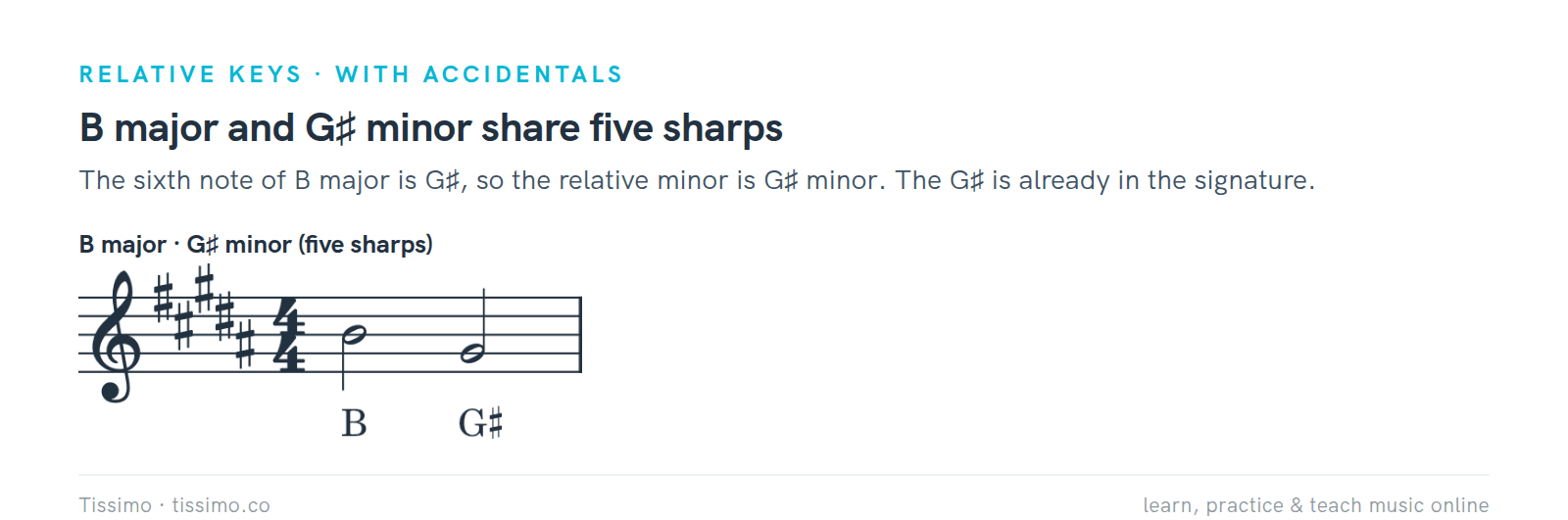
B major and G♯ minor share five sharps. The G♯ is already in the signature, so it needs no accidental.
By the key signature. With sharps, the last sharp in the signature is a half step below the major key's name (two sharps, F♯ and C♯, mean D major). With flats, the second-to-last flat names the major key, and one flat alone means F major. Then the relative minor sits three half steps below. This is the trick printed on the key signatures chart linked above, and it holds for all fourteen signatures with sharps or flats on that chart (no sharps or flats means C major).
On the circle of fifths. Draw the major keys on an outer ring and put the minor keys on an inner ring, each minor directly under its relative major. Same slot, same signature.
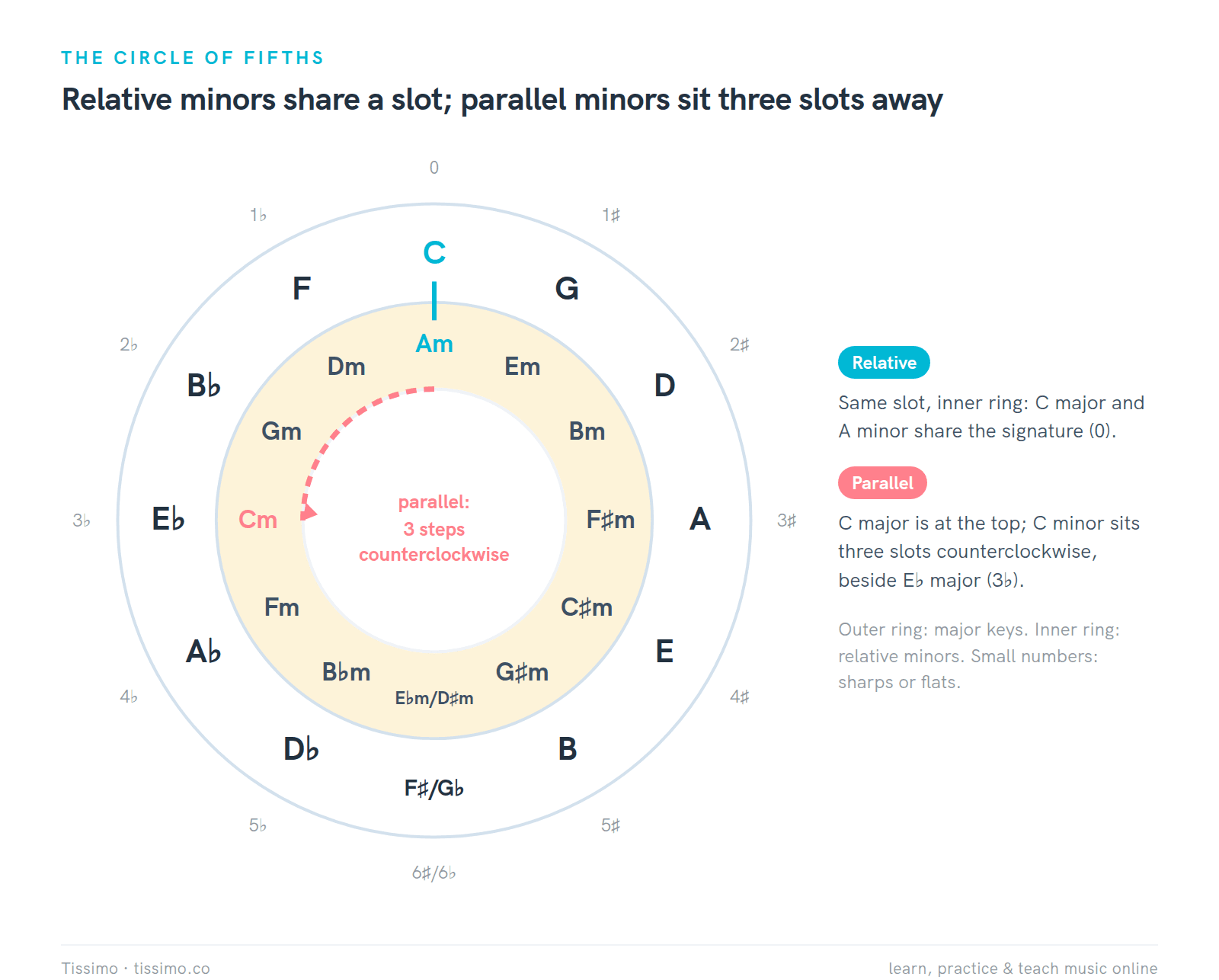
A circle of fifths with a minor ring. Reading straight inward from any major key gives its relative minor. The coral arc, explained below, finds the parallel minor.
Because neighbors on the circle differ by only one sharp or flat, the circle also shows which keys sit closest to a key and its relative minor. Our article on the circle of fifths at the piano builds this clock step by step, and the worksheet The Circle of Fifths is the handout version of the outer ring, the twelve major keys.
Parallel keys: same home, different notes
Now keep the home note and change the notes. Start on C again, but this time play the C minor scale: C, D, E♭, F, G, A♭, B♭, C. The tonic is the same as C major, and the third, sixth and seventh notes have each dropped a half step. C major and C minor are parallel keys, and C minor is the parallel minor of C major.
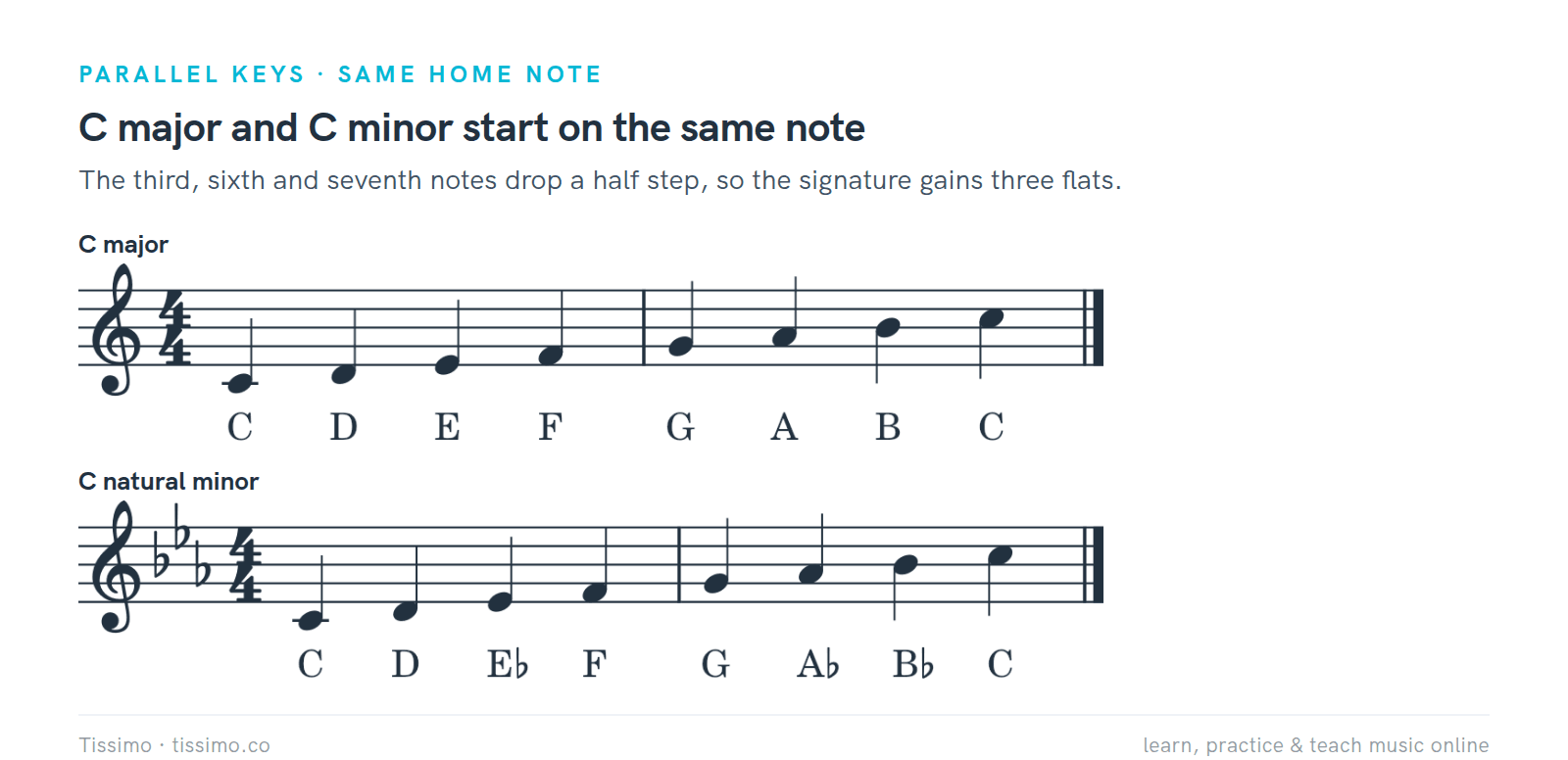
The same tonic with a different signature. C natural minor needs three flats: B♭, E♭ and A♭.
At the keyboard, this is the easiest relationship to feel, because your thumb stays on C. You swap three white keys (E, A, B) for the black key just below each one.
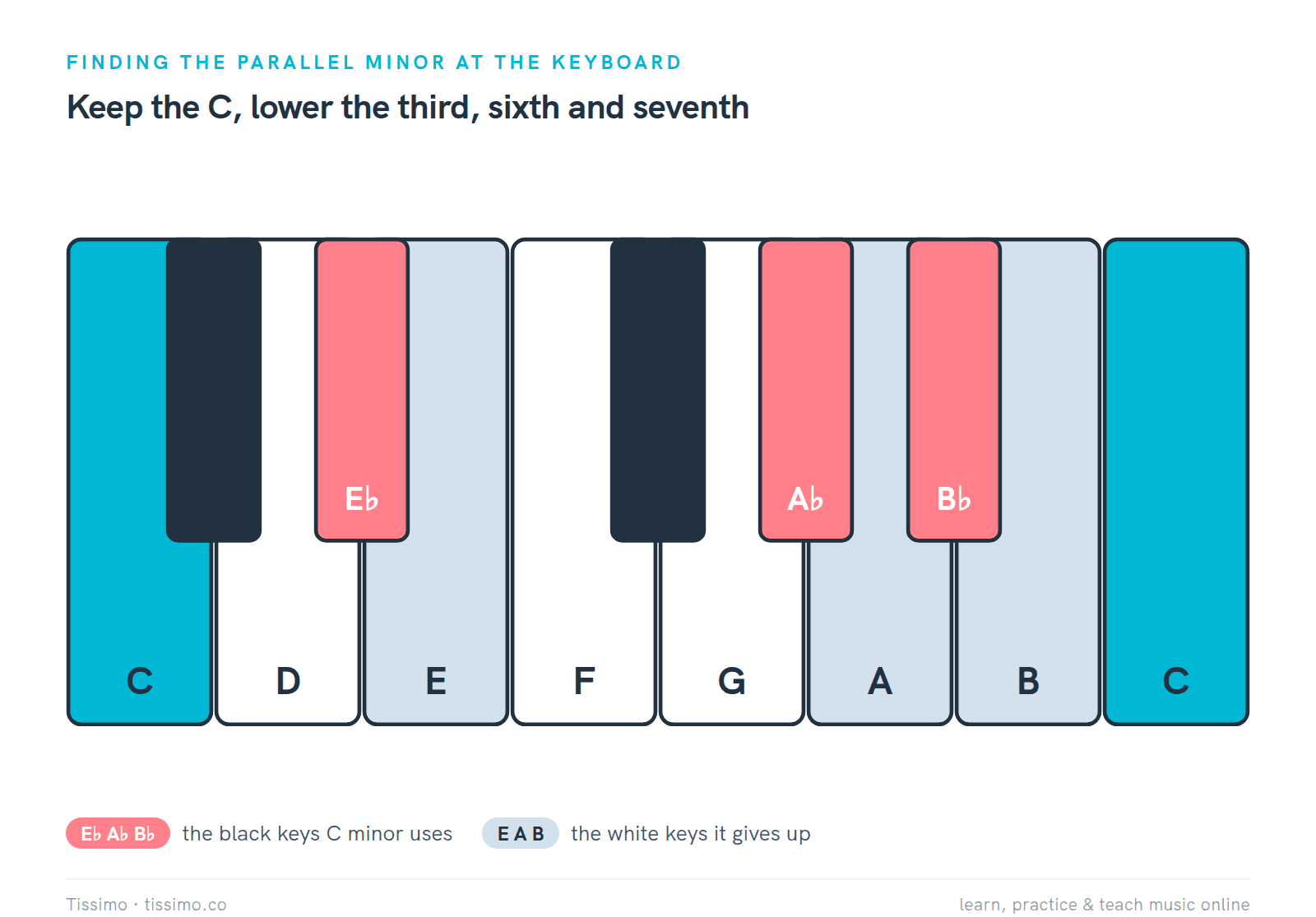
C minor uses the black keys E♭, A♭ and B♭ in place of E, A and B. D, F and G are unchanged.
Major & minor: two colors of home shows the one-note difference between the C major and C minor chords (E vs E♭). The tonic stays put, but the signatures differ a lot: C major has none, C minor has three flats. Parallel vs Relative Minor puts the three scales on one page, with the lowered notes marked.
Finding the parallel minor
There are two quick routes.
- Lower the 3rd, 6th and 7th a half step. This is the route to take when you are writing or playing the scale.
- Move the signature three steps toward flats. On the circle of fifths, go three slots counterclockwise from the major key. Each step removes a sharp or, once there are none left, adds a flat. G major (1♯) becomes G minor (2♭): one step removes the sharp, then two steps add two flats. A major (3♯) becomes A minor (no sharps or flats).
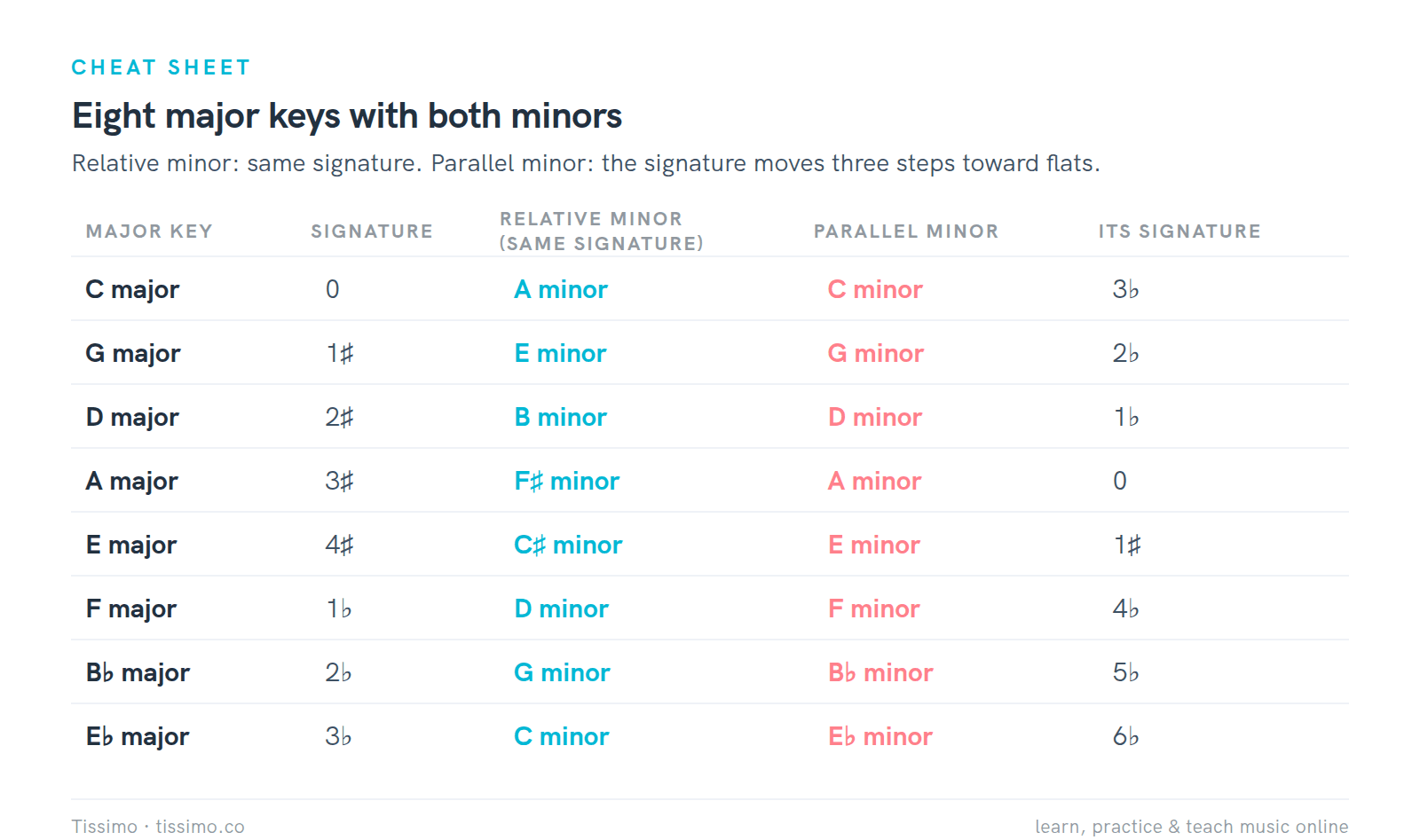
Eight major keys with both minors. The relative minor shares the signature in the second column; the parallel minor's signature sits three steps toward flats.
The same table is the first exercise in Relative or parallel?, which we return to below. One limit: past seven flats or sharps a signature would need double accidentals, which is extremely rare, so musicians write the enharmonic key instead. D♭ minor would need eight flats; C♯ minor, with four sharps, sounds the same.
Relative or parallel: the comparison at a glance
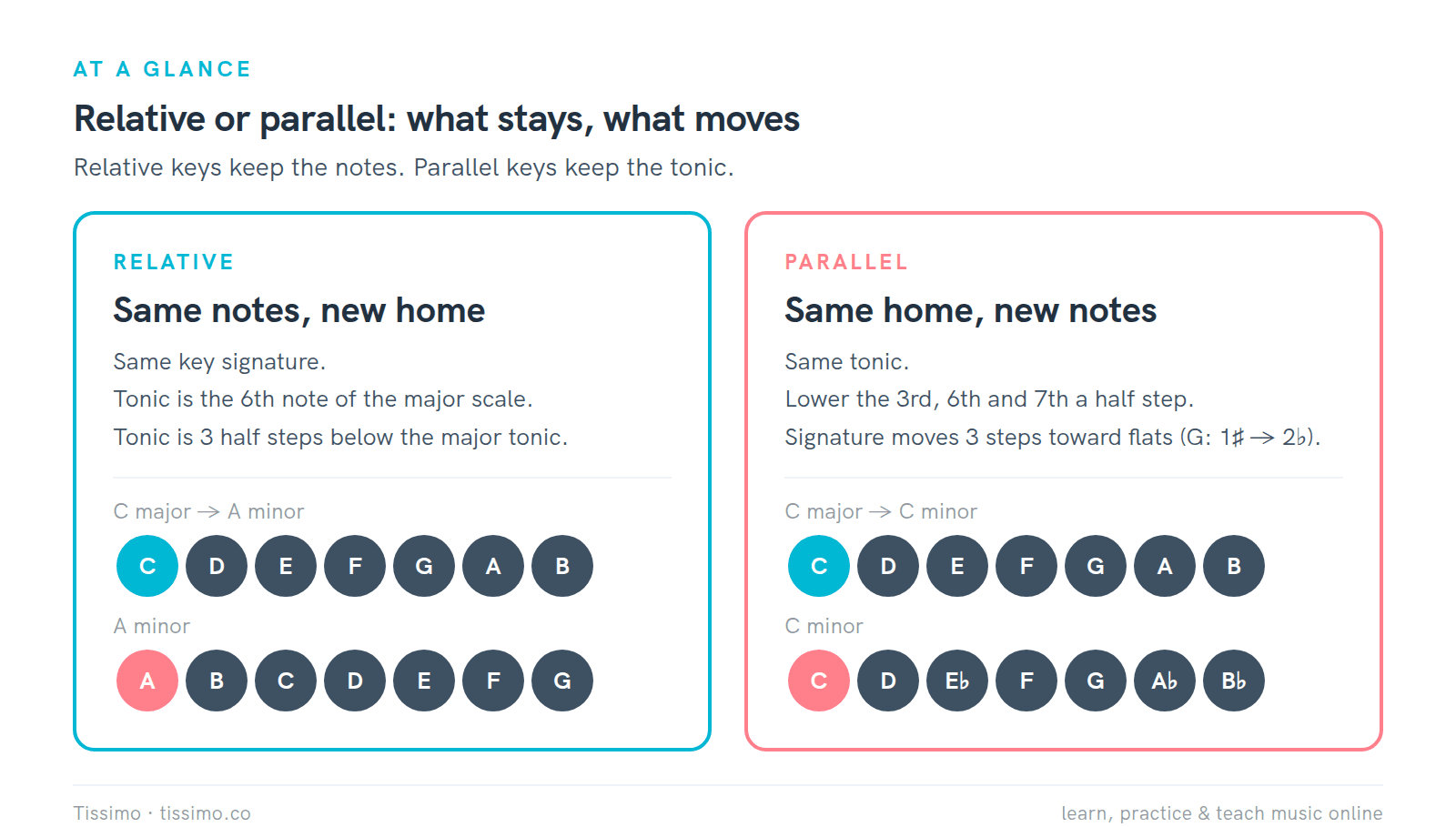
Relative keys keep the notes. Parallel keys keep the tonic.
A quick memory aid: relatives are family, so they share everything (all seven notes) but live in different homes. Parallel lines start side by side, so parallel keys start on the same note and run alongside each other with different notes.
Why the difference matters
Modulation. Relative keys share exactly the same notes, so they count as the most closely related keys, and most modulations happen between closely related keys. Moving from C major to A minor needs no change of key signature. Open Music Theory lists I→vi (C to A minor) and, in minor, i→III (C minor to E♭) among the most common modulations. Our modulation guide shows how composers do it, and Wikipedia's article on relative keys points to a Bach chorale, BWV 300, that moves from F major to D minor by changing one note, C to C♯, with no change of key signature. The next figure shows the same move in a short original melody.
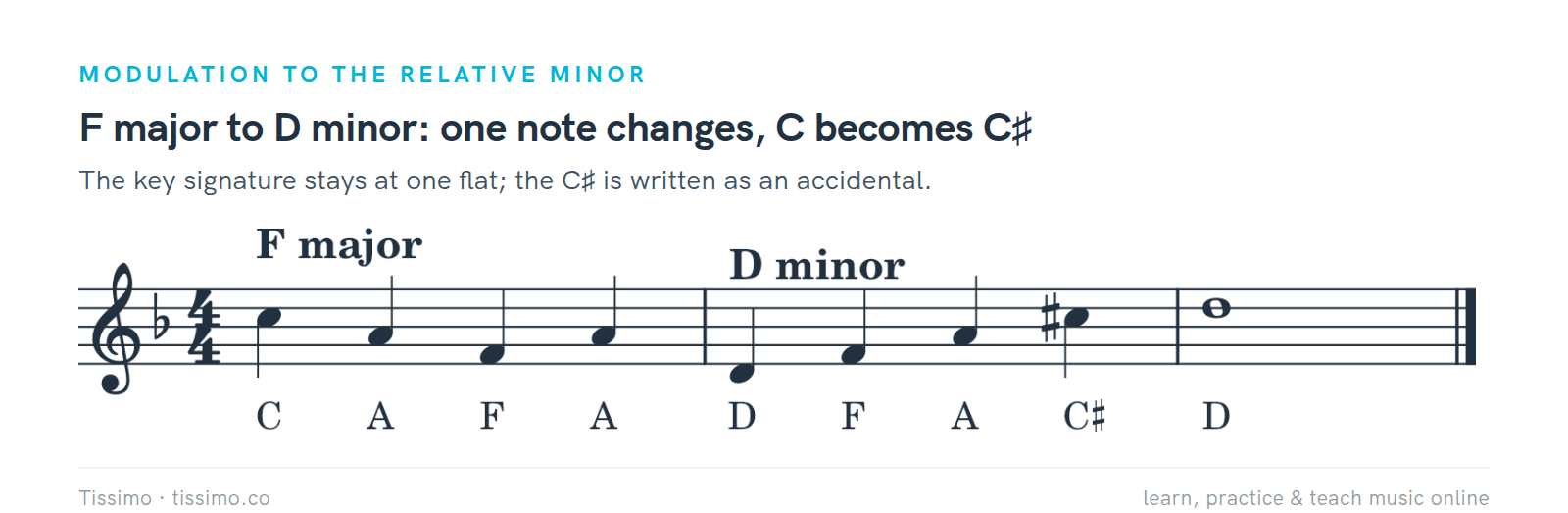
F major to D minor: the signature never changes; only C becomes C♯.
Borrowed chords. When a song in C major suddenly uses an F minor or A♭ major chord, it borrows from C minor, the parallel key. According to Wikipedia's article on parallel keys, composers in the early nineteenth century began borrowing freely from the parallel key. The full story is in borrowed chords and modal interchange. The handout Major & minor: two colors of home shows the tonic and subdominant chords turning minor in C minor while the dominant stays major.
The Picardy third. A Picardy third is a major tonic chord at the end of a section in a minor key (or a modal one). The third of the expected minor triad is raised a half step. In C minor, that means finishing on a C major chord (C, E, G) instead of C minor (C, E♭, G). Wikipedia notes that it was established in practice by the early seventeenth century and that J. S. Bach and his contemporaries use it in many places, including minor-key chorales.
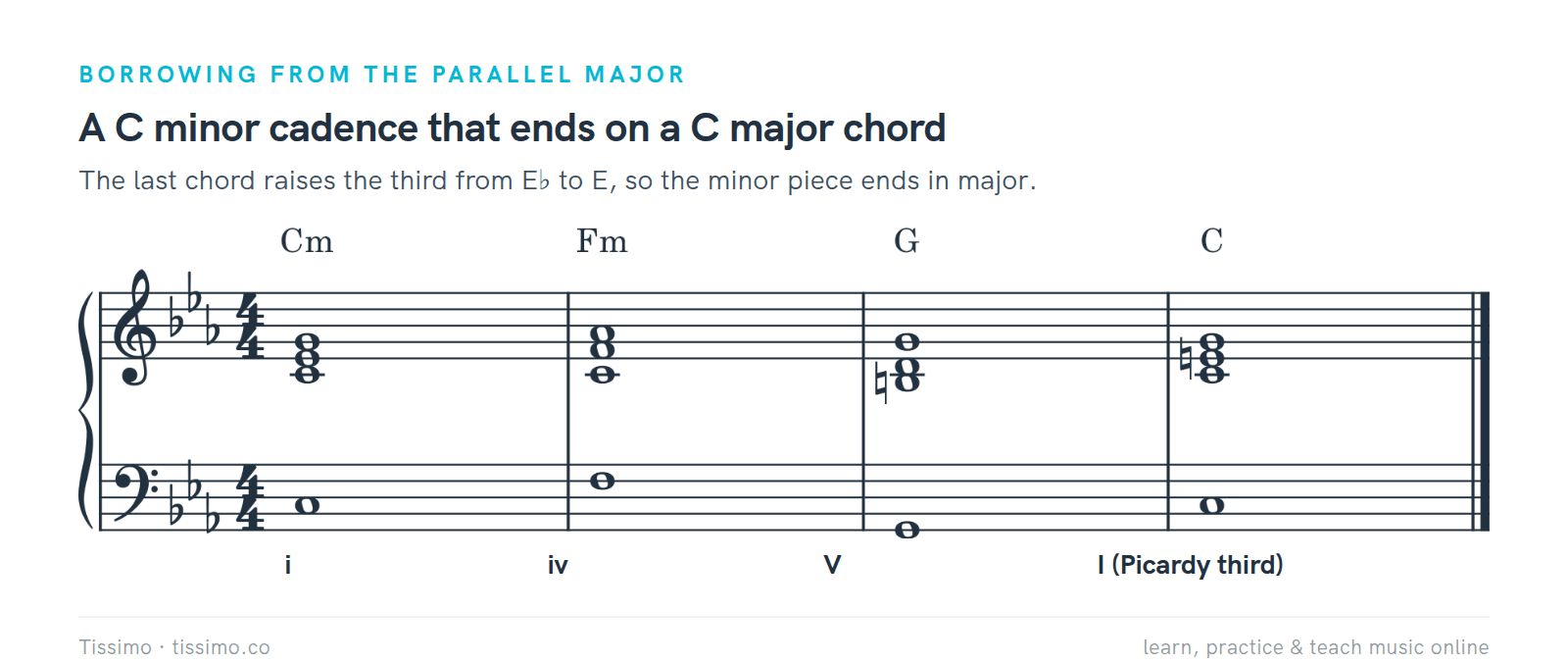
i, iv, V, then I. The G major chord adds a natural sign to B (the raised seventh), and the final chord adds a natural E in place of E♭: a Picardy third.
Minor-key music. A piece in a minor key can visit its relative major without adding a single accidental, which makes it an easy, bright contrast. A visit to the parallel major is a bigger change, because three notes move. For the chords of the minor key itself, see The primary chords in minor: i, iv & V.
Hear the two relationships in real music
- Beethoven, Symphony No. 5. The first movement is in C minor; its exposition moves to E♭ major, the relative major. The finale is in the symphony's home key of C, but now in the major mode: that is the parallel major.
- Mozart, Symphony No. 40. The minuet is in G minor and its contrasting trio is in G major, the parallel major.
- Bach, chorale Jesu, meine Freude (BWV 81.7). A chorale in a minor key whose final cadence ends on a major tonic chord: a Picardy third.
- Your own ear. Play the C major scale, then the C minor scale, and notice that only three notes changed. Then play C major and A minor and notice that none did.
If you want to hear the relationship with your own hands, take a melody you know in C major and change every E, A and B to the flat, as in the next figure.

Same tune, parallel minor. The shape stays the same; the three lowered notes change its character.
Common confusions
"Relative minor" and "parallel minor" are not synonyms. Open Music Theory draws the same line: parallel keys share a tonic, relative keys share a key signature. Both are minor keys connected to the same major key, but only the relative minor shares the key signature (A minor for C major); the parallel minor shares the tonic (C minor).
A key signature does not name a key by itself. The same signature serves a major and a relative minor. To decide, look at where the music begins and ends and which chord feels like home; our guide to finding the key of a song walks through it. A raised seventh (G♯ in A minor) is another strong clue, because the signature stays empty and the sharp appears as an accidental. That is the harmonic minor form, covered in natural, harmonic and melodic minor and on the worksheet The three minors.
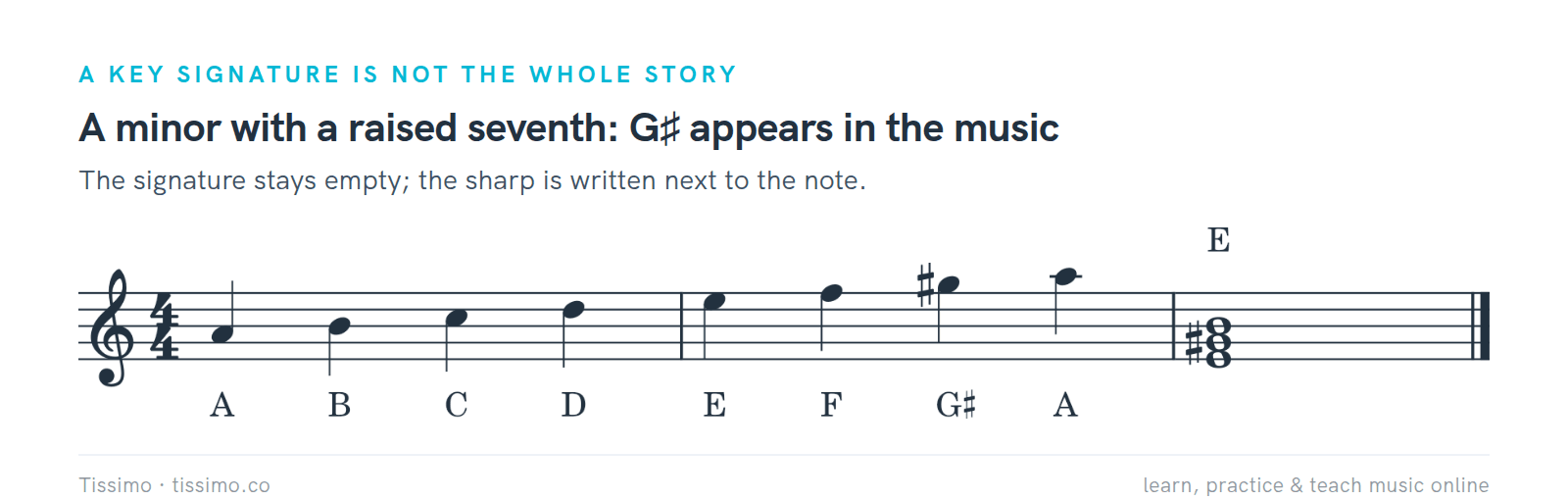
A harmonic minor. The G♯ is not in the key signature; it is written beside the note. G♯ is also the third of the E major chord on the right.
Counting in the wrong direction. The relative minor is three half steps below the major tonic, not above it. A quick check: counting the letters from the minor tonic to the major, A to C, is a third (A, B, C).
Pairs that are neither. E minor is the relative of G major, and E major and E minor are parallel. C minor and A♭ major are neither, even though both have flats: A♭ major's relative minor is F minor, and C minor's relative major is E♭ major.
A five-minute practice routine
Reading about keys only goes so far; your hands have to learn the difference. Try this once a day for a week, starting in C and moving to any key you know.
- Relative pair. Play the C major scale up one octave, then the A minor scale from A to A, hands separate. Say "same notes" aloud when you finish. For a first A minor position under your hand (five notes, A to E, with fingering), use The A Minor 5-Finger Scale.
- Parallel pair. Play C major, then C minor, keeping your thumb on C. Say the three notes that moved: E, A, B.
- Name it. Say the relative and the parallel minor of a major key out loud, then check the circle or the cheat sheet. Move around the circle one key at a time.
- Spot the form. Play A natural minor, then A harmonic minor, and listen for the raised seventh. The worksheet Identify the minor scales gives nine scales to name, natural, harmonic or melodic.
Five minutes is plenty, as long as you say the names aloud as you play.
Try it yourself
- Give the relative minor of D major and its key signature.
- Give the parallel minor of D major and its signature.
- Label each pair relative, parallel or neither: (a) F♯ minor and A major; (b) E♭ major and G minor; (c) B♭ minor and B♭ major; (d) B minor and D major.
- What is the signature of E minor, the parallel minor of E major? Count three steps from E major's four sharps.
- Play your favorite tune in C major, then move it to C minor. Which notes did you change?
Answers: (1) B minor, two sharps. (2) D minor, one flat. (3a) relative, (3b) neither, (3c) parallel, (3d) relative. (4) One sharp. (5) E, A and B each become a half step lower.
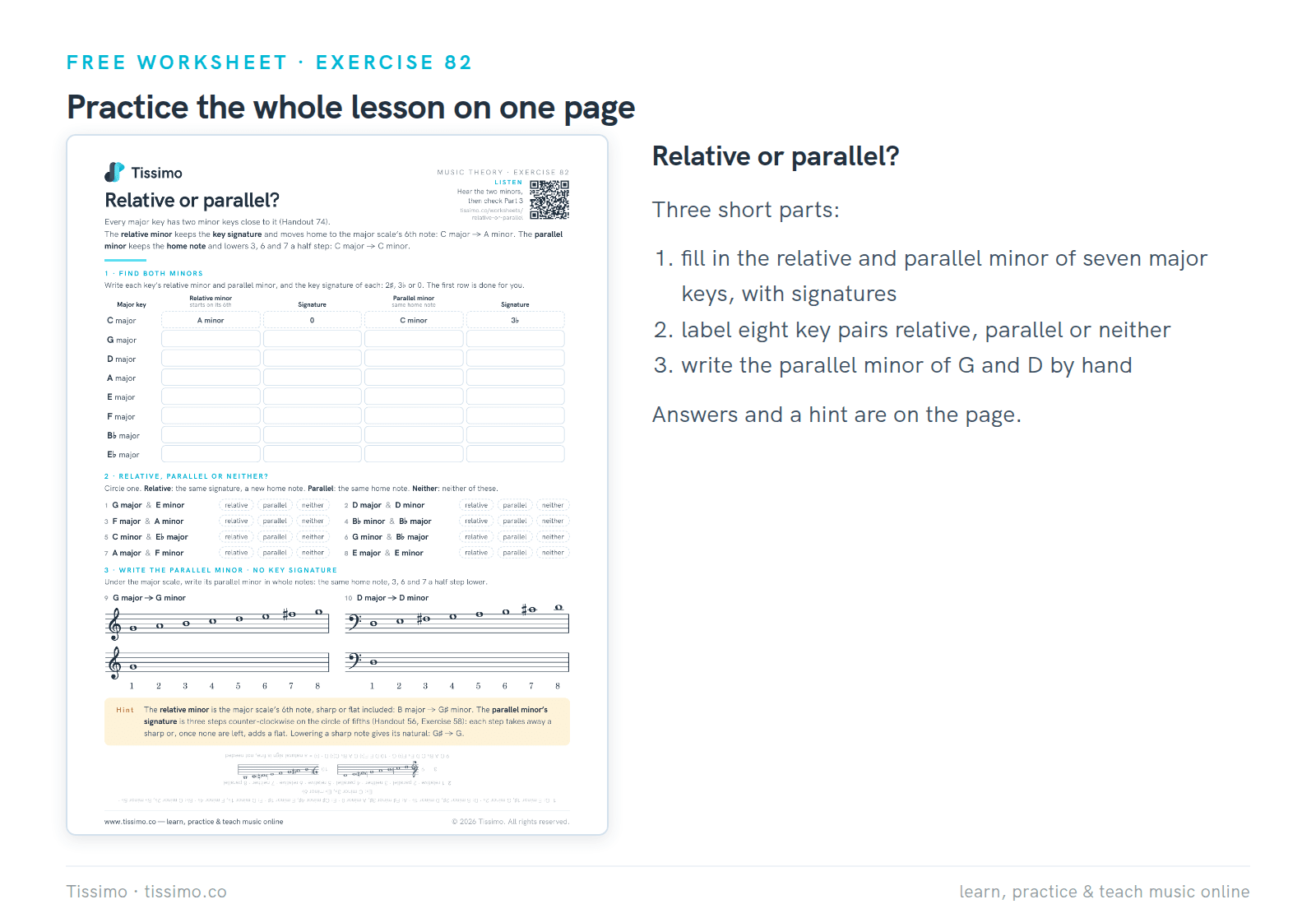
The worksheet Relative or parallel? has seven major keys to fill in, eight pairs to label, and two parallel minors to write on a staff, with answers on the page.
Free worksheets for this lesson
- Relative or parallel? — find both minors for seven major keys, label eight pairs, write two parallel minors
- Parallel vs Relative Minor — C major, A minor and C minor side by side
- Key Signatures: Major & Minor — all fifteen signatures, each with its major and relative minor
- Name the Key Signatures — read eight signatures and name the major and minor for each
- Write the key signatures — draw twelve major and minor key signatures
- The Circle of Fifths — all twelve keys on a clock, one more sharp for each step clockwise
- Major & minor: two colors of home — C major and C minor, with i and iv turning minor while V stays major
- The three minors: natural, harmonic & melodic — the three forms of the minor scale
- The primary chords in minor: i, iv & V — the three-chord toolkit in C minor
- The A Minor 5-Finger Scale — A minor under your fingers, the relative of C major
- Identify the minor scales — name nine minor scales as natural, harmonic or melodic, and give their keys
Where to go next
Every major key has a relative minor and a parallel minor, and once you can name them, a lot of harmony starts to make sense. A Tissimo piano teacher can listen as you move a tune between keys and help you hear which relationship you are using. When you want that kind of feedback, book a lesson.
Sources
- Relative key — Wikipedia
- Parallel key — Wikipedia
- Key signature — Wikipedia
- Circle of fifths — Wikipedia
- Picardy third — Wikipedia
- Symphony No. 5 (Beethoven) — Wikipedia
- Symphony No. 40 (Mozart) — Wikipedia
- Minor scale — Wikipedia
- Minor Scales, Scale Degrees, and Key Signatures — Open Music Theory
- Extended Tonicization and Modulation to Closely Related Keys — Open Music Theory
Read this article online: https://tissimo.co/articles/relative-and-parallel-keys-explained




Comments